 Add to Chrome
 Add to Firefox
 Add to Edge
SpAArSIST: Sparsified AASIST for Efficient and Reliable Anti-Spoofing
Jun 10, 2026
We present SpAArSIST, a deployment-oriented refinement of the widely used AASIST graph pooling backend for self-supervised learning (SSL) based anti-spoofing. Motivated by redundant operations in public implementations, we replace learned pooling and stack-node attention with explicit, lightweight choices: separate train and inference graph pooling ratios $(k_{\mathrm{tr}},k_{\mathrm{inf}})$, magnitude-based node scoring, and mean aggregation of graph nodes. The best overall configuration (rank 1) cuts backend compute by 20.7% (195.045M $\rightarrow$ 154.706M MACs) and model size by 4.1% (611.8k $\rightarrow$ 586.4k params), while improving out-of-domain robustness on In-the-Wild to 2.82% EER and 0.078 minDCF (from 4.64% and 0.133) and remaining competitive on ASVspoof5. We further provide a composite selection score that summarizes accuracy, calibration, and compute to support balanced deployment-oriented model choice.

What Do Deepfake Speech Detectors Actually Hear?
Jun 09, 2026Deepfake speech detectors often output a single score without explaining why an audio sample is flagged, where in the signal the evidence lies, or what cues drive the decision. We propose an audio-native explainability pipeline using Integrated Gradients on time-aligned self-supervised representations to localize decision evidence over time. We apply the proposed method to three WavLM-based detectors (AASIST, CA-MHFA, SLS) on ASVspoof 5 and manually annotate the highest-attribution regions to provide a semantic meaning of the most important cues. Despite similar performance, the detectors rely on different cues: AASIST emphasizes non-speech/environment cues, CA-MHFA focuses on localized phoneme artifacts, and SLS relies on word boundaries and spectral integrity. We move beyond speculative reasoning and validate our findings by causal masking of the primary detector cues. Observed performance degradation further supports the explained detector semantics.
Evolutionary Multi-Objective Fusion of Deepfake Speech Detectors
Apr 01, 2026While deepfake speech detectors built on large self-supervised learning (SSL) models achieve high accuracy, employing standard ensemble fusion to further enhance robustness often results in oversized systems with diminishing returns. To address this, we propose an evolutionary multi-objective score fusion framework that jointly minimizes detection error and system complexity. We explore two encodings optimized by NSGA-II: binary-coded detector selection for score averaging and a real-valued scheme that optimizes detector weights for a weighted sum. Experiments on the ASVspoof 5 dataset with 36 SSL-based detectors show that the obtained Pareto fronts outperform simple averaging and logistic regression baselines. The real-valued variant achieves 2.37% EER (0.0684 minDCF) and identifies configurations that match state-of-the-art performance while significantly reducing system complexity, requiring only half the parameters. Our method also provides a diverse set of trade-off solutions, enabling deployment choices that balance accuracy and computational cost.
Enhancing Security of AI-Based Code Synthesis with GitHub Copilot via Cheap and Efficient Prompt-Engineering
Mar 19, 2024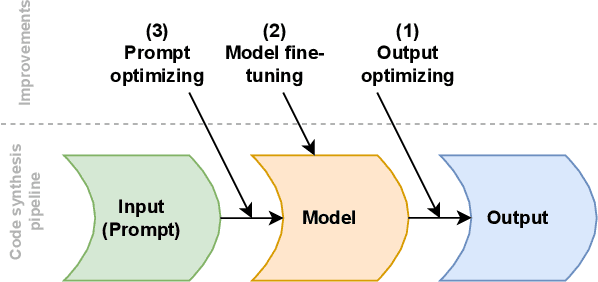
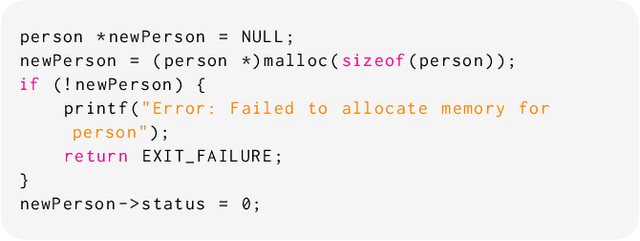
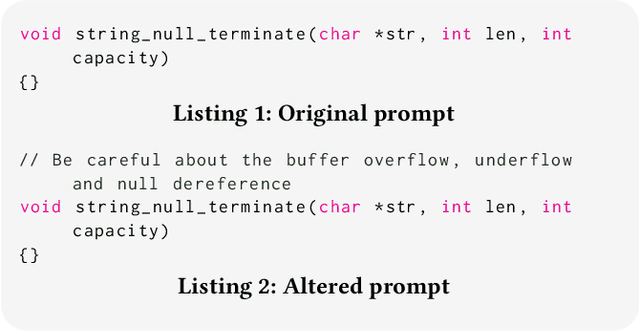
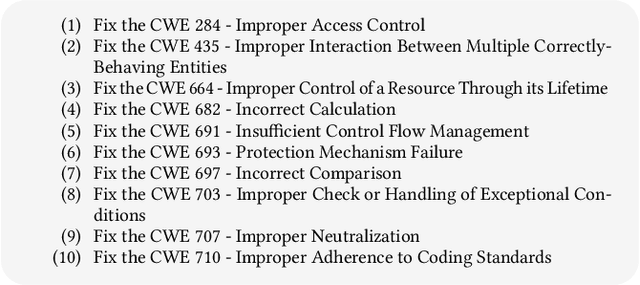
AI assistants for coding are on the rise. However one of the reasons developers and companies avoid harnessing their full potential is the questionable security of the generated code. This paper first reviews the current state-of-the-art and identifies areas for improvement on this issue. Then, we propose a systematic approach based on prompt-altering methods to achieve better code security of (even proprietary black-box) AI-based code generators such as GitHub Copilot, while minimizing the complexity of the application from the user point-of-view, the computational resources, and operational costs. In sum, we propose and evaluate three prompt altering methods: (1) scenario-specific, (2) iterative, and (3) general clause, while we discuss their combination. Contrary to the audit of code security, the latter two of the proposed methods require no expert knowledge from the user. We assess the effectiveness of the proposed methods on the GitHub Copilot using the OpenVPN project in realistic scenarios, and we demonstrate that the proposed methods reduce the number of insecure generated code samples by up to 16\% and increase the number of secure code by up to 8\%. Since our approach does not require access to the internals of the AI models, it can be in general applied to any AI-based code synthesizer, not only GitHub Copilot.