 Add to Chrome
 Add to Firefox
 Add to Edge
Tracking the Trend in How Speech Synthesizers Deceive People
Aug 20, 2026
Advances in speech synthesis have made deepfake audio highly realistic. Earlier studies reported 70-80% human detection accuracy, but relied primarily on older synthesizers. We compare human detection for three selected voice synthesis tools released in 2019, 2022, and 2024 with 82 IT professionals, and benchmark humans against six pretrained detectors on the same material. For fully synthetic speech (full spoofs), the F1 score drops from about 90% for RTVC and YourTTS to 48% for ElevenLabs, although listeners were explicitly warned that deepfakes were present. For partial spoofing, where only one sentence of an utterance is altered, strict accuracy falls to 9%, and listeners classify the synthetic sentence as bona fide 77% of the time. Humans and detectors fail in complementary ways, and neither reliably localizes short manipulations. Additionally, listeners increasingly mislabel bona fide speech as fake, eroding trust in unmanipulated audio. These findings show that human perception alone is unreliable for the selected modern and partial-spoof conditions and motivate procedural verification, provenance, watermarking, and segment-level detection.

VQCSim: When Does Compile-Once Statevector Simulation Beat Generic Quantum Frameworks?
Jul 13, 2026Hybrid quantum-classical machine learning workflows repeatedly evaluate many small parametrized circuits during training and model exploration. In this regime, framework dispatch and orchestration overhead often dominate runtime. Prior simulators accelerate execution but leave open the question of when compile-once specialization is the right choice for static variational circuits. We answer this question with VQCSim, a compile-once, PyTorch-native statevector execution path with native autograd. In a systematic MQT Bench study, VQCSim compiles all tested static circuits and provides 87.7% end-to-end semantic validation. Across a five-GPU evaluation set, VQCSim delivers pooled median speedups of 4.49x for native inference and 26.78x for native training, while retaining a 3.31x advantage under matched finite-difference training. Ablation identifies native autograd as the dominant source of acceleration (27.6x), with compile-once caching and batch vectorization contributing additional gains. The speedup trades higher GPU memory (VQCSim is memory-limited at the high end) for lower runtime. We derive a hardware-aware regime map and release vqcsim-oracle, an open-source backend selector with 91.1%-97.7% top-1 agreement (including cross-GPU transfers), enabling automatic simulator selection in QML design loops.
SpAArSIST: Sparsified AASIST for Efficient and Reliable Anti-Spoofing
Jun 10, 2026We present SpAArSIST, a deployment-oriented refinement of the widely used AASIST graph pooling backend for self-supervised learning (SSL) based anti-spoofing. Motivated by redundant operations in public implementations, we replace learned pooling and stack-node attention with explicit, lightweight choices: separate train and inference graph pooling ratios $(k_{\mathrm{tr}},k_{\mathrm{inf}})$, magnitude-based node scoring, and mean aggregation of graph nodes. The best overall configuration (rank 1) cuts backend compute by 20.7% (195.045M $\rightarrow$ 154.706M MACs) and model size by 4.1% (611.8k $\rightarrow$ 586.4k params), while improving out-of-domain robustness on In-the-Wild to 2.82% EER and 0.078 minDCF (from 4.64% and 0.133) and remaining competitive on ASVspoof5. We further provide a composite selection score that summarizes accuracy, calibration, and compute to support balanced deployment-oriented model choice.
What Do Deepfake Speech Detectors Actually Hear?
Jun 09, 2026Deepfake speech detectors often output a single score without explaining why an audio sample is flagged, where in the signal the evidence lies, or what cues drive the decision. We propose an audio-native explainability pipeline using Integrated Gradients on time-aligned self-supervised representations to localize decision evidence over time. We apply the proposed method to three WavLM-based detectors (AASIST, CA-MHFA, SLS) on ASVspoof 5 and manually annotate the highest-attribution regions to provide a semantic meaning of the most important cues. Despite similar performance, the detectors rely on different cues: AASIST emphasizes non-speech/environment cues, CA-MHFA focuses on localized phoneme artifacts, and SLS relies on word boundaries and spectral integrity. We move beyond speculative reasoning and validate our findings by causal masking of the primary detector cues. Observed performance degradation further supports the explained detector semantics.
RAT: Reference-Augmented Training for ASV Anti-Spoofing
Jun 09, 2026We introduce a spoofing countermeasure architecture conditioned on speaker-reference recordings, but observe that it converges to a solution that effectively ignores the reference during inference. Surprisingly, training with a reference channel induces invariance that improves deepfake detection, even when the reference is absent or mismatched during inference. Based on this observation, we propose a Reference-Augmented Training (RAT) strategy. RAT yields improved detection performance compared to single-utterance baselines, even when the reference recording is replaced with a zero vector at inference. Through rigorous analysis, we demonstrate that the optimization process rapidly diminishes the reference contributions, leading to inference largely independent of the reference channel. Using RAT, we achieve state-of-the-art 2.57% EER and 0.074 minDCF on the ASVspoof 5 benchmark with a single detector, surpassing even large ensemble systems.
Ethical and Technical Limits of Deepfake Speech Datasets
Jun 09, 2026Claims about the robustness and fairness of deepfake speech detectors are only as credible as the datasets used to train and evaluate those systems. We present a dataset-level audit of the deepfake speech landscape. We compile and analyze 39 deepfake speech datasets, examining key attributes including accessibility, documentation, demographic and language coverage, dataset scale, and the underlying bona fide speech sources. Our audit reveals two important takeaways. Firstly, fairness assessment is largely infeasible because most datasets lack demographic metadata, and only a few contain gender or language labels. This prevents any meaningful subgroup analysis and leaves other demographic attributes unaddressed. Secondly, we identify substantial overlap in underlying bona fide source corpora across datasets, which can undermine cross-dataset evaluation and lead to overstated generalization claims.
Evolutionary Multi-Objective Fusion of Deepfake Speech Detectors
Apr 01, 2026While deepfake speech detectors built on large self-supervised learning (SSL) models achieve high accuracy, employing standard ensemble fusion to further enhance robustness often results in oversized systems with diminishing returns. To address this, we propose an evolutionary multi-objective score fusion framework that jointly minimizes detection error and system complexity. We explore two encodings optimized by NSGA-II: binary-coded detector selection for score averaging and a real-valued scheme that optimizes detector weights for a weighted sum. Experiments on the ASVspoof 5 dataset with 36 SSL-based detectors show that the obtained Pareto fronts outperform simple averaging and logistic regression baselines. The real-valued variant achieves 2.37% EER (0.0684 minDCF) and identifies configurations that match state-of-the-art performance while significantly reducing system complexity, requiring only half the parameters. Our method also provides a diverse set of trade-off solutions, enabling deployment choices that balance accuracy and computational cost.
SCDF: A Speaker Characteristics DeepFake Speech Dataset for Bias Analysis
Aug 11, 2025Despite growing attention to deepfake speech detection, the aspects of bias and fairness remain underexplored in the speech domain. To address this gap, we introduce the Speaker Characteristics Deepfake (SCDF) dataset: a novel, richly annotated resource enabling systematic evaluation of demographic biases in deepfake speech detection. SCDF contains over 237,000 utterances in a balanced representation of both male and female speakers spanning five languages and a wide age range. We evaluate several state-of-the-art detectors and show that speaker characteristics significantly influence detection performance, revealing disparities across sex, language, age, and synthesizer type. These findings highlight the need for bias-aware development and provide a foundation for building non-discriminatory deepfake detection systems aligned with ethical and regulatory standards.
STOPA: A Database of Systematic VariaTion Of DeePfake Audio for Open-Set Source Tracing and Attribution
May 26, 2025A key research area in deepfake speech detection is source tracing - determining the origin of synthesised utterances. The approaches may involve identifying the acoustic model (AM), vocoder model (VM), or other generation-specific parameters. However, progress is limited by the lack of a dedicated, systematically curated dataset. To address this, we introduce STOPA, a systematically varied and metadata-rich dataset for deepfake speech source tracing, covering 8 AMs, 6 VMs, and diverse parameter settings across 700k samples from 13 distinct synthesisers. Unlike existing datasets, which often feature limited variation or sparse metadata, STOPA provides a systematically controlled framework covering a broader range of generative factors, such as the choice of the vocoder model, acoustic model, or pretrained weights, ensuring higher attribution reliability. This control improves attribution accuracy, aiding forensic analysis, deepfake detection, and generative model transparency.
Diffuse or Confuse: A Diffusion Deepfake Speech Dataset
Oct 09, 2024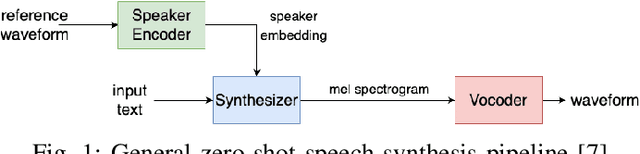

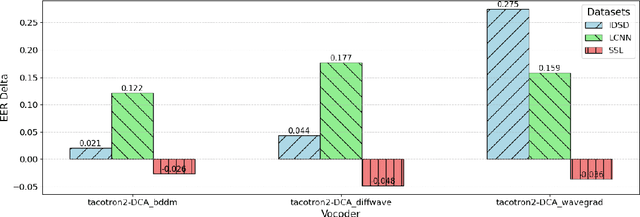
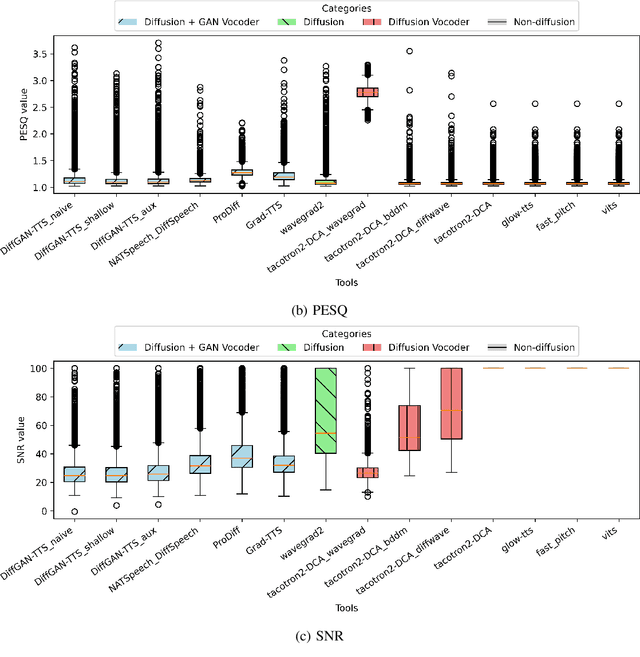
Advancements in artificial intelligence and machine learning have significantly improved synthetic speech generation. This paper explores diffusion models, a novel method for creating realistic synthetic speech. We create a diffusion dataset using available tools and pretrained models. Additionally, this study assesses the quality of diffusion-generated deepfakes versus non-diffusion ones and their potential threat to current deepfake detection systems. Findings indicate that the detection of diffusion-based deepfakes is generally comparable to non-diffusion deepfakes, with some variability based on detector architecture. Re-vocoding with diffusion vocoders shows minimal impact, and the overall speech quality is comparable to non-diffusion methods.