 Add to Chrome
 Add to Firefox
 Add to Edge
On the Hardness of Computing Counterfactual and Semifactual Explanations in XAI
Jan 14, 2026
Providing clear explanations to the choices of machine learning models is essential for these models to be deployed in crucial applications. Counterfactual and semi-factual explanations have emerged as two mechanisms for providing users with insights into the outputs of their models. We provide an overview of the computational complexity results in the literature for generating these explanations, finding that in many cases, generating explanations is computationally hard. We strengthen the argument for this considerably by further contributing our own inapproximability results showing that not only are explanations often hard to generate, but under certain assumptions, they are also hard to approximate. We discuss the implications of these complexity results for the XAI community and for policymakers seeking to regulate explanations in AI.
* Accepted in Transactions on Machine Learning Research (TMLR), 2025 -- https://openreview.net/pdf?id=aELzBw0q1O

Approximating Optimal Labelings for Temporal Connectivity
Apr 23, 2025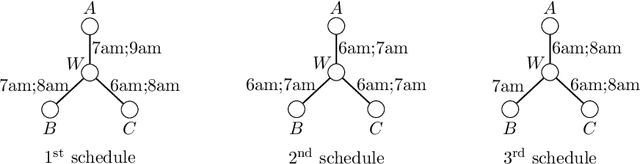
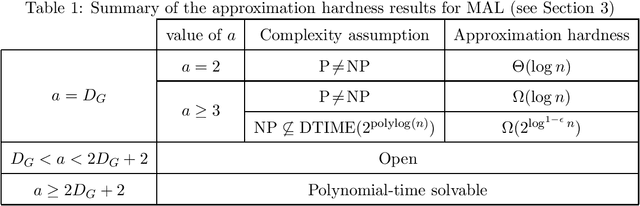
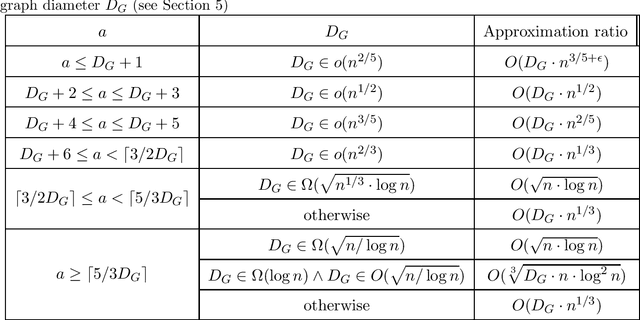
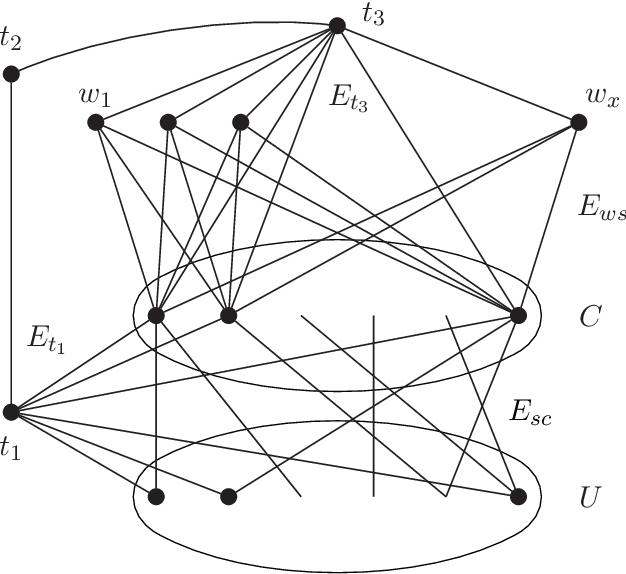
In a temporal graph the edge set dynamically changes over time according to a set of time-labels associated with each edge that indicates at which time-steps the edge is available. Two vertices are connected if there is a path connecting them in which the edges are traversed in increasing order of their labels. We study the problem of scheduling the availability time of the edges of a temporal graph in such a way that all pairs of vertices are connected within a given maximum allowed time $a$ and the overall number of labels is minimized. The problem, known as \emph{Minimum Aged Labeling} (MAL), has several applications in logistics, distribution scheduling, and information spreading in social networks, where carefully choosing the time-labels can significantly reduce infrastructure costs, fuel consumption, or greenhouse gases. The problem MAL has previously been proved to be NP-complete on undirected graphs and \APX-hard on directed graphs. In this paper, we extend our knowledge on the complexity and approximability of MAL in several directions. We first show that the problem cannot be approximated within a factor better than $O(\log n)$ when $a\geq 2$, unless $\text{P} = \text{NP}$, and a factor better than $2^{\log ^{1-\epsilon} n}$ when $a\geq 3$, unless $\text{NP}\subseteq \text{DTIME}(2^{\text{polylog}(n)})$, where $n$ is the number of vertices in the graph. Then we give a set of approximation algorithms that, under some conditions, almost match these lower bounds. In particular, we show that the approximation depends on a relation between $a$ and the diameter of the input graph. We further establish a connection with a foundational optimization problem on static graphs called \emph{Diameter Constrained Spanning Subgraph} (DCSS) and show that our hardness results also apply to DCSS.