 Add to Chrome
 Add to Firefox
 Add to Edge
FGR-ColBERT: Identifying Fine-Grained Relevance Tokens During Retrieval
Mar 31, 2026
Document retrieval identifies relevant documents but does not provide fine-grained evidence cues, such as specific relevant spans. A possible solution is to apply an LLM after retrieval; however, this introduces significant computational overhead and limits practical deployment. We propose FGR-ColBERT, a modification of ColBERT retrieval model that integrates fine-grained relevance signals distilled from an LLM directly into the retrieval function. Experiments on MS MARCO show that FGR-ColBERT (110M) achieves a token-level F1 of 64.5, exceeding the 62.8 of Gemma 2 (27B), despite being approximately 245 times smaller. At the same time, it preserves retrieval effectiveness (99% relative Recall@50) and remains efficient, incurring only a ~1.12x latency overhead compared to the original ColBERT.

Examining the Metrics for Document-Level Claim Extraction in Czech and Slovak
Nov 18, 2025Document-level claim extraction remains an open challenge in the field of fact-checking, and subsequently, methods for evaluating extracted claims have received limited attention. In this work, we explore approaches to aligning two sets of claims pertaining to the same source document and computing their similarity through an alignment score. We investigate techniques to identify the best possible alignment and evaluation method between claim sets, with the aim of providing a reliable evaluation framework. Our approach enables comparison between model-extracted and human-annotated claim sets, serving as a metric for assessing the extraction performance of models and also as a possible measure of inter-annotator agreement. We conduct experiments on newly collected dataset-claims extracted from comments under Czech and Slovak news articles-domains that pose additional challenges due to the informal language, strong local context, and subtleties of these closely related languages. The results draw attention to the limitations of current evaluation approaches when applied to document-level claim extraction and highlight the need for more advanced methods-ones able to correctly capture semantic similarity and evaluate essential claim properties such as atomicity, checkworthiness, and decontextualization.
BUT-FIT at SemEval-2020 Task 4: Multilingual commonsense
Aug 21, 2020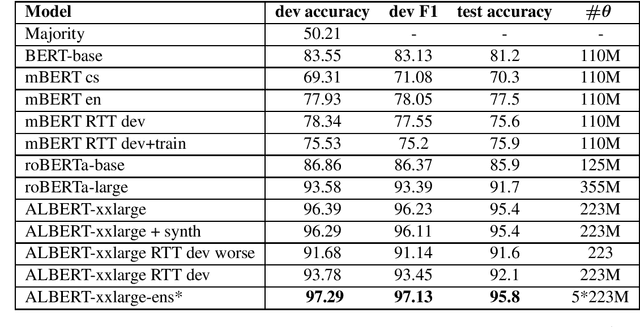
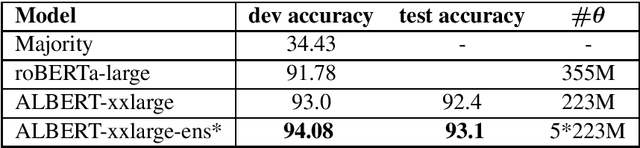
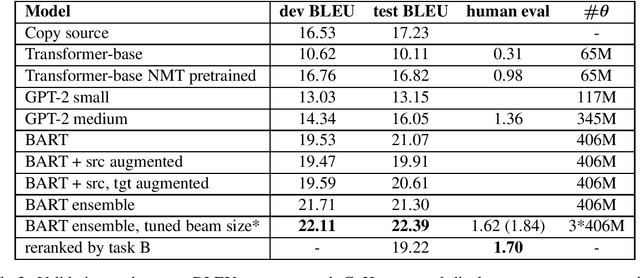
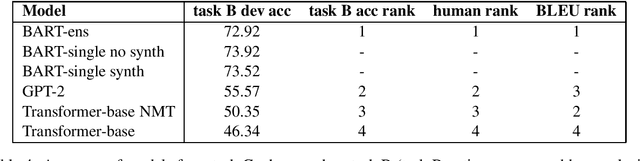
This paper describes work of the BUT-FIT's team at SemEval 2020 Task 4 - Commonsense Validation and Explanation. We participated in all three subtasks. In subtasks A and B, our submissions are based on pretrained language representation models (namely ALBERT) and data augmentation. We experimented with solving the task for another language, Czech, by means of multilingual models and machine translated dataset, or translated model inputs. We show that with a strong machine translation system, our system can be used in another language with a small accuracy loss. In subtask C, our submission, which is based on pretrained sequence-to-sequence model (BART), ranked 1st in BLEU score ranking, however, we show that the correlation between BLEU and human evaluation, in which our submission ended up 4th, is low. We analyse the metrics used in the evaluation and we propose an additional score based on model from subtask B, which correlates well with our manual ranking, as well as reranking method based on the same principle. We performed an error and dataset analysis for all subtasks and we present our findings.