 Add to Chrome
 Add to Firefox
 Add to Edge
MM-algorithms for traditional and convex NMF with Tweedie and Negative Binomial cost functions and empirical evaluation
Mar 10, 2026
Non-negative matrix factorisation (NMF) is a widely used tool for unsupervised learning and feature extraction, with applications ranging from genomics to text analysis and signal processing. Standard formulations of NMF are typically derived under Gaussian or Poisson noise assumptions, which may be inadequate for data exhibiting overdispersion or other complex mean-variance relationships. In this paper, we develop a unified framework for both traditional and convex NMF under a broad class of distributional assumptions, including Negative Binomial and Tweedie models, where the connection between the Tweedie and the $β$-divergence is also highlighted. Using a Majorize-Minimisation approach, we derive multiplicative update rules for all considered models, and novel updates for convex NMF with Poisson and Negative Binomial cost functions. We provide a unified implementation of all considered models, including the first implementations of several convex NMF models. Empirical evaluations on mutational and word count data demonstrate that the choice of noise model critically affects model fit and feature recovery, and that convex NMF can provide an efficient and robust alternative to traditional NMF in scenarios where the number of classes is large. The code for our proposed updates is available in the R package nmfgenr and can be found at https://github.com/MartaPelizzola/nmfgenr.

On the Relation Between Autoencoders and Non-negative Matrix Factorization, and Their Application for Mutational Signature Extraction
May 13, 2024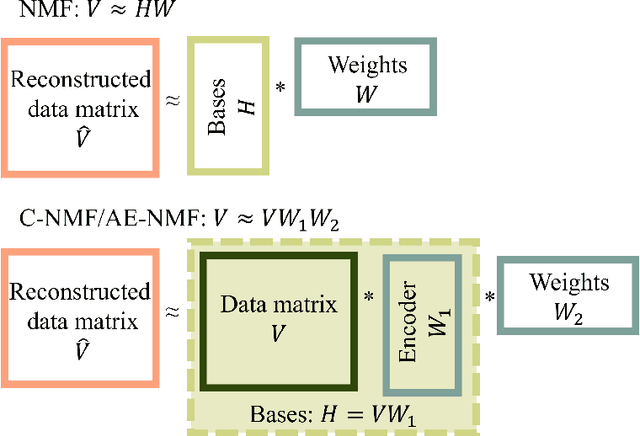
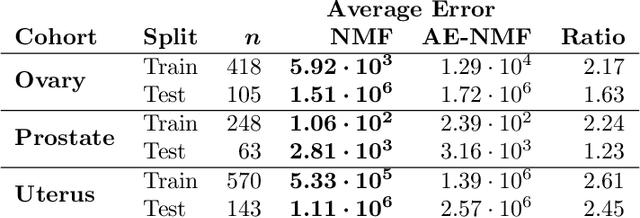
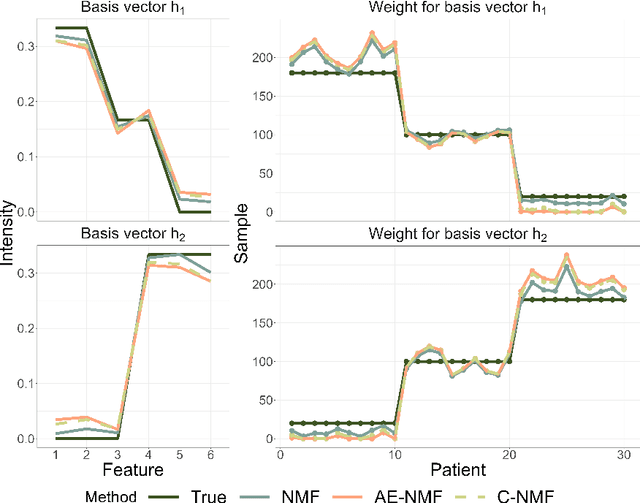
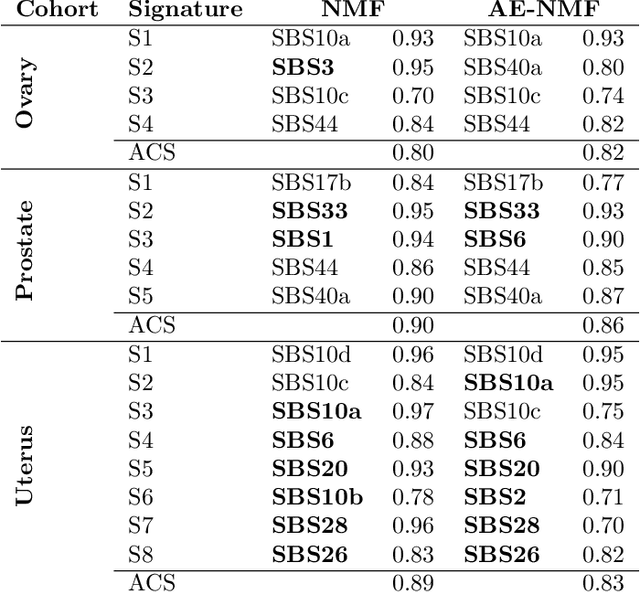
The aim of this study is to provide a foundation to understand the relationship between non-negative matrix factorization (NMF) and non-negative autoencoders enabling proper interpretation and understanding of autoencoder-based alternatives to NMF. Since its introduction, NMF has been a popular tool for extracting interpretable, low-dimensional representations of high-dimensional data. However, recently, several studies have proposed to replace NMF with autoencoders. This increasing popularity of autoencoders warrants an investigation on whether this replacement is in general valid and reasonable. Moreover, the exact relationship between non-negative autoencoders and NMF has not been thoroughly explored. Thus, a main aim of this study is to investigate in detail the relationship between non-negative autoencoders and NMF. We find that the connection between the two models can be established through convex NMF, which is a restricted case of NMF. In particular, convex NMF is a special case of an autoencoder. The performance of NMF and autoencoders is compared within the context of extraction of mutational signatures from cancer genomics data. We find that the reconstructions based on NMF are more accurate compared to autoencoders, while the signatures extracted using both methods show comparable consistencies and values when externally validated. These findings suggest that the non-negative autoencoders investigated in this article do not provide an improvement of NMF in the field of mutational signature extraction.