 Add to Chrome
 Add to Firefox
 Add to Edge
VAE-MS: An Asymmetric Variational Autoencoder for Mutational Signature Extraction
Feb 24, 2026
Mutational signature analysis has emerged as a powerful method for uncovering the underlying biological processes driving cancer development. However, the signature extraction process, typically performed using non-negative matrix factorization (NMF), often lacks reliability and clinical applicability. To address these limitations, several solutions have been introduced, including the use of neural networks to achieve more accurate estimates and probabilistic methods to better capture natural variation in the data. In this work, we introduce a Variational Autoencoder for Mutational Signatures (VAE-MS), a novel model that leverages both an asymmetric architecture and probabilistic methods for the extraction of mutational signatures. VAE-MS is compared to with three state-of-the-art models for mutational signature extraction: SigProfilerExtractor, the NMF-based gold standard; MUSE-XAE, an autoencoder that employs an asymmetric design without probabilistic components; and SigneR, a Bayesian NMF model, to illustrate the strength in combining a nonlinear extraction with a probabilistic model. In the ability to reconstruct input data and generalize to unseen data, models with probabilistic components (VAE-MS, SigneR) dramatically outperformed models without (SigProfilerExtractor, MUSE-XAE). The NMF-baed models (SigneR, SigProfilerExtractor) had the most accurate reconstructions in simulated data, while VAE-MS reconstructed more accurately on real cancer data. Upon evaluating the ability to extract signatures consistently, no model exhibited a clear advantage over the others. Software for VAE-MS is available at https://github.com/CLINDA-AAU/VAE-MS.

On the Relation Between Autoencoders and Non-negative Matrix Factorization, and Their Application for Mutational Signature Extraction
May 13, 2024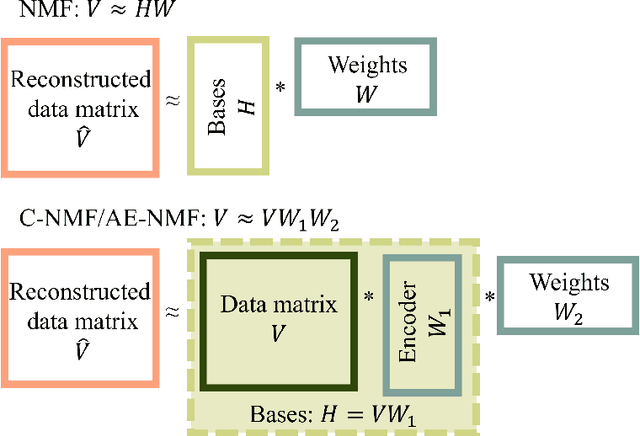
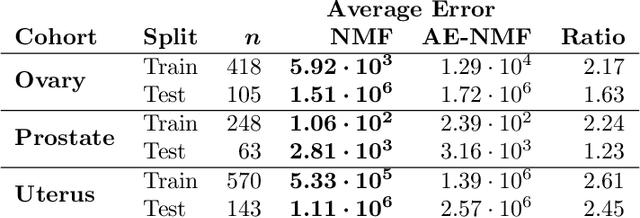
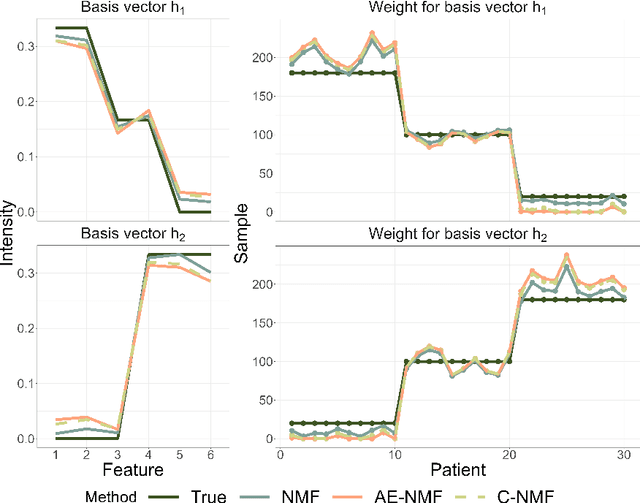
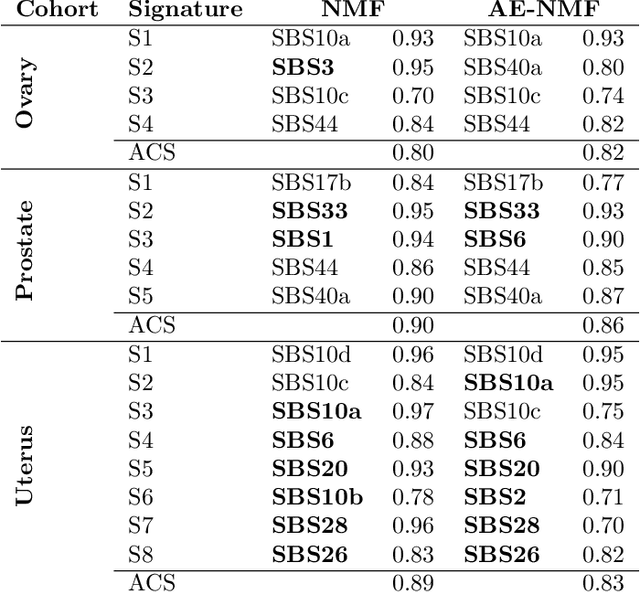
The aim of this study is to provide a foundation to understand the relationship between non-negative matrix factorization (NMF) and non-negative autoencoders enabling proper interpretation and understanding of autoencoder-based alternatives to NMF. Since its introduction, NMF has been a popular tool for extracting interpretable, low-dimensional representations of high-dimensional data. However, recently, several studies have proposed to replace NMF with autoencoders. This increasing popularity of autoencoders warrants an investigation on whether this replacement is in general valid and reasonable. Moreover, the exact relationship between non-negative autoencoders and NMF has not been thoroughly explored. Thus, a main aim of this study is to investigate in detail the relationship between non-negative autoencoders and NMF. We find that the connection between the two models can be established through convex NMF, which is a restricted case of NMF. In particular, convex NMF is a special case of an autoencoder. The performance of NMF and autoencoders is compared within the context of extraction of mutational signatures from cancer genomics data. We find that the reconstructions based on NMF are more accurate compared to autoencoders, while the signatures extracted using both methods show comparable consistencies and values when externally validated. These findings suggest that the non-negative autoencoders investigated in this article do not provide an improvement of NMF in the field of mutational signature extraction.