 Add to Chrome
 Add to Firefox
 Add to Edge
Point-Based 3D Reconstruction from Sparse Views under Known Illumination
Aug 20, 2026
Sparse view 3D reconstruction is commonly addressed with neural implicit surfaces or dense point-based representations such as Gaussian splatting. Surface-aware splatting methods improve extracted geometry through oriented primitives and regularization, while RadiosityGS incorporates differentiable light transport through a radiosity inspired finite-element surfel formulation. We propose a differentiable point rendering method based on opacity-bearing beta surfels. An opacity explicit adjoint light transport formulation provides gradients for surfel geometry and appearance parameters, allowing physically based light transport to constrain reconstruction. Across five synthetic objects reconstructed from ten posed views, our method achieves the lowest mean symmetric Chamfer distance among the evaluated baselines and reduces mean Chamfer distance by 28.5% relative to the strongest point-based baseline while using only 267 surfels on average, approximately ~161 fewer primitives. Directional Chamfer results further show improved accuracy and competitive completion relative to related point-based methods. These results show that, in the controlled direct illumination setting, compact beta surfels combined with transport-based optimization can recover surfaces without relying on the tens to hundreds of thousands of primitives used by the evaluated baselines.

Differentiable Shadow Mapping for Efficient Inverse Graphics
Aug 21, 2023We show how shadows can be efficiently generated in differentiable rendering of triangle meshes. Our central observation is that pre-filtered shadow mapping, a technique for approximating shadows based on rendering from the perspective of a light, can be combined with existing differentiable rasterizers to yield differentiable visibility information. We demonstrate at several inverse graphics problems that differentiable shadow maps are orders of magnitude faster than differentiable light transport simulation with similar accuracy -- while differentiable rasterization without shadows often fails to converge.
Multi-View Mesh Reconstruction with Neural Deferred Shading
Dec 08, 2022


We propose an analysis-by-synthesis method for fast multi-view 3D reconstruction of opaque objects with arbitrary materials and illumination. State-of-the-art methods use both neural surface representations and neural rendering. While flexible, neural surface representations are a significant bottleneck in optimization runtime. Instead, we represent surfaces as triangle meshes and build a differentiable rendering pipeline around triangle rasterization and neural shading. The renderer is used in a gradient descent optimization where both a triangle mesh and a neural shader are jointly optimized to reproduce the multi-view images. We evaluate our method on a public 3D reconstruction dataset and show that it can match the reconstruction accuracy of traditional baselines and neural approaches while surpassing them in optimization runtime. Additionally, we investigate the shader and find that it learns an interpretable representation of appearance, enabling applications such as 3D material editing.
Accurate Human Body Reconstruction for Volumetric Video
Feb 26, 2022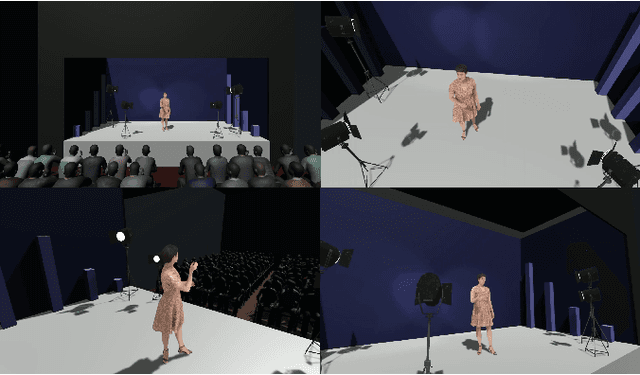
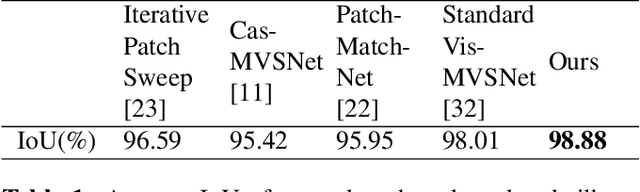
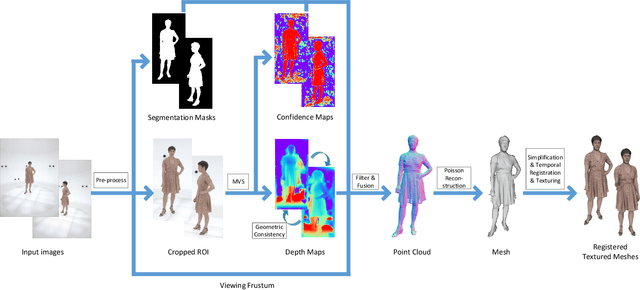

In this work, we enhance a professional end-to-end volumetric video production pipeline to achieve high-fidelity human body reconstruction using only passive cameras. While current volumetric video approaches estimate depth maps using traditional stereo matching techniques, we introduce and optimize deep learning-based multi-view stereo networks for depth map estimation in the context of professional volumetric video reconstruction. Furthermore, we propose a novel depth map post-processing approach including filtering and fusion, by taking into account photometric confidence, cross-view geometric consistency, foreground masks as well as camera viewing frustums. We show that our method can generate high levels of geometric detail for reconstructed human bodies.