 Add to Chrome
 Add to Firefox
 Add to Edge
Flood Mapping from RGB imagery using a Vision Foundation Model
Jun 23, 2026
Timely, high-resolution maps of flood extent around settlements are essential for emergency response and damage assessment. We consider airborne RGB imagery for flood mapping as it can be collected rapidly at low cost. To produce flood maps, deep learning models for water segmentation are often used. CNN based and small vision transformer models are used. However, they need much data for adaptation to a change of scenery, i.e., another flooding event. Vision foundation models or large vision transformers are known to generalize across domains. Recently, foundation models for Earth observation became available. They are pretrained on satellite data, whose spatial resolution, viewing geometry, and radiometry differ from nadir RGB imagery. Thus, adaptation is required. We investigate how a satellite-pretrained Earth observation foundation model can be adapted to centimeter-scale floodwater mapping from RGB imagery. Specifically, we fine-tune a model we call Prithvi-2.0-UPN consisting of the Prithvi-EO-2.0-600M Vision Transformer combined with a UPerNet decoder for binary water segmentation on two RGB datasets (BlessemFlood21, NeuenahrFlood). In a first experiment we observe that Prithvi-2.0-UPN reaches state-of-the-art results on BlessemFlood21 and NeuenahrFlood, when trained on their datasets. In a second experiment we show that Prithvi-2.0-UPN performs better than state-of-the-art baseline models for transfer to a new flood event (trained on BlessemFlood21, tested on NeuenahrFlood) in a zero-shot setting. However, the performance indicates room for improvement. In this respect, we investigate in a third experiment how performance improves when further fine-tuning the models with small shares of NeuenahrFlood training data: Prithvi-2.0-UPN improves the fastest and reaches almost the performance level when fully trained on NeuenahrFlood, indicating transfer capabilities.

Remote Sensing Imagery for Flood Detection: Exploration of Augmentation Strategies
Apr 28, 2025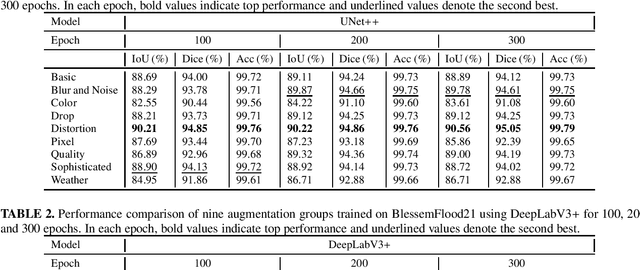
Floods cause serious problems around the world. Responding quickly and effectively requires accurate and timely information about the affected areas. The effective use of Remote Sensing images for accurate flood detection requires specific detection methods. Typically, Deep Neural Networks are employed, which are trained on specific datasets. For the purpose of river flood detection in RGB imagery, we use the BlessemFlood21 dataset. We here explore the use of different augmentation strategies, ranging from basic approaches to more complex techniques, including optical distortion. By identifying effective strategies, we aim to refine the training process of state-of-the-art Deep Learning segmentation networks.
BlessemFlood21: Advancing Flood Analysis with a High-Resolution Georeferenced Dataset for Humanitarian Aid Support
Jul 06, 2024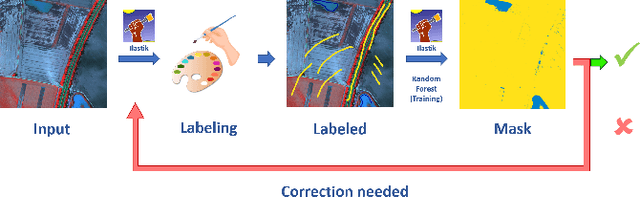
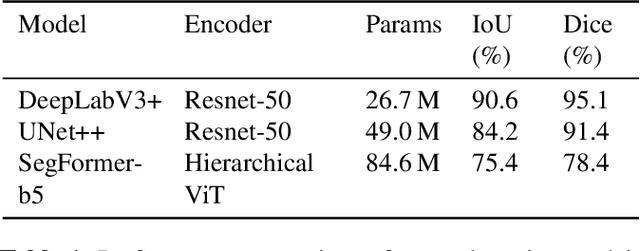
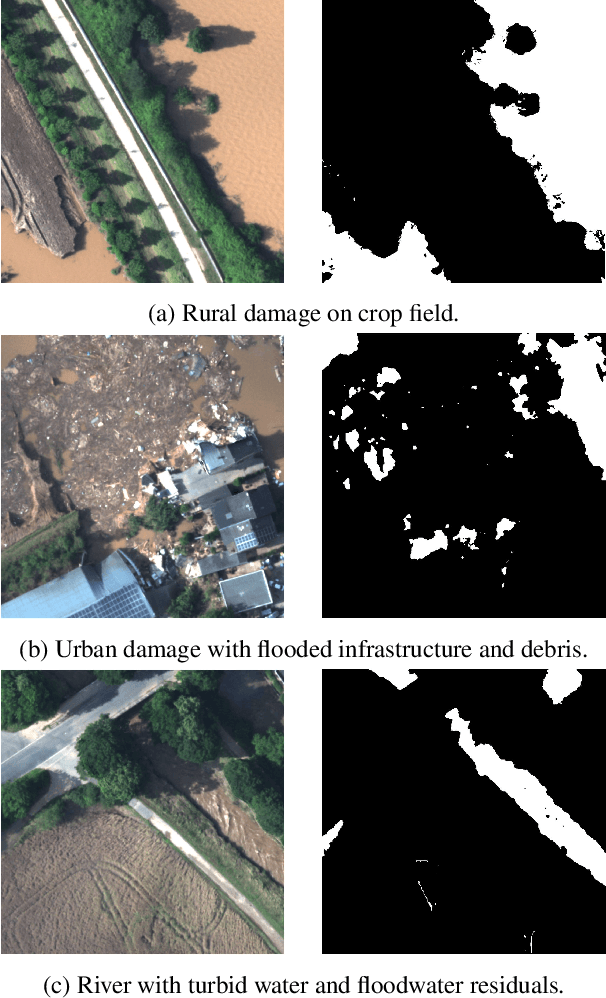
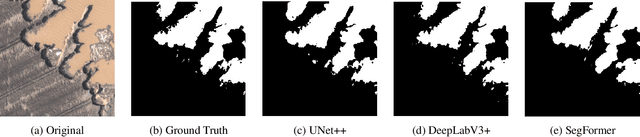
Floods are an increasingly common global threat, causing emergencies and severe damage to infrastructure. During crises, organisations such as the World Food Programme use remotely sensed imagery, typically obtained through drones, for rapid situational analysis to plan life-saving actions. Computer Vision tools are needed to support task force experts on-site in the evaluation of the imagery to improve their efficiency and to allocate resources strategically. We introduce the BlessemFlood21 dataset to stimulate research on efficient flood detection tools. The imagery was acquired during the 2021 Erftstadt-Blessem flooding event and consists of high-resolution and georeferenced RGB-NIR images. In the resulting RGB dataset, the images are supplemented with detailed water masks, obtained via a semi-supervised human-in-the-loop technique, where in particular the NIR information is leveraged to classify pixels as either water or non-water. We evaluate our dataset by training and testing established Deep Learning models for semantic segmentation. With BlessemFlood21 we provide labeled high-resolution RGB data and a baseline for further development of algorithmic solutions tailored to flood detection in RGB imagery.