 Add to Chrome
 Add to Firefox
 Add to Edge
Quantifying System Level KPI Deviations of Sionna RT: Material and Near-Field Error Analysis Using a 5G OAI Testbed
May 11, 2026
Ray tracing (RT) has recently gained renewed interest in wireless communications, driven by its integration into digital twin (DT) frameworks for site specific channel modeling. Several previous studies have validated RT at the channel level, yet how these errors propagate into real 5G system level key performance indicators (KPIs) on actual hardware remains unquantified. This paper addresses this gap by comparing Sionna RT simulated channels against vector network analyzer (VNA) measured channels using an OpenAirInterface (OAI) 5G NR testbed. Channel measurements are conducted at 20 receiver positions in an indoor laboratory, with both channel types injected into a hardware in the loop channel emulator interfacing an OAIBOX MAX base station and a Quectel UE. RSRP, PUCCH SNR, and SINR are evaluated under both conditions. The results identify antenna near-field transition effects as a critical position-dependent error source, alongside material property mismatch, providing a quantitative benchmark for digital twin-based 5G and beyond network planning.

IRS-enabled Breath Tracking with Colocated Commodity WiFi Transceivers
Mar 10, 2022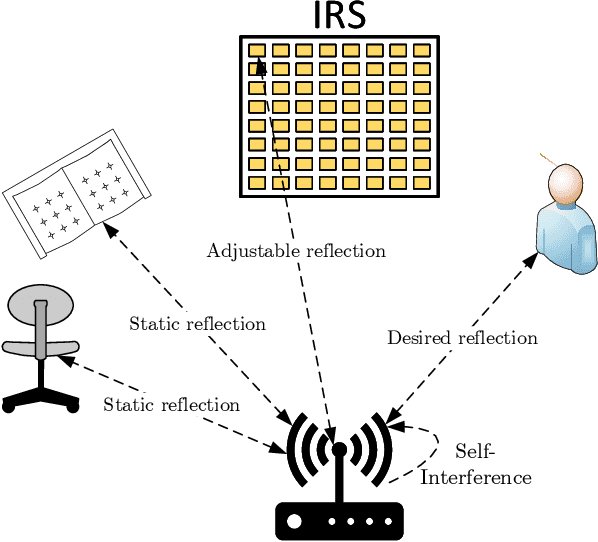
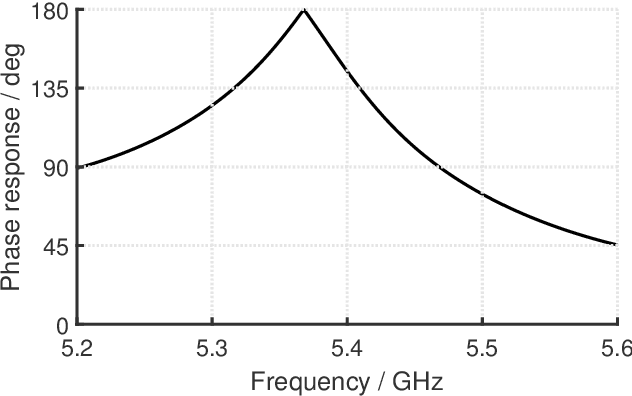
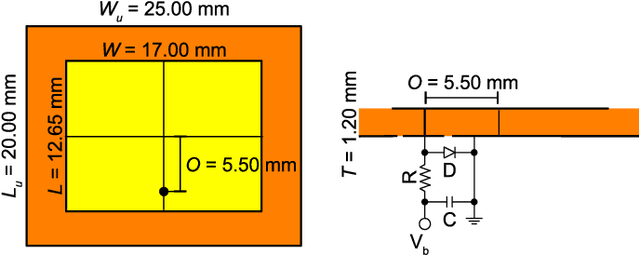
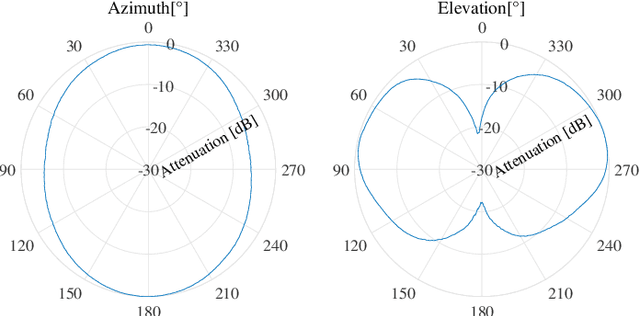
Intelligent reflecting surfaces (IRS) are a key enabler of various new applications in 6G smart radio environments. By utilizing an IRS prototype system, this paper aims to enhance self-interference (SI) cancellation for breath tracking with commodity WiFi devices. SI suppression is a crucial requirement for breath tracking with a single antenna site as the SI severely limits the radio sensing range by shadowing the received signal with its own transmit signal. To this end, we propose to assist SI cancellation by exploiting an IRS to form a suitable cancellation signal in the analog domain. Building upon a 256-element IRS prototype, we present results of breath tracking with IRS-assisted SI cancellation from a practical testbed. We use inexpensive WiFi hardware to extract the Channel State Information (CSI) in the 5~GHz band and analyze the phase change between a colocated transmitter and receiver with added local oscillator (LO) synchronization. We are able to track the breath of a test person regardless of the position in an indoor environment in a room-level range. The presented case study shows promising performance in both capturing the breath frequency as well as the breathing patterns.
Full-Duplex meets Reconfigurable Surfaces: RIS-assisted SIC for Full-Duplex Radios
May 26, 2021


Reconfigurable intelligent surfaces (RIS) are a key enabler of various new applications in 6G smart radio environments. By utilizing an RIS prototype system, this paper aims to enhance self-interference (SI) cancellation for in-band full-duplex(FD) communication systems. In FD communication, SI of a node severely limits the performance of the node by shadowing the received signal from a distant node with its own transmit signal. To this end, we propose to assist SI cancellation by exploiting a RIS to form a suitable cancellation signal, thus canceling the leaked SI in the analog domain. Building upon a 64 element RIS prototype we present results of RIS-assisted SI cancellation from a real testbed. Given a suitable amount of initial analog isolation, we are able to cancel the leaked signal by as much as -85 dB. The presented case study shows promising performance to build an FD communication system on this foundation.