 Add to Chrome
 Add to Firefox
 Add to Edge
Aligning LLM-Simulated and Human Examinees for Psychometric Calibration: A Cognitive Diagnostic Profiling Approach
Jul 28, 2026
Psychometric calibration for educational tests typically requires costly human response data. Large language models (LLMs) simulated examinees offer a promising route to early calibration, but their responses are too accurate and too uniform. We propose Cognitive Diagnostic Profiling (CDP), a zero-shot framework that prompts LLMs to simulate plausible examinees with diverse cognitive profiles: binary attribute-mastery patterns are rendered as natural-language profiles and sampled under an uninformative or an informative distribution. Using the Tatsuoka fraction-subtraction dataset (536 examinees, 15 items, five attributes), we evaluated eight LLM configurations under no-profile, uninformative-CDP, and informative-CDP conditions, assessing alignment with human examinees at the ability-distribution, mastery-profile, and item-difficulty levels. CDP improved all three levels: distributional overlap rose across configurations; weighted correlations between profile-level scores and human profile expectations reached 0.92 to 0.98; and item-difficulty recovery improved in rank order and absolute alignment, most for reasoning-enabled models; in the strongest case, Gemini 3.0 Flash (Thinking), one-parameter logistic (1PL) difficulty Spearman correlations rose from 0.24 to 0.86 and 0.90 and the root-mean-square error (RMSE) fell from 6.31 to 1.30 and 0.90; the informative condition helped most where profile-level alignment was strong. CDP brings LLM-simulated examinees into closer psychometric alignment with human examinees, making them practical for operational test development.

Toward Mitigating Sex Bias in Pilot Trainees' Stress and Fatigue Modeling
Sep 16, 2024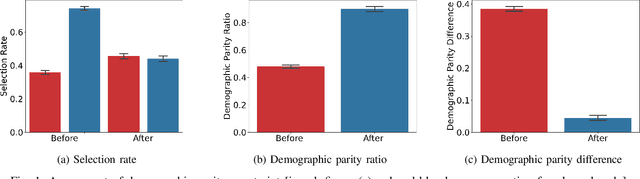
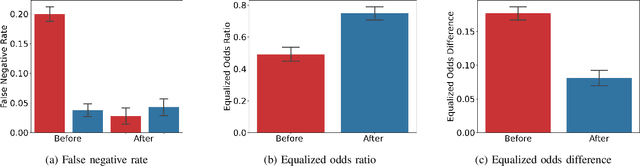
While researchers have been trying to understand the stress and fatigue among pilots, especially pilot trainees, and to develop stress/fatigue models to automate the process of detecting stress/fatigue, they often do not consider biases such as sex in those models. However, in a critical profession like aviation, where the demographic distribution is disproportionately skewed to one sex, it is urgent to mitigate biases for fair and safe model predictions. In this work, we investigate the perceived stress/fatigue of 69 college students, including 40 pilot trainees with around 63% male. We construct models with decision trees first without bias mitigation and then with bias mitigation using a threshold optimizer with demographic parity and equalized odds constraints 30 times with random instances. Using bias mitigation, we achieve improvements of 88.31% (demographic parity difference) and 54.26% (equalized odds difference), which are also found to be statistically significant.