 Add to Chrome
 Add to Firefox
 Add to Edge
Concept Drift Detection and Adaptive Retraining of Malware Classification Models
Aug 13, 2026
Concept drift refers to changes over time in the statistical properties of data, as compared to the data that was used to train a learning model. Machine learning models for malware detection or classification are particularly susceptible to performance degradation caused by concept drift, as attackers constantly modify existing malware. In this chapter, we analyze two machine learning-based approaches to automated concept drift detection-a novel approach based on One-Class Support Vector Machines (OCSVM) and a previously-studied technique based on Minibatch K-Means (MK-Means). For comparison we also consider Maximum Mean Discrepancy (MMD), a statistical technique for detecting changes in multidimensional data. We conduct an extensive series of experiments comparing the effectiveness of four learning models, namely, Multilayer Perceptron, Random Forest, Support Vector Machines, and eXtreme Gradient Boosting. For each of these models, we consider three distinct scenarios: A static scenario where no model retraining occurs, a periodic scenario where models are constantly retrained irrespective of concept drift, and a drift-aware scenario where models are only retrained when concept drift is detected. Under the drift-aware scenario, we analyze the tradeoff between accuracy and training efficiency using Pareto Front analysis. We find that all three concept drift detection techniques achieve classification accuracy comparable to periodic retraining, while offering substantially greater efficiency in terms of the number of models that must be retrained. In addition, drift-aware retraining based on our OCSVM technique generally outperforms the MK-Means and MMD approaches. Overall, these results provide strong evidence that we can accurately detect concept drift in malware classification models.

Robustness of AI-Art Detectors under Generator Shift
Aug 12, 2026Text-to-image generative models have advanced rapidly, with modern Diffusion Transformer architectures producing images that are increasingly difficult to distinguish from human-created artwork. This development has raised significant concerns regarding copyright protection, misinformation, fraud, impersonation, and the authenticity of digital content. Most AI-art detectors are trained and evaluated on the same generator family, leaving robustness to newer architectures underexplored. In this chapter, we analyze generator shift based on a Stable Diffusion 3.5 Medium (SD3.5m) artwork dataset spanning ten art styles through reverse prompting of held-out human artwork samples. Five detectors are trained on U-Net-based latent diffusion artwork and evaluated in a zero-shot cross-generator setting on the SD3.5m dataset. Deep learning models perform strongly in-distribution but degrade under generator shift, misclassifying many SD3.5m images as human while human false positives remain low. The CLIP ViT-L/14 model performs best overall, while Grad-CAM analysis reveals weaker and more diffuse activation on false negatives. These findings highlight a generalization gap in current AI-art detectors and motivate the development of detectors as one component of a layered defense that remains reliable across rapidly evolving generative architectures.
CAM-Guided Saliency Cutout and Image-Based Malware Classification
Aug 12, 2026Dropout regularization is commonly used to reduce overfitting by removing parts of a neural network during training. For Convolutional Neural Networks (CNN), cutouts serve a somewhat analogous purpose. Cutouts can be implemented as data augmentation: the original training image is retained, and additional copies are created with regions removed. In this chapter, we test whether cutout placement can be improved by using High-Resolution Class Activation Mapping (HiResCAM). We compare four controlled training conditions: no cutout, standard random cutout, low-saliency cutout, and high-saliency cutout. We experiment using grayscale malware images from the RawMal-TF dataset (17 families with~1,000 samples per family), and for comparison to natural images, we experiment with the well-known CIFAR-100 dataset. All experiments are based on ResNet18 with~100 training epochs. For the cutout experiments, we test cutout areas of~5\%, 10\%, 20\%, and~30\%, and we consider~$M\in\{4,8}$ augmented copies per original training image. The RawMal-TF results are slightly worse for all three cutout cases (random, high and low saliency) as compared to no cutouts. In contrast, our CIFAR-100 experimental results improve slightly under low-saliency cutout. These results suggest that the value of saliency-guided cutout is domain dependent, and that malware images should not be treated as equivalent to natural images.
Detecting Concept Drift in Evolving Malware Families Using Rule-Based Classifier Representations
Apr 24, 2026This work proposes a structural approach to concept drift detection in malware classification using decision tree rulesets. Classifiers are trained across temporal windows on the EMBER2024 dataset, and drift is quantified by comparing extracted rule representations using feature importance, prediction agreement, activation stability, and coverage metrics. These metrics are correlated with both accuracy degradation and data distribution shift as complementary drift indicators. The approach is evaluated across six malware families using fixed-interval and clustering-based windowing in family-vs-benign and family-vs-family settings, and compared against RIPPER and Transcendent baselines. Results show that fixed two-month windowing with feature-level Pearson correlation is the most reliable configuration, being the only one where all family pairs produce positive drift-accuracy correlations. The methods are complementary - no single approach dominates across all pairs.
Transforming Chatbot Text: A Sequence-to-Sequence Approach
Jun 15, 2025Due to advances in Large Language Models (LLMs) such as ChatGPT, the boundary between human-written text and AI-generated text has become blurred. Nevertheless, recent work has demonstrated that it is possible to reliably detect GPT-generated text. In this paper, we adopt a novel strategy to adversarially transform GPT-generated text using sequence-to-sequence (Seq2Seq) models, with the goal of making the text more human-like. We experiment with the Seq2Seq models T5-small and BART which serve to modify GPT-generated sentences to include linguistic, structural, and semantic components that may be more typical of human-authored text. Experiments show that classification models trained to distinguish GPT-generated text are significantly less accurate when tested on text that has been modified by these Seq2Seq models. However, after retraining classification models on data generated by our Seq2Seq technique, the models are able to distinguish the transformed GPT-generated text from human-generated text with high accuracy. This work adds to the accumulating knowledge of text transformation as a tool for both attack -- in the sense of defeating classification models -- and defense -- in the sense of improved classifiers -- thereby advancing our understanding of AI-generated text.
AGRO: An Autonomous AI Rover for Precision Agriculture
May 02, 2025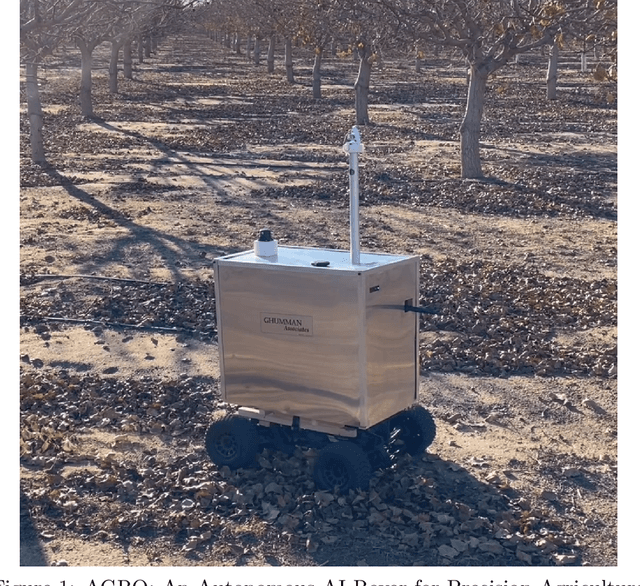
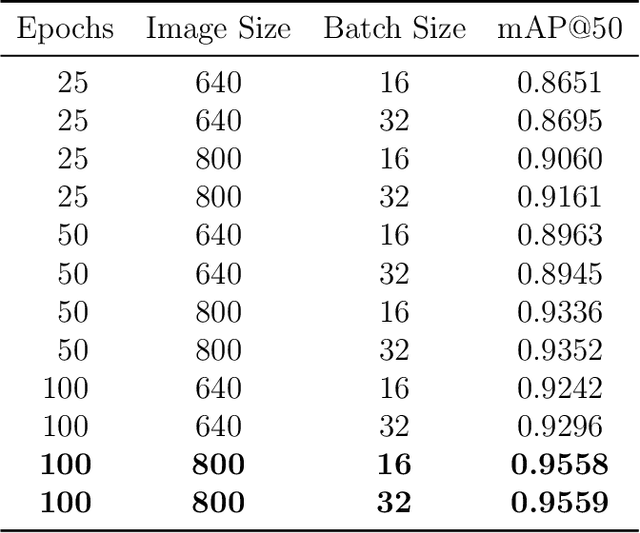
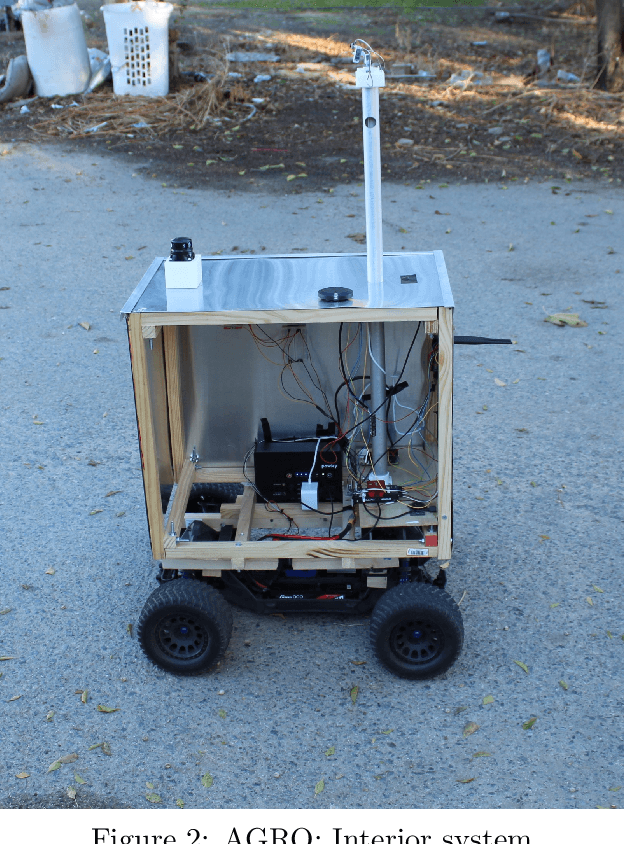
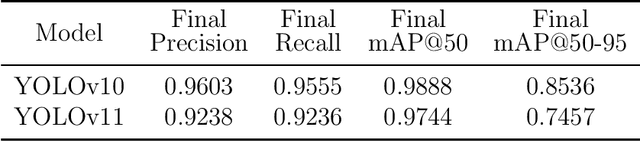
Unmanned Ground Vehicles (UGVs) are emerging as a crucial tool in the world of precision agriculture. The combination of UGVs with machine learning allows us to find solutions for a range of complex agricultural problems. This research focuses on developing a UGV capable of autonomously traversing agricultural fields and capturing data. The project, known as AGRO (Autonomous Ground Rover Observer) leverages machine learning, computer vision and other sensor technologies. AGRO uses its capabilities to determine pistachio yields, performing self-localization and real-time environmental mapping while avoiding obstacles. The main objective of this research work is to automate resource-consuming operations so that AGRO can support farmers in making data-driven decisions. Furthermore, AGRO provides a foundation for advanced machine learning techniques as it captures the world around it.
Detecting AI-generated Artwork
Apr 09, 2025The high efficiency and quality of artwork generated by Artificial Intelligence (AI) has created new concerns and challenges for human artists. In particular, recent improvements in generative AI have made it difficult for people to distinguish between human-generated and AI-generated art. In this research, we consider the potential utility of various types of Machine Learning (ML) and Deep Learning (DL) models in distinguishing AI-generated artwork from human-generated artwork. We focus on three challenging artistic styles, namely, baroque, cubism, and expressionism. The learning models we test are Logistic Regression (LR), Support Vector Machine (SVM), Multilayer Perceptron (MLP), and Convolutional Neural Network (CNN). Our best experimental results yield a multiclass accuracy of 0.8208 over six classes, and an impressive accuracy of 0.9758 for the binary classification problem of distinguishing AI-generated from human-generated art.
Cluster Analysis and Concept Drift Detection in Malware
Feb 19, 2025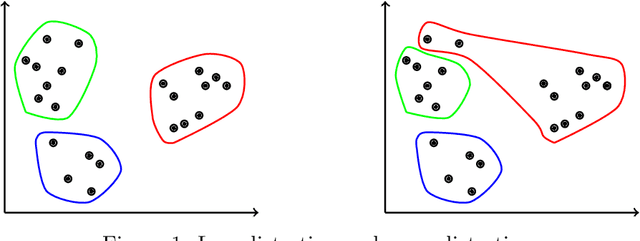
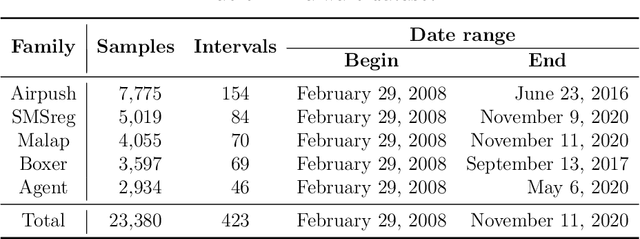
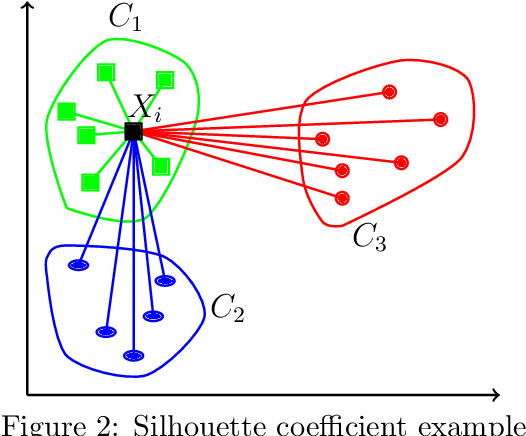
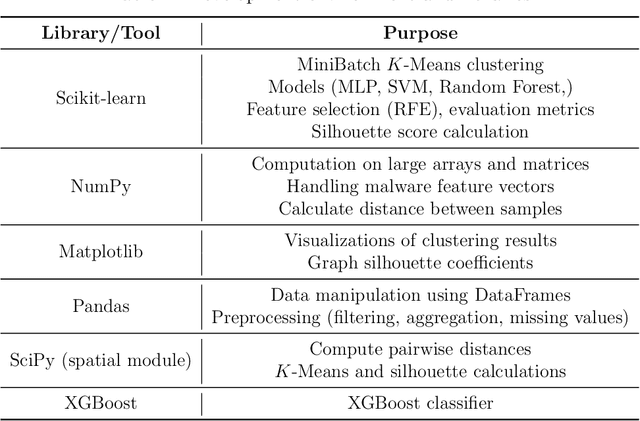
Concept drift refers to gradual or sudden changes in the properties of data that affect the accuracy of machine learning models. In this paper, we address the problem of concept drift detection in the malware domain. Specifically, we propose and analyze a clustering-based approach to detecting concept drift. Using a subset of the KronoDroid dataset, malware samples are partitioned into temporal batches and analyzed using MiniBatch $K$-Means clustering. The silhouette coefficient is used as a metric to identify points in time where concept drift has likely occurred. To verify our drift detection results, we train learning models under three realistic scenarios, which we refer to as static training, periodic retraining, and drift-aware retraining. In each scenario, we consider four supervised classifiers, namely, Multilayer Perceptron (MLP), Support Vector Machine (SVM), Random Forest, and XGBoost. Experimental results demonstrate that drift-aware retraining guided by silhouette coefficient thresholding achieves classification accuracy far superior to static models, and generally within 1% of periodic retraining, while also being far more efficient than periodic retraining. These results provide strong evidence that our clustering-based approach is effective at detecting concept drift, while also illustrating a highly practical and efficient fully automated approach to improved malware classification via concept drift detection.
Temporal Analysis of Adversarial Attacks in Federated Learning
Jan 19, 2025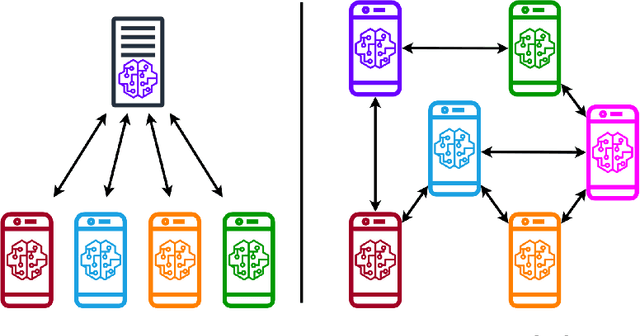


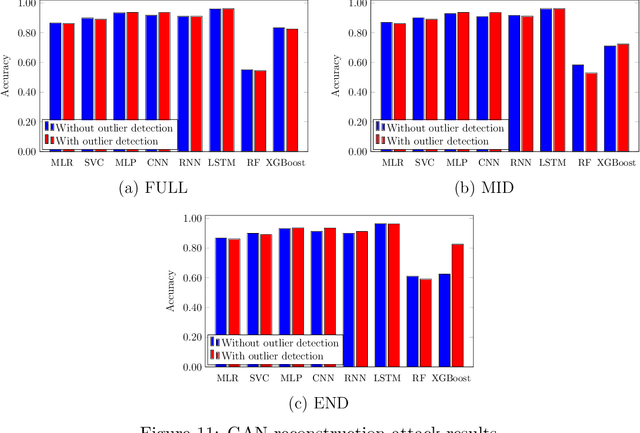
In this paper, we experimentally analyze the robustness of selected Federated Learning (FL) systems in the presence of adversarial clients. We find that temporal attacks significantly affect model performance in the FL models tested, especially when the adversaries are active throughout or during the later rounds. We consider a variety of classic learning models, including Multinominal Logistic Regression (MLR), Random Forest, XGBoost, Support Vector Classifier (SVC), as well as various Neural Network models including Multilayer Perceptron (MLP), Convolution Neural Network (CNN), Recurrent Neural Network (RNN), and Long Short-Term Memory (LSTM). Our results highlight the effectiveness of temporal attacks and the need to develop strategies to make the FL process more robust against such attacks. We also briefly consider the effectiveness of defense mechanisms, including outlier detection in the aggregation algorithm.
Multimodal Techniques for Malware Classification
Jan 19, 2025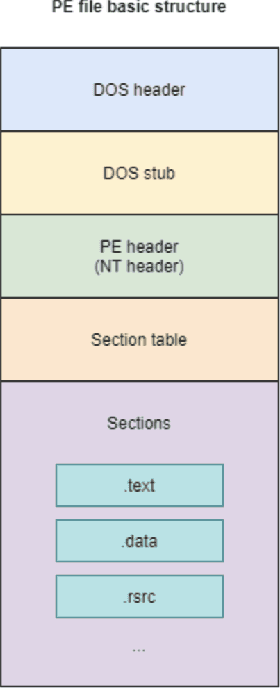
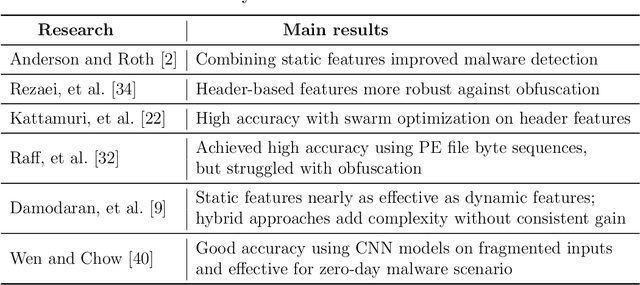
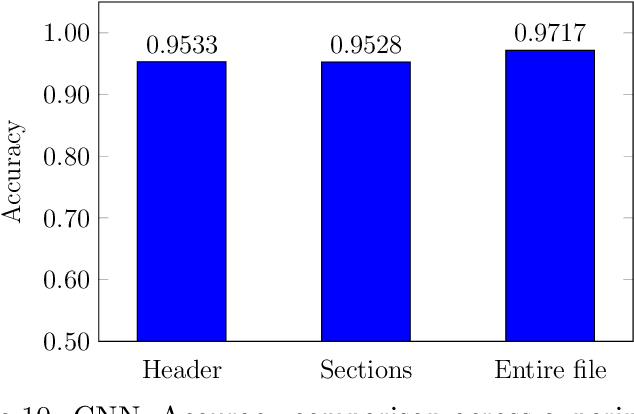
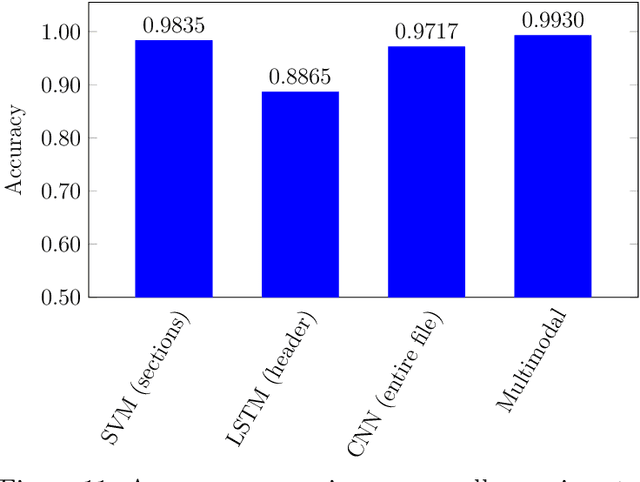
The threat of malware is a serious concern for computer networks and systems, highlighting the need for accurate classification techniques. In this research, we experiment with multimodal machine learning approaches for malware classification, based on the structured nature of the Windows Portable Executable (PE) file format. Specifically, we train Support Vector Machine (SVM), Long Short-Term Memory (LSTM), and Convolutional Neural Network (CNN) models on features extracted from PE headers, we train these same models on features extracted from the other sections of PE files, and train each model on features extracted from the entire PE file. We then train SVM models on each of the nine header-sections combinations of these baseline models, using the output layer probabilities of the component models as feature vectors. We compare the baseline cases to these multimodal combinations. In our experiments, we find that the best of the multimodal models outperforms the best of the baseline cases, indicating that it can be advantageous to train separate models on distinct parts of Windows PE files.