 Add to Chrome
 Add to Firefox
 Add to Edge
Scalably Enhancing the Clinical Validity of a Task Benchmark with Physician Oversight
Dec 22, 2025
Automating the calculation of clinical risk scores offers a significant opportunity to reduce physician administrative burden and enhance patient care. The current standard for evaluating this capability is MedCalc-Bench, a large-scale dataset constructed using LLM-based feature extraction and rule-based aggregation. However, treating such model-generated benchmarks as static oracles risks enshrining historical model errors as evaluation gold standards, a problem dangerously amplified when these datasets serve as reward signals for Reinforcement Learning (RL). In this work, we propose viewing benchmarks for complex tasks such as clinical score computation as ''in-progress living documents'' that should be periodically re-evaluated as the processes for creating them improve. We introduce a systematic, physician-in-the-loop pipeline that leverages advanced agentic verifiers to audit and relabel MedCalc-Bench, utilizing automated triage to reserve scarce clinician attention for the most contentious instances. Our audit reveals that a notable fraction of original labels diverge from medical ground truth due to extraction errors, calculator logic mismatches, and clinical ambiguity. To study whether this label noise meaningfully impacts downstream RL training, we fine-tune a Qwen3-8B model via Group Relative Policy Optimization (GRPO) and demonstrate that training on corrected labels yields an 8.7% absolute improvement in accuracy over the original baseline -- validating that label noise materially affects model evaluation. These findings underscore that in safety-critical domains, rigorous benchmark maintenance is a prerequisite for genuine model alignment.

On Aligning Prediction Models with Clinical Experiential Learning: A Prostate Cancer Case Study
Sep 04, 2025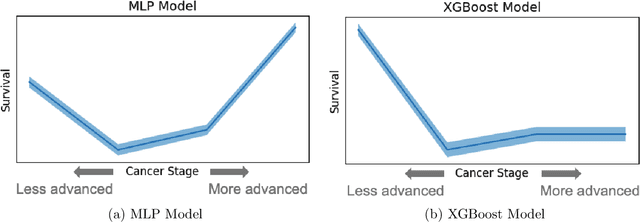
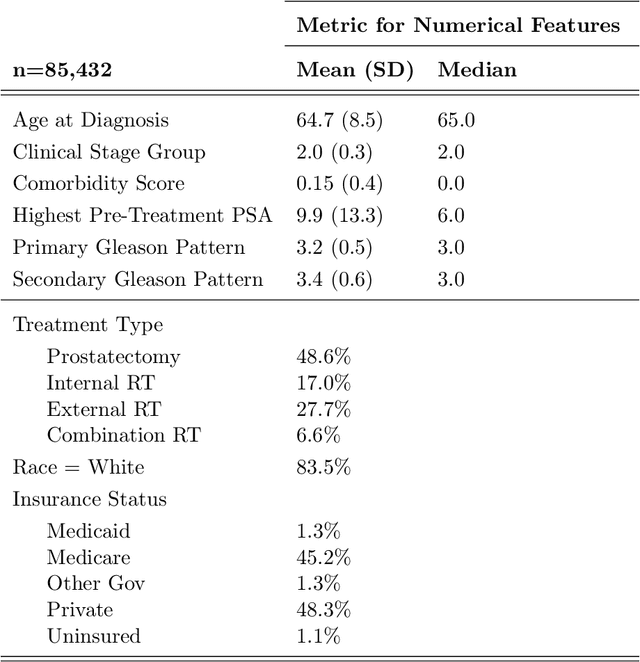
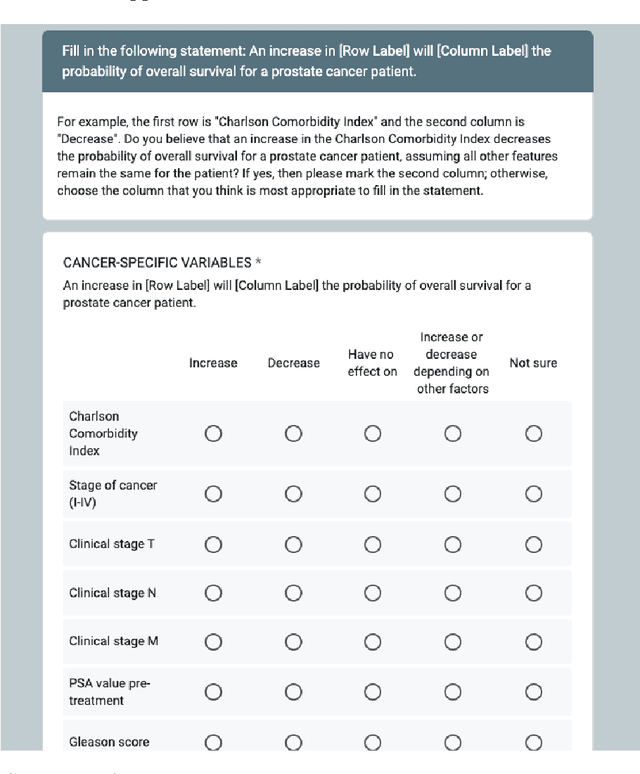
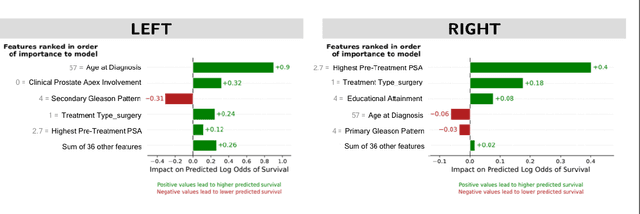
Over the past decade, the use of machine learning (ML) models in healthcare applications has rapidly increased. Despite high performance, modern ML models do not always capture patterns the end user requires. For example, a model may predict a non-monotonically decreasing relationship between cancer stage and survival, keeping all other features fixed. In this paper, we present a reproducible framework for investigating this misalignment between model behavior and clinical experiential learning, focusing on the effects of underspecification of modern ML pipelines. In a prostate cancer outcome prediction case study, we first identify and address these inconsistencies by incorporating clinical knowledge, collected by a survey, via constraints into the ML model, and subsequently analyze the impact on model performance and behavior across degrees of underspecification. The approach shows that aligning the ML model with clinical experiential learning is possible without compromising performance. Motivated by recent literature in generative AI, we further examine the feasibility of a feedback-driven alignment approach in non-generative AI clinical risk prediction models through a randomized experiment with clinicians. Our findings illustrate that, by eliciting clinicians' model preferences using our proposed methodology, the larger the difference in how the constrained and unconstrained models make predictions for a patient, the more apparent the difference is in clinical interpretation.