 Add to Chrome
 Add to Firefox
 Add to Edge
EstLLM: Enhancing Estonian Capabilities in Multilingual LLMs via Continued Pretraining and Post-Training
Mar 02, 2026
Large language models (LLMs) are predominantly trained on English-centric data, resulting in uneven performance for smaller languages. We study whether continued pretraining (CPT) can substantially improve Estonian capabilities in a pretrained multilingual LLM while preserving its English and general reasoning performance. Using Llama 3.1 8B as the main base model, we perform CPT on a mixture that increases Estonian exposure while approximating the original training distribution through English replay and the inclusion of code, mathematics, and instruction-like data. We subsequently apply supervised fine-tuning, preference optimization, and chat vector merging to introduce robust instruction-following behavior. Evaluation on a comprehensive suite of Estonian benchmarks shows consistent gains in linguistic competence, knowledge, reasoning, translation quality, and instruction-following compared to the original base model and its instruction-tuned variant, while maintaining competitive performance on English benchmarks. These findings indicate that CPT, with an appropriately balanced data mixture, together with post-training alignment, can substantially improve single-language capabilities in pretrained multilingual LLMs.

Extremely low-resource machine translation for closely related languages
May 27, 2021
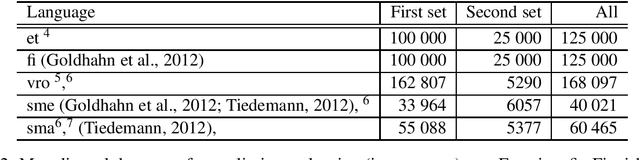


An effective method to improve extremely low-resource neural machine translation is multilingual training, which can be improved by leveraging monolingual data to create synthetic bilingual corpora using the back-translation method. This work focuses on closely related languages from the Uralic language family: from Estonian and Finnish geographical regions. We find that multilingual learning and synthetic corpora increase the translation quality in every language pair for which we have data. We show that transfer learning and fine-tuning are very effective for doing low-resource machine translation and achieve the best results. We collected new parallel data for V\~oro, North and South Saami and present first results of neural machine translation for these languages.
Neural Speech Synthesis for Estonian
Oct 06, 2020This technical report describes the results of a collaboration between the NLP research group at the University of Tartu and the Institute of Estonian Language on improving neural speech synthesis for Estonian. The report (written in Estonian) describes the project results, the summary of which is: (1) Speech synthesis data from 6 speakers for a total of 92.4 hours is collected and openly released (CC-BY-4.0). Data available at https://konekorpus.tartunlp.ai and https://www.eki.ee/litsents/. (2) software and models for neural speech synthesis is released open-source (MIT license). Available at https://koodivaramu.eesti.ee/tartunlp/text-to-speech . (3) We ran evaluations of the new models and compared them to other existing solutions (HMM-based HTS models from EKI, http://www.eki.ee/heli/, and Google's speech synthesis for Estonian, accessed via https://translate.google.com). Evaluation includes voice acceptability MOS scores for sentence-level and longer excerpts, detailed error analysis and evaluation of the pre-processing module.