 Add to Chrome
 Add to Firefox
 Add to Edge
DenseBEV: Transforming BEV Grid Cells into 3D Objects
Dec 18, 2025
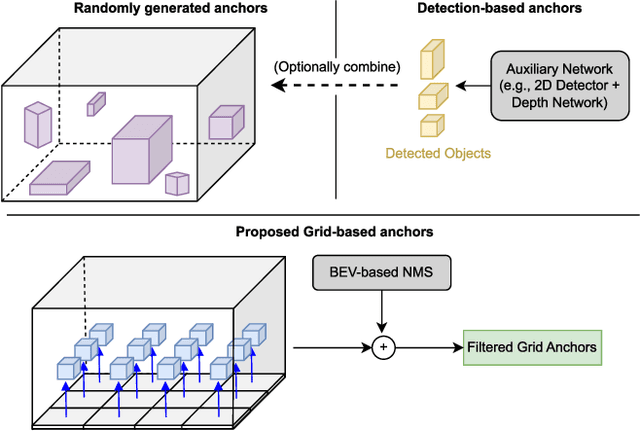
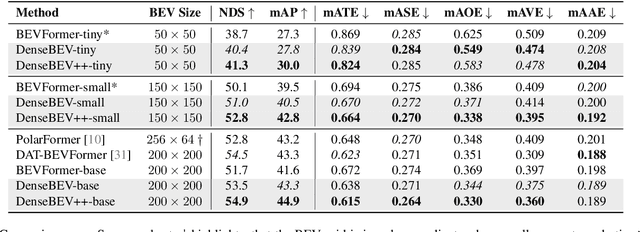
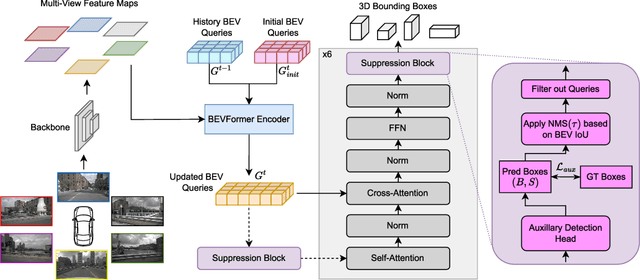
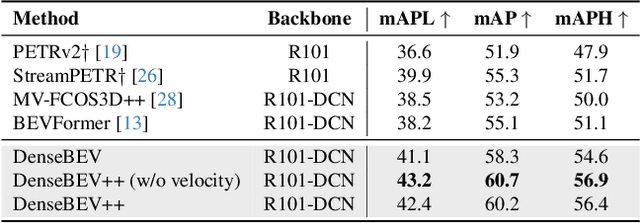
In current research, Bird's-Eye-View (BEV)-based transformers are increasingly utilized for multi-camera 3D object detection. Traditional models often employ random queries as anchors, optimizing them successively. Recent advancements complement or replace these random queries with detections from auxiliary networks. We propose a more intuitive and efficient approach by using BEV feature cells directly as anchors. This end-to-end approach leverages the dense grid of BEV queries, considering each cell as a potential object for the final detection task. As a result, we introduce a novel two-stage anchor generation method specifically designed for multi-camera 3D object detection. To address the scaling issues of attention with a large number of queries, we apply BEV-based Non-Maximum Suppression, allowing gradients to flow only through non-suppressed objects. This ensures efficient training without the need for post-processing. By using BEV features from encoders such as BEVFormer directly as object queries, temporal BEV information is inherently embedded. Building on the temporal BEV information already embedded in our object queries, we introduce a hybrid temporal modeling approach by integrating prior detections to further enhance detection performance. Evaluating our method on the nuScenes dataset shows consistent and significant improvements in NDS and mAP over the baseline, even with sparser BEV grids and therefore fewer initial anchors. It is particularly effective for small objects, enhancing pedestrian detection with a 3.8% mAP increase on nuScenes and an 8% increase in LET-mAP on Waymo. Applying our method, named DenseBEV, to the challenging Waymo Open dataset yields state-of-the-art performance, achieving a LET-mAP of 60.7%, surpassing the previous best by 5.4%. Code is available at https://github.com/mdaehl/DenseBEV.

CrowdQuery: Density-Guided Query Module for Enhanced 2D and 3D Detection in Crowded Scenes
Sep 10, 2025This paper introduces a novel method for end-to-end crowd detection that leverages object density information to enhance existing transformer-based detectors. We present CrowdQuery (CQ), whose core component is our CQ module that predicts and subsequently embeds an object density map. The embedded density information is then systematically integrated into the decoder. Existing density map definitions typically depend on head positions or object-based spatial statistics. Our method extends these definitions to include individual bounding box dimensions. By incorporating density information into object queries, our method utilizes density-guided queries to improve detection in crowded scenes. CQ is universally applicable to both 2D and 3D detection without requiring additional data. Consequently, we are the first to design a method that effectively bridges 2D and 3D detection in crowded environments. We demonstrate the integration of CQ into both a general 2D and 3D transformer-based object detector, introducing the architectures CQ2D and CQ3D. CQ is not limited to the specific transformer models we selected. Experiments on the STCrowd dataset for both 2D and 3D domains show significant performance improvements compared to the base models, outperforming most state-of-the-art methods. When integrated into a state-of-the-art crowd detector, CQ can further improve performance on the challenging CrowdHuman dataset, demonstrating its generalizability. The code is released at https://github.com/mdaehl/CrowdQuery.