 Add to Chrome
 Add to Firefox
 Add to Edge
Real-Time Streamable Generative Speech Restoration with Flow Matching
Dec 22, 2025
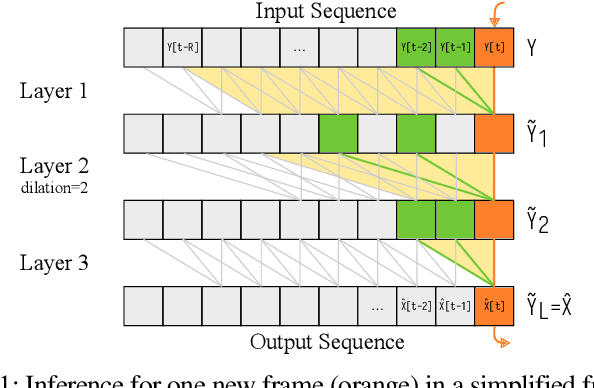
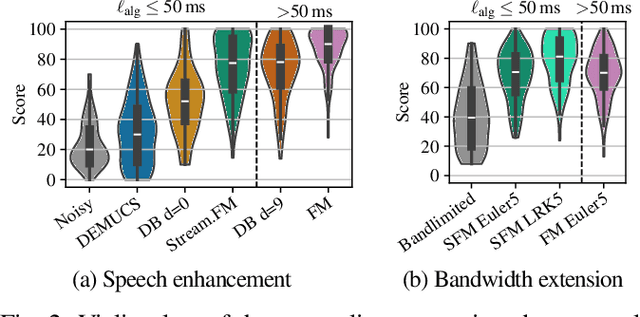
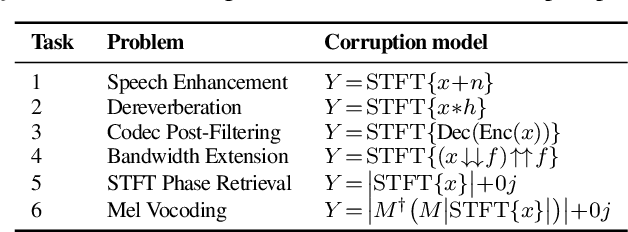
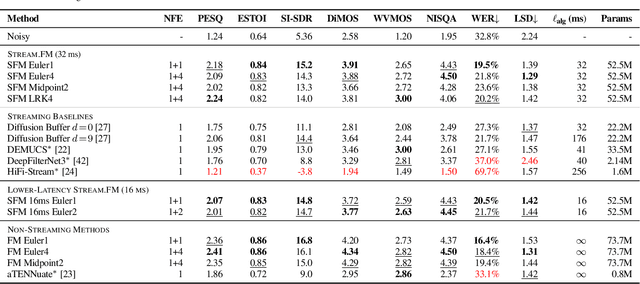
Diffusion-based generative models have greatly impacted the speech processing field in recent years, exhibiting high speech naturalness and spawning a new research direction. Their application in real-time communication is, however, still lagging behind due to their computation-heavy nature involving multiple calls of large DNNs. Here, we present Stream.FM, a frame-causal flow-based generative model with an algorithmic latency of 32 milliseconds (ms) and a total latency of 48 ms, paving the way for generative speech processing in real-time communication. We propose a buffered streaming inference scheme and an optimized DNN architecture, show how learned few-step numerical solvers can boost output quality at a fixed compute budget, explore model weight compression to find favorable points along a compute/quality tradeoff, and contribute a model variant with 24 ms total latency for the speech enhancement task. Our work looks beyond theoretical latencies, showing that high-quality streaming generative speech processing can be realized on consumer GPUs available today. Stream.FM can solve a variety of speech processing tasks in a streaming fashion: speech enhancement, dereverberation, codec post-filtering, bandwidth extension, STFT phase retrieval, and Mel vocoding. As we verify through comprehensive evaluations and a MUSHRA listening test, Stream.FM establishes a state-of-the-art for generative streaming speech restoration, exhibits only a reasonable reduction in quality compared to a non-streaming variant, and outperforms our recent work (Diffusion Buffer) on generative streaming speech enhancement while operating at a lower latency.

SOS: Segment Object System for Open-World Instance Segmentation With Object Priors
Sep 22, 2024


We propose an approach for Open-World Instance Segmentation (OWIS), a task that aims to segment arbitrary unknown objects in images by generalizing from a limited set of annotated object classes during training. Our Segment Object System (SOS) explicitly addresses the generalization ability and the low precision of state-of-the-art systems, which often generate background detections. To this end, we generate high-quality pseudo annotations based on the foundation model SAM. We thoroughly study various object priors to generate prompts for SAM, explicitly focusing the foundation model on objects. The strongest object priors were obtained by self-attention maps from self-supervised Vision Transformers, which we utilize for prompting SAM. Finally, the post-processed segments from SAM are used as pseudo annotations to train a standard instance segmentation system. Our approach shows strong generalization capabilities on COCO, LVIS, and ADE20k datasets and improves on the precision by up to 81.6% compared to the state-of-the-art. Source code is available at: https://github.com/chwilms/SOS