 Add to Chrome
 Add to Firefox
 Add to Edge
Probabilistic Prediction of Neural Dynamics via Autoregressive Flow Matching
Apr 13, 2026
Forecasting neural activity in response to naturalistic stimuli remains a key challenge for understanding brain dynamics and enabling downstream neurotechnological applications. Here, we introduce a generative forecasting framework for modeling neural dynamics based on autoregressive flow matching (AFM). Building on recent advances in transport-based generative modeling, our approach probabilistically predicts neural responses at scale from multimodal sensory input. Specifically, we learn the conditional distribution of future neural activity given past neural dynamics and concurrent sensory input, explicitly modeling neural activity as a temporally evolving process in which future states depend on recent neural history. We evaluate our framework on the Algonauts project 2025 challenge functional magnetic resonance imaging dataset using subject-specific models. AFM significantly outperforms both a non-autoregressive flow-matching baseline and the official challenge general linear model baseline in predicting short-term parcel-wise blood oxygenation level-dependent (BOLD) activity, demonstrating improved generalization and widespread cortical prediction performance. Ablation analyses show that access to past BOLD dynamics is a dominant driver of performance, while autoregressive factorization yields consistent, modest gains under short-horizon, context-rich conditions. Together, these findings position autoregressive flow-based generative modeling as an effective approach for short-term probabilistic forecasting of neural dynamics with promising applications in closed-loop neurotechnology.

Biologically Inspired Semantic Lateral Connectivity for Convolutional Neural Networks
May 20, 2021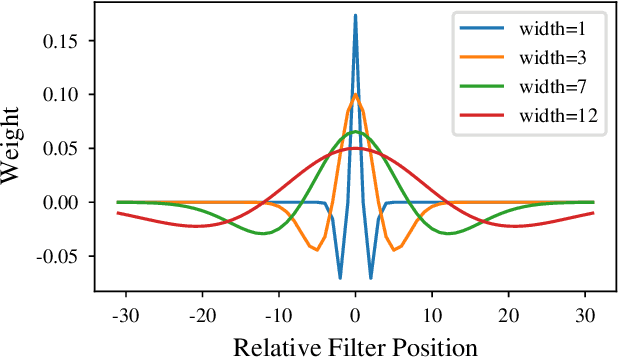
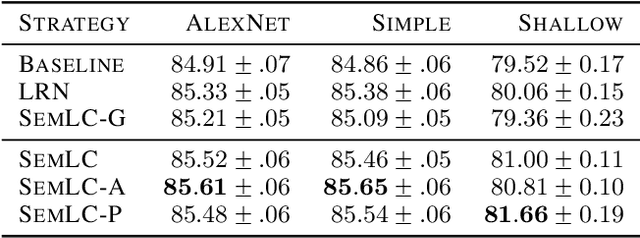
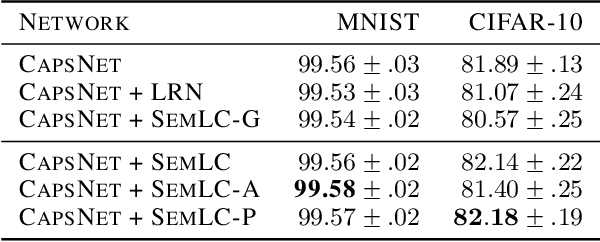
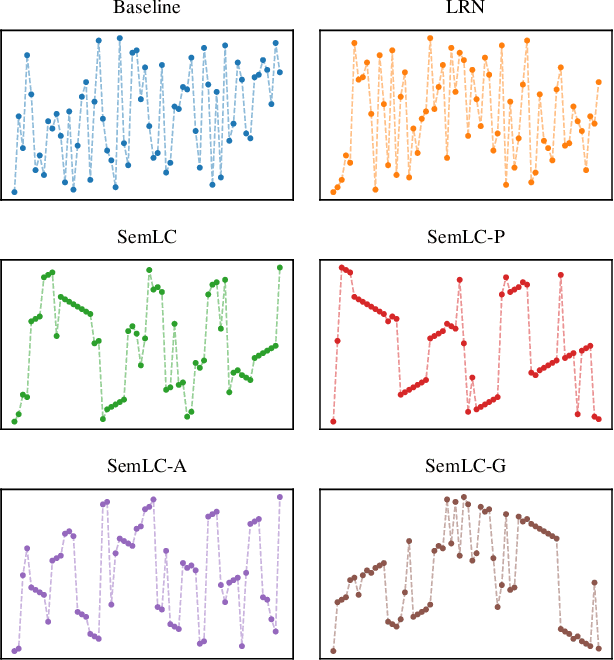
Lateral connections play an important role for sensory processing in visual cortex by supporting discriminable neuronal responses even to highly similar features. In the present work, we show that establishing a biologically inspired Mexican hat lateral connectivity profile along the filter domain can significantly improve the classification accuracy of a variety of lightweight convolutional neural networks without the addition of trainable network parameters. Moreover, we demonstrate that it is possible to analytically determine the stationary distribution of modulated filter activations and thereby avoid using recurrence for modeling temporal dynamics. We furthermore reveal that the Mexican hat connectivity profile has the effect of ordering filters in a sequence resembling the topographic organization of feature selectivity in early visual cortex. In an ordered filter sequence, this profile then sharpens the filters' tuning curves.
Contextual Encoder-Decoder Network for Visual Saliency Prediction
Feb 18, 2019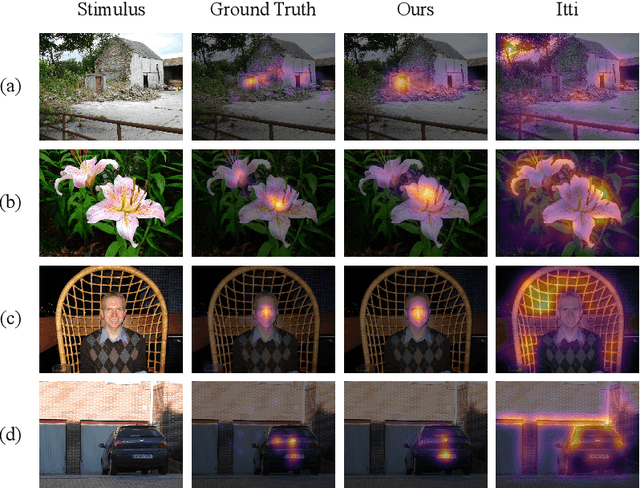
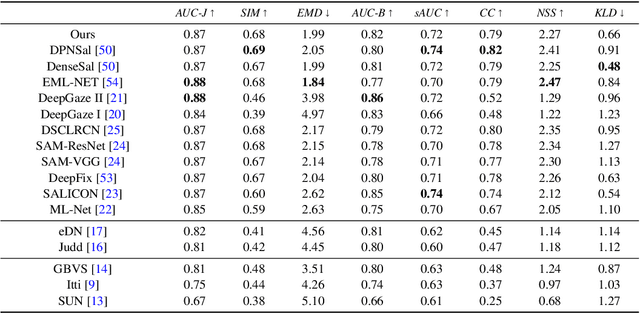
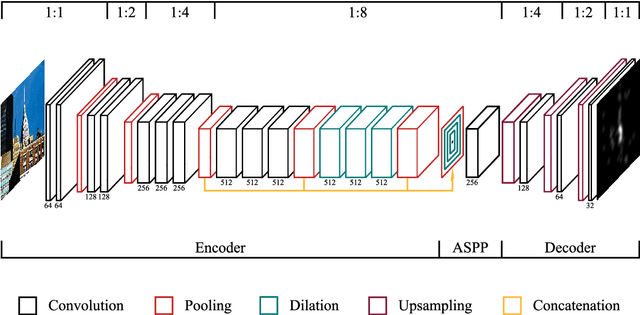
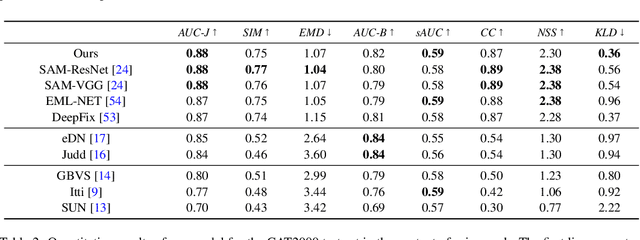
Predicting salient regions in natural images requires the detection of objects that are present in a scene. To develop robust representations for this challenging task, high-level visual features at multiple spatial scales must be extracted and augmented with contextual information. However, existing models aimed at explaining human fixation maps do not incorporate such a mechanism explicitly. Here we propose an approach based on a convolutional neural network pre-trained on a large-scale image classification task. The architecture forms an encoder-decoder structure and includes a module with multiple convolutional layers at different dilation rates to capture multi-scale features in parallel. Moreover, we combine the resulting representations with global scene information for accurately predicting visual saliency. Our model achieves competitive results on two public saliency benchmarks and we demonstrate the effectiveness of the suggested approach on selected examples. The network is based on a lightweight image classification backbone and hence presents a suitable choice for applications with limited computational resources to estimate human fixations across complex natural scenes.