 Add to Chrome
 Add to Firefox
 Add to Edge
Data-Driven Estimation of the interfacial Dzyaloshinskii-Moriya Interaction with Machine Learning
Mar 28, 2026
Machine learning offers powerful tools to support experimental techniques, particularly for extracting latent features from large datasets. In magnetic materials, accurately estimating the interfacial Dzyaloshinskii-Moriya interaction strength remains challenging, as existing experimental methods often rely on indirect measurements and can yield inconsistent results across techniques. Because this interaction is often extracted experimentally from bubble domain expansion, we investigate whether bubble textures alone contain sufficient and reliable information for data driven DMI inference. We therefore develop a compact convolutional neural network trained on a comprehensive micromagnetic dataset of magnetic bubble domains designed to emulate magneto optical Kerr effect imaging, including structural non uniformity, additive noise, and image pixelation. The proposed network demonstrates strong robustness against sample inhomogeneities, noise, and reduced spatial resolution. Furthermore, it exhibits reliable generalization by accurately predicting DMI values outside the trained interval. These results support the use of machine learning as a fast and quantitative tool to characterize magnetic textures with interfacial DMI.

Automatic crack detection and classification by exploiting statistical event descriptors for Deep Learning
Jul 24, 2019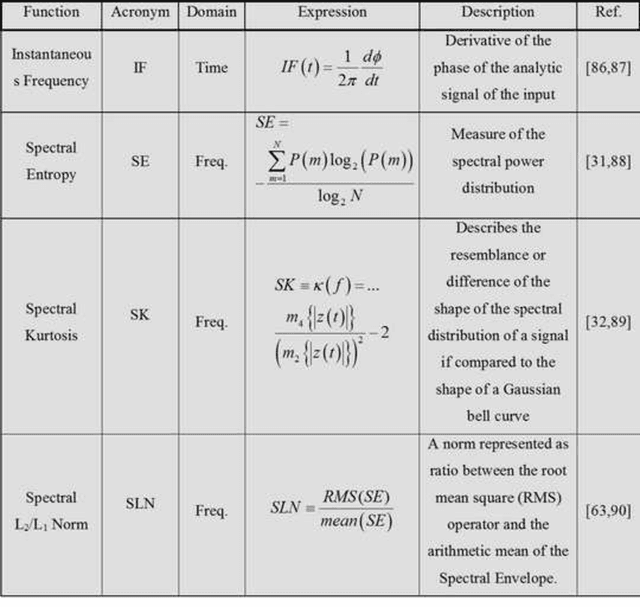
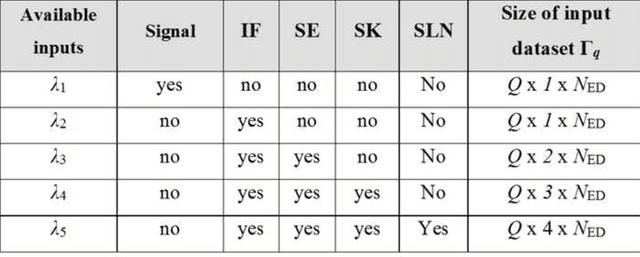
In modern building infrastructures, the chance to devise adaptive and unsupervised data-driven health monitoring systems is gaining in popularity due to the large availability of data from low-cost sensors with internetworking capabilities. In particular, deep learning provides the tools for processing and analyzing this unprecedented amount of data efficiently. The main purpose of this paper is to combine the recent advances of Deep Learning (DL) and statistical analysis on structural health monitoring (SHM) to develop an accurate classification tool able to discriminate among different acoustic emission events (cracks) by means of the identification of tensile, shear and mixed modes. The applications of DL in SHM systems is described by using the concept of Bidirectional Long Short Term Memory. We investigated on effective event descriptors to capture the unique characteristics from the different types of modes. Among them, Spectral Kurtosis and Spectral L2/L1 Norm exhibit distinctive behavior and effectively contributed to the learning process. This classification will contribute to unambiguously detect incipient damages, which is advantageous to realize predictive maintenance. Tests on experimental results confirm that this method achieves accurate classification (92%) capabilities of crack events and can impact on the design of future SHM technologies.