 Add to Chrome
 Add to Firefox
 Add to Edge
Improving Evaluation of Recombination-based Cartesian Genetic Programming
May 27, 2026
Cartesian Genetic Programming has traditionally been using mutation as its main and often sole genetic operator to drive evolutionary search. Despite advancements in recent years, recombinationbased approaches have long been avoided, due to apparent lack of performance gains. This study examines two recently suggested recombination-based operators, subgraph crossover and discrete phenotypic recombination on SRBench, a benchmarking platform for symbolic regression. Using the implementations provided in the TinyverseGP framework, we perform hyperparameter optimisation of the respective representations with these two operators. Our work demonstrates that hyperparameter optimisation can lead to improvements in performance for recombination-based Cartesian Genetic Programming.
* Accepted for presentation as workshop paper in the graph-based genetic programming workshop (GGP) at the Genetic and Evolutionary Computation Conference (GECCO). To appear in the GECCO'26 conference companion. GECCO'26 will be held July 13-17, 2026 in San Jose, Costa Rica

TinyverseGP: Towards a Modular Cross-domain Benchmarking Framework for Genetic Programming
Apr 14, 2025Over the years, genetic programming (GP) has evolved, with many proposed variations, especially in how they represent a solution. Being essentially a program synthesis algorithm, it is capable of tackling multiple problem domains. Current benchmarking initiatives are fragmented, as the different representations are not compared with each other and their performance is not measured across the different domains. In this work, we propose a unified framework, dubbed TinyverseGP (inspired by tinyGP), which provides support to multiple representations and problem domains, including symbolic regression, logic synthesis and policy search.
* Accepted for presentation as a poster at the Genetic and Evolutionary Computation Conference (GECCO) and will appear in the GECCO'25 companion. GECCO'25 will be held July 14-18, 2025 in M\'alaga, Spain
Q(D)O-ES: Population-based Quality (Diversity) Optimisation for Post Hoc Ensemble Selection in AutoML
Aug 02, 2023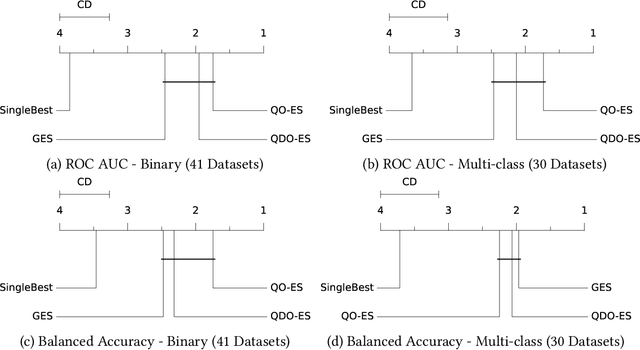
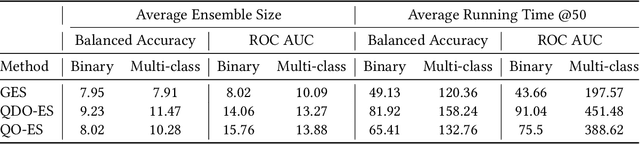

Automated machine learning (AutoML) systems commonly ensemble models post hoc to improve predictive performance, typically via greedy ensemble selection (GES). However, we believe that GES may not always be optimal, as it performs a simple deterministic greedy search. In this work, we introduce two novel population-based ensemble selection methods, QO-ES and QDO-ES, and compare them to GES. While QO-ES optimises solely for predictive performance, QDO-ES also considers the diversity of ensembles within the population, maintaining a diverse set of well-performing ensembles during optimisation based on ideas of quality diversity optimisation. The methods are evaluated using 71 classification datasets from the AutoML benchmark, demonstrating that QO-ES and QDO-ES often outrank GES, albeit only statistically significant on validation data. Our results further suggest that diversity can be beneficial for post hoc ensembling but also increases the risk of overfitting.