 Add to Chrome
 Add to Firefox
 Add to Edge
Planetary Exploration 3.0: A Roadmap for Software-Defined, Radically Adaptive Space Systems
Apr 22, 2026
The surface and subsurface of worlds beyond Mars remain largely unexplored. Yet these worlds hold keys to fundamental questions in planetary science - from potentially habitable subsurface oceans on icy moons to ancient records preserved in Kuiper Belt objects. NASA's success in Mars exploration was achieved through incrementalism: 22 progressively sophisticated missions over decades. This paradigm, which we call Planetary Exploration 2.0 (PE 2.0), is untenable for the outer Solar System, where cruise times of a decade or more make iterative missions infeasible. We propose Planetary Exploration 3.0 (PE 3.0): a paradigm in which unvisited worlds are explored by a single or a few missions with radically adaptive space systems. A PE 3.0 mission conducts both initial exploratory science and follow-on hypothesis-driven science based on its own in situ data returns, evolving spacecraft capabilities to work resiliently in previously unseen environments. The key enabler of PE 3.0 is software-defined space systems (SDSSs) - systems that can adapt their functions at all levels through software updates. This paper presents findings from a Keck Institute for Space Studies (KISS) workshop on PE 3.0, covering: (1) PE 3.0 systems engineering including science definition, architecture, design methods, and verification & validation; (2) software-defined space system technologies including reconfigurable hardware, multi-functionality, and modularity; (3) onboard intelligence including autonomous science, navigation, controls, and embodied AI; and (4) three PE 3.0 mission concepts: a Neptune/Triton smart flyby, an ocean world explorer, and an Oort cloud reconnaissance mission.

The POLAR Traverse Dataset: A Dataset of Stereo Camera Images Simulating Traverses across Lunar Polar Terrain under Extreme Lighting Conditions
Mar 18, 2024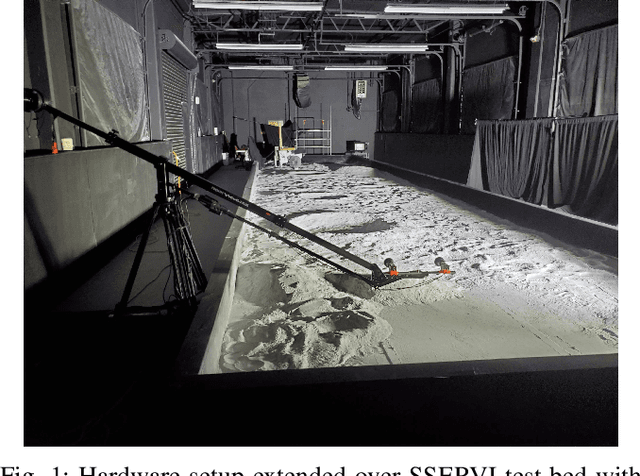
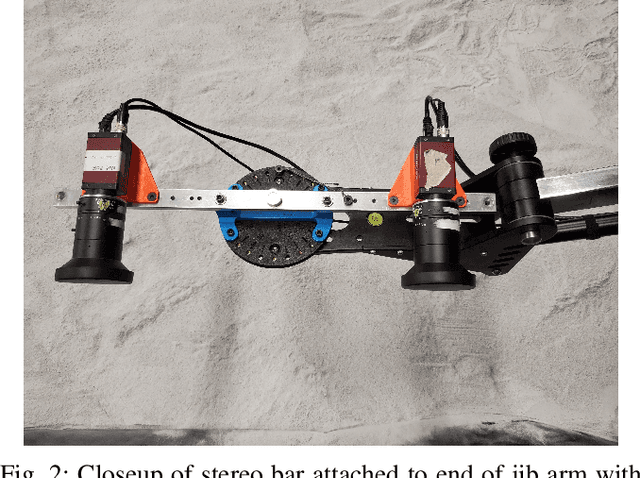
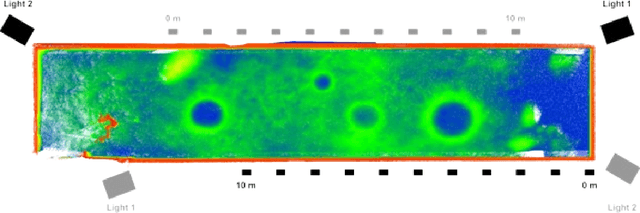
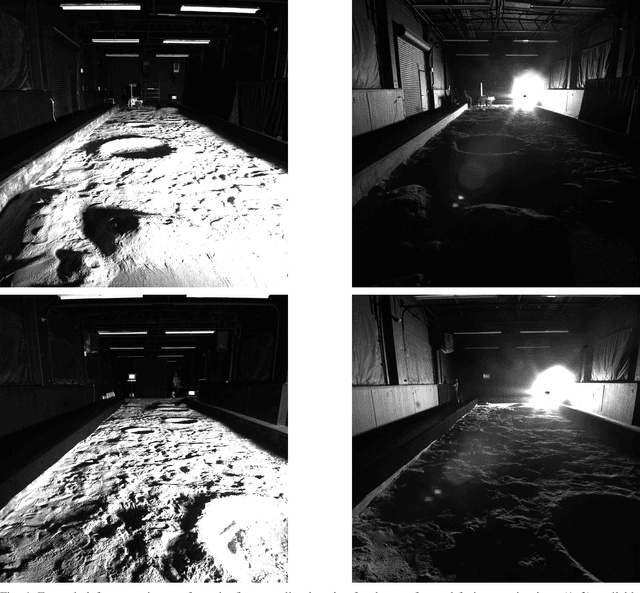
We present the POLAR Traverse Dataset: a dataset of high-fidelity stereo pair images of lunar-like terrain under polar lighting conditions designed to simulate a straight-line traverse. Images from individual traverses with different camera heights and pitches were recorded at 1 m intervals by moving a suspended stereo bar across a test bed filled with regolith simulant and shaped to mimic lunar south polar terrain. Ground truth geometry and camera position information was also recorded. This dataset is intended for developing and testing software algorithms that rely on stereo or monocular camera images, such as visual odometry, for use in the lunar polar environment, as well as to provide insight into the expected lighting conditions in lunar polar regions.