 Add to Chrome
 Add to Firefox
 Add to Edge
Infrequent Child-Directed Speech Is Bursty and May Draw Infant Vocalizations
Mar 25, 2026
Children in many parts of the world hear relatively little speech directed to them, yet still reach major language development milestones. What differs about the speech input that infants learn from when directed input is rare? Using longform, infant-centered audio recordings taken in rural Bolivia and the urban U.S., we examined temporal patterns of infants' speech input and their pre-linguistic vocal behavior. We find that child-directed speech in Bolivia, though less frequent, was just as temporally clustered as speech input in the U.S, arriving in concentrated bursts rather than spread across the day. In both communities, infants were most likely to produce speech-like vocalizations during periods of speech directed to them, with the probability of infants' speech-like vocalizations during target child-directed speech nearly double that during silence. In Bolivia, infants' speech-like vocalizations were also more likely to occur during bouts of directed speech from older children than from adults. Together, these findings suggest that the developmental impact of child-directed speech may depend not only on quantity, but on temporal concentration and source, with older children serving as an important source of input in some communities, including where adult speech to infants is less frequent.

Employing self-supervised learning models for cross-linguistic child speech maturity classification
Jun 10, 2025
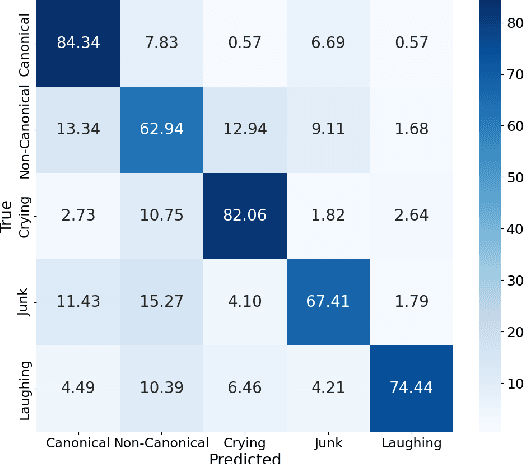
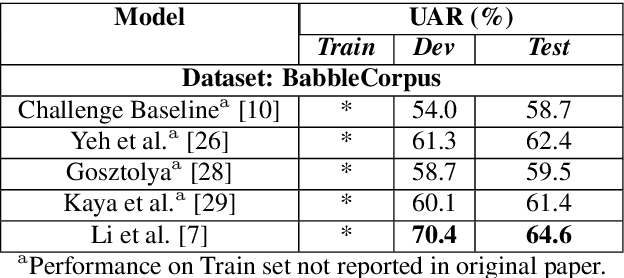
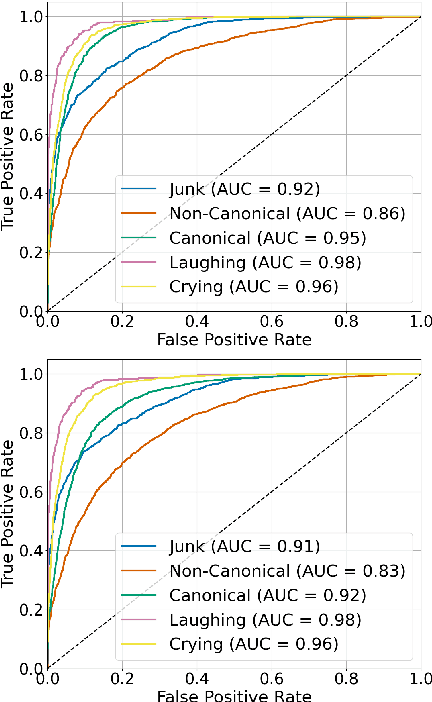
Speech technology systems struggle with many downstream tasks for child speech due to small training corpora and the difficulties that child speech pose. We apply a novel dataset, SpeechMaturity, to state-of-the-art transformer models to address a fundamental classification task: identifying child vocalizations. Unlike previous corpora, our dataset captures maximally ecologically-valid child vocalizations across an unprecedented sample, comprising children acquiring 25+ languages in the U.S., Bolivia, Vanuatu, Papua New Guinea, Solomon Islands, and France. The dataset contains 242,004 labeled vocalizations, magnitudes larger than previous work. Models were trained to distinguish between cry, laughter, mature (consonant+vowel), and immature speech (just consonant or vowel). Models trained on the dataset outperform state-of-the-art models trained on previous datasets, achieved classification accuracy comparable to humans, and were robust across rural and urban settings.