 Add to Chrome
 Add to Firefox
 Add to Edge
From Layers to Submodules: Rethinking Granularity in Replacement-Based LLM Compression
Jun 01, 2026
Post-training compression of Large Language Models (LLMs) removes entire architectural components, either deleting them or replacing them with fitted modules. Existing replacement-based methods share two design constraints: full-layer granularity and contiguous selection. We argue that this is overly restrictive: in fact, redundancy in pretrained transformers is not confined to contiguous regions, nor does it evenly distribute between Attention and FeedForward outputs, implying that different strategies best approximate different submodule types and that removable components need not cluster within contiguous depth ranges. Based on this intuition, we introduce SubFit (Submodule-level Fitted residual replacement), which compresses LLMs at the submodule level: Attention and FeedForward submodules are selected non-contiguously, and each receives its own lightweight fitted residual bypass. SubFit operates post-training and requires only calibration data. Across ten LLMs (five base, five instruction-tuned), five sparsity levels from 12.5% to 37.5%, and four replacement-based baselines, SubFit achieves the best aggregate perplexity-accuracy trade-off across the evaluated sparsity levels, with larger gains under aggressive compression. At 25% sparsity, it retains 84.6% of dense downstream accuracy and incurs 2.42x perplexity degradation, against 81.6% and 4.34x for the strongest baselines, while delivering measurable inference speedup and KV-cache savings. Code is available at https://github.com/eliacunegatti/SubFit.

Hallucination as an Anomaly: Dynamic Intervention via Probabilistic Circuits
May 07, 2026One of the most critical challenges in Large Language Models is their tendency to hallucinate, i.e., produce factually incorrect responses. Existing approaches show promising results in terms of hallucination correction, but still suffer from a main limitation: they apply corrections indiscriminately to every token, corrupting also the originally correct generations. To overcome this drawback, we propose PCNET, a Probabilistic Circuit trained as a tractable density estimator over the LLM residual stream. The method detects hallucinations as geometric anomalies on the factual manifold, which is done via exact Negative Log-Likelihood computation, hence without the need for sampling, external verifiers, or weight modifications, as in existing techniques. To demonstrate its effectiveness, we exploit PCNET as a dynamic gate that distinguishes hallucinated from factual hidden states at each decoding step. This triggers our second main contribution, PC-LDCD (Probabilistic Circuit Latent Density Contrastive Decoding), only when the latent geometry deviates from factual regions, while leaving correct generations untouched. Across four LLMs, ranging from 1B to 8B models, and four benchmarks covering conversational reasoning, knowledge-intensive QA, reading comprehension, and truthfulness, PCNET achieves near-perfect hallucination detection across CoQA, SQuAD v2.0, and TriviaQA, with AUROC reaching up to 99%. Moreover, PC-LDCD obtains the highest True+Info, MC2, and MC3 scores on TruthfulQA in three out of four models, in comparison with state-of-the-art baselines, while reducing the mean corruption rate to 53.7% and achieving a preservation rate of 79.3%. Our proposed method is publicly available on GitHub.
A Benchmark Dataset for Graph Regression with Homogeneous and Multi-Relational Variants
May 29, 2025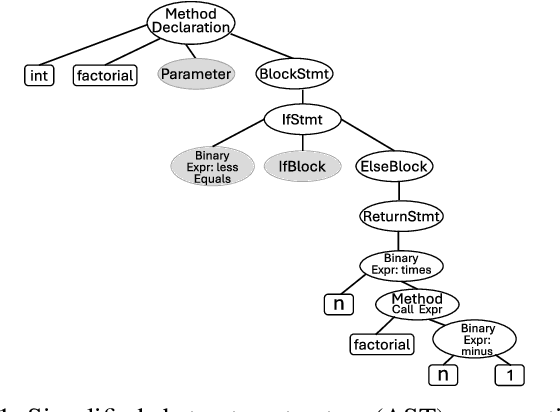

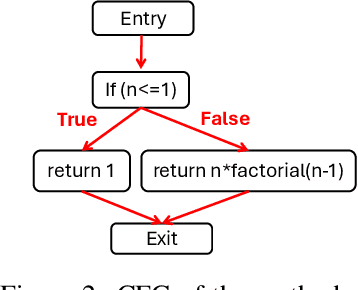
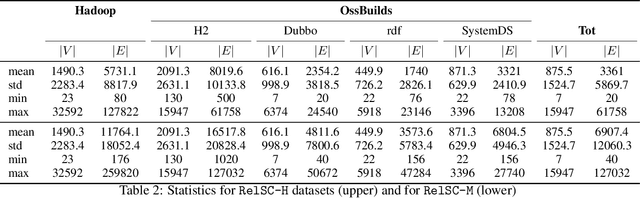
Graph-level regression underpins many real-world applications, yet public benchmarks remain heavily skewed toward molecular graphs and citation networks. This limited diversity hinders progress on models that must generalize across both homogeneous and heterogeneous graph structures. We introduce RelSC, a new graph-regression dataset built from program graphs that combine syntactic and semantic information extracted from source code. Each graph is labelled with the execution-time cost of the corresponding program, providing a continuous target variable that differs markedly from those found in existing benchmarks. RelSC is released in two complementary variants. RelSC-H supplies rich node features under a single (homogeneous) edge type, while RelSC-M preserves the original multi-relational structure, connecting nodes through multiple edge types that encode distinct semantic relationships. Together, these variants let researchers probe how representation choice influences model behaviour. We evaluate a diverse set of graph neural network architectures on both variants of RelSC. The results reveal consistent performance differences between the homogeneous and multi-relational settings, emphasising the importance of structural representation. These findings demonstrate RelSC's value as a challenging and versatile benchmark for advancing graph regression methods.