 Add to Chrome
 Add to Firefox
 Add to Edge
LogSieve: Task-Aware CI Log Reduction for Sustainable LLM-Based Analysis
Jan 28, 2026
Logs are essential for understanding Continuous Integration (CI) behavior, particularly for diagnosing build failures and performance regressions. Yet their growing volume and verbosity make both manual inspection and automated analysis increasingly costly, time-consuming, and environmentally costly. While prior work has explored log compression, anomaly detection, and LLM-based log analysis, most efforts target structured system logs rather than the unstructured, noisy, and verbose logs typical of CI workflows. We present LogSieve, a lightweight, RCA-aware and semantics-preserving log reduction technique that filters low-information lines while retaining content relevant to downstream reasoning. Evaluated on CI logs from 20 open-source Android projects using GitHub Actions, LogSieve achieves an average 42% reduction in lines and 40% reduction in tokens with minimal semantic loss. This pre-inference reduction lowers computational cost and can proportionally reduce energy use (and associated emissions) by decreasing the volume of data processed during LLM inference. Compared with structure-first baselines (LogZip and random-line removal), LogSieve preserves much higher semantic and categorical fidelity (Cosine = 0.93, GPTScore = 0.93, 80% exact-match accuracy). Embedding-based classifiers automate relevance detection with near-human accuracy (97%), enabling scalable and sustainable integration of semantics-aware filtering into CI workflows. LogSieve thus bridges log management and LLM reasoning, offering a practical path toward greener and more interpretable CI automation.

Gender inference: can chatGPT outperform common commercial tools?
Nov 24, 2023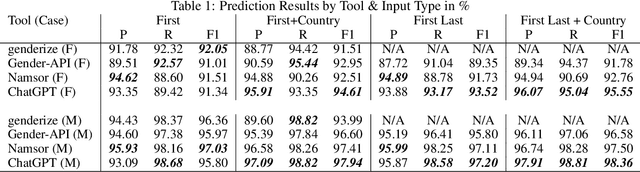
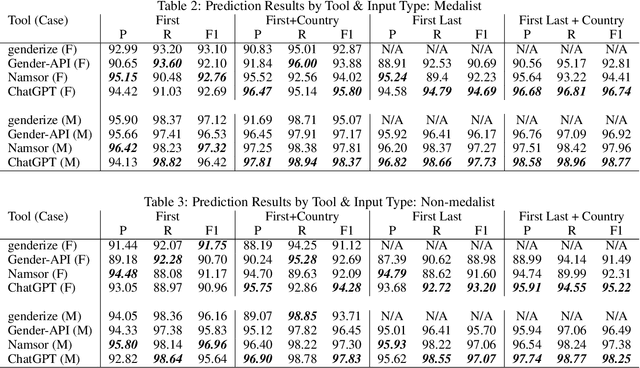
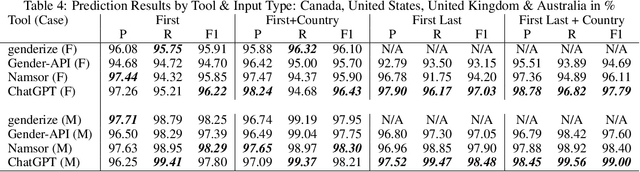
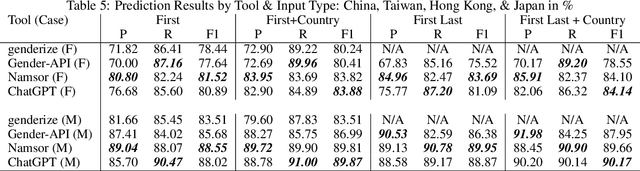
An increasing number of studies use gender information to understand phenomena such as gender bias, inequity in access and participation, or the impact of the Covid pandemic response. Unfortunately, most datasets do not include self-reported gender information, making it necessary for researchers to infer gender from other information, such as names or names and country information. An important limitation of these tools is that they fail to appropriately capture the fact that gender exists on a non-binary scale, however, it remains important to evaluate and compare how well these tools perform in a variety of contexts. In this paper, we compare the performance of a generative Artificial Intelligence (AI) tool ChatGPT with three commercially available list-based and machine learning-based gender inference tools (Namsor, Gender-API, and genderize.io) on a unique dataset. Specifically, we use a large Olympic athlete dataset and report how variations in the input (e.g., first name and first and last name, with and without country information) impact the accuracy of their predictions. We report results for the full set, as well as for the subsets: medal versus non-medal winners, athletes from the largest English-speaking countries, and athletes from East Asia. On these sets, we find that Namsor is the best traditional commercially available tool. However, ChatGPT performs at least as well as Namsor and often outperforms it, especially for the female sample when country and/or last name information is available. All tools perform better on medalists versus non-medalists and on names from English-speaking countries. Although not designed for this purpose, ChatGPT may be a cost-effective tool for gender prediction. In the future, it might even be possible for ChatGPT or other large scale language models to better identify self-reported gender rather than report gender on a binary scale.
* 14 pages, 8 tables