 Add to Chrome
 Add to Firefox
 Add to Edge
A Unified Mamba--MoE Surrogate for Closed-Loop Simulation and Measurement-Window Forecasting of Inverter Transients
Aug 15, 2026
This paper proposes a Mamba surrogate model with mixture-of-experts (MoE) routing to represent the transient dynamics of inverter-based resources. A Mamba surrogate model is a predictive machine learning model built on the Mamba architecture. MoE routing uses a router network to assign data-dependent weights to specialized subnetworks (experts). The resulting Mamba--MoE surrogate can perform two tasks: (i) closed-loop simulation and (ii) measurement-window forecasting of inverter transients. A single Mamba backbone with task conditioning and expert routing serves both tasks, replacing two separate specialists. Task-matched objectives fit each prediction form, and an adaptive conformal layer provides prediction intervals for both tasks. For the considered grid-following inverter, the unified surrogate model remains in the same low-error regime as a Mamba specialist pair while using 13% fewer parameters. The prediction intervals achieve 94--96% empirical mean marginal coverage across the two tasks. For transient dynamics---that is, beyond the vicinity of an equilibrium point---our surrogate model with MoE routing yields lower errors across all outputs in both tasks compared to a shared Mamba backbone without expert routing. A controller hardware-in-the-loop simulation validates our results and shows that adapting only the shared output head with limited measured data reduces held-out forecasting error.

Physics-Guided Dimension Reduction for Simulation-Free Operator Learning of Stiff Differential--Algebraic Systems
Apr 21, 2026Neural surrogates for stiff differential-algebraic equations (DAEs) face two key challenges: soft-constraint methods leave algebraic residuals that stiffness amplifies into large errors, while hard-constraint methods require trajectory data from computationally expensive stiff integrators. We introduce an extended Newton implicit layer that enforces algebraic consistency and quasi-steady-state reduction within a single differentiable solve. Given slow-state predictions from a physics-informed DeepONet, the proposed layer recovers fast and algebraic states, eliminates the stiffness-amplification pathway within each time window, and reduces the output dimension to the slow states alone. Gradients derived via the implicit function theorem capture a stiffness-scaled coupling term that is absent in penalty-based approaches. Cascaded implicit layers further extend the framework to multi-component systems with provable convergence. On a grid-forming inverter DAE (21 states), the proposed method (7 outputs, 1.42 percent error) significantly outperforms penalty methods (39.3 percent), standard Newton approaches (57.0 percent), and augmented Lagrangian or feedback linearization baselines, which fail to converge. Two independently trained models compose into a 44-state system without retraining, achieving 0.72 to 1.16 percent error with zero algebraic residual. Conformal prediction further provides 90 percent coverage in-distribution and enables automatic out-of-distribution detection.
Robust Dynamic Mode Decomposition
May 25, 2021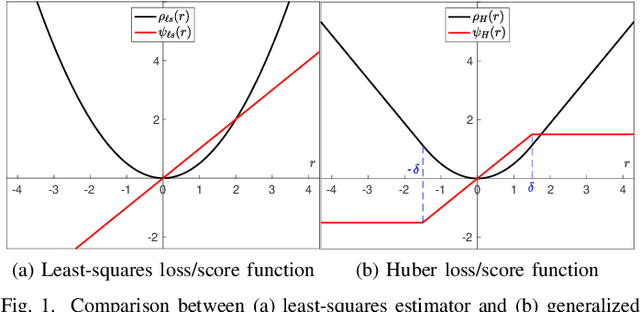
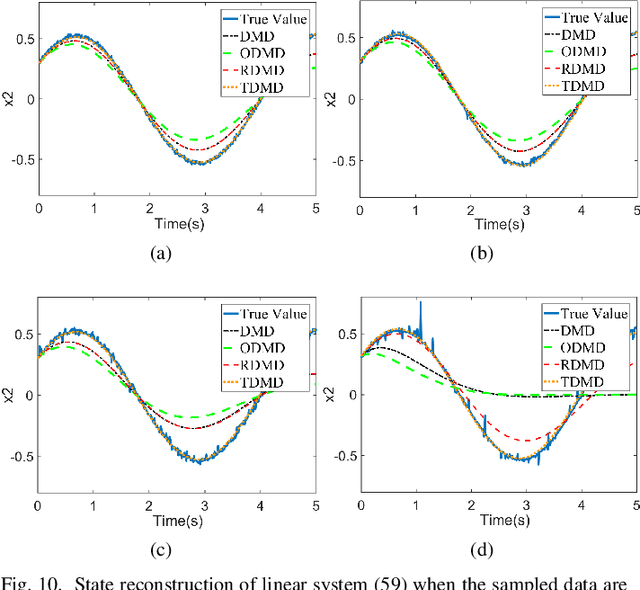
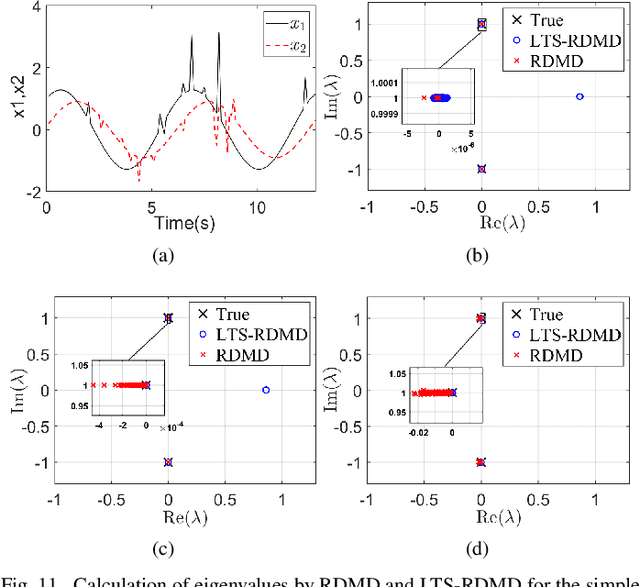
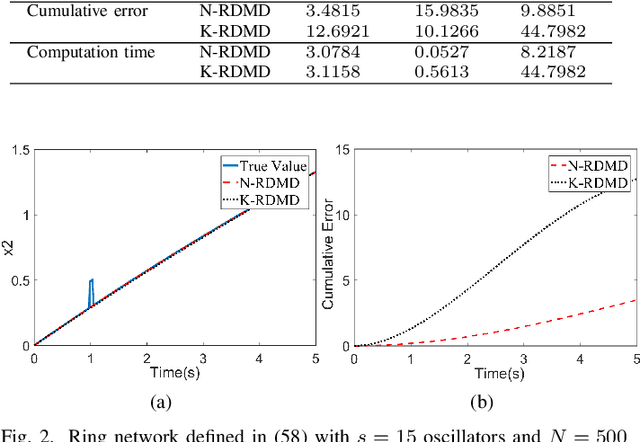
The paper develops a robust estimation method that makes the dynamic mode decomposition method resistant to outliers while being fast to compute and statistically efficient (i.e. accurate) at the Gaussian and non-Gaussian thick tailed distributions. The proposed robust dynamic mode decomposition (RDMD) is anchored on the theory of robust statistics. Specifically, it relies on the Schweppe-type Huber generalized maximum-likelihood estimator that minimizes a convex weighted Huber loss function, where the weights are calculated via projection statistics, thereby making the proposed RDMD robust to outliers, whether vertical outliers or bad leverage points. The performance of the proposed RDMD is demonstrated numerically using canonical models of dynamical systems. Simulation results reveal that it outperforms several other methods proposed in the literature.