 Add to Chrome
 Add to Firefox
 Add to Edge
Explainable-by-Design Audio Deepfake Detection via Wiener-Hopf Linear Prediction
Jul 14, 2026
The rapid advancement of synthetic speech generation methods has made audio deepfake detection a critical challenge in multimedia forensics. While recent approaches achieve high detection accuracy, they typically rely on black-box architectures that offer limited interpretability and high computational complexity. In this paper, we propose an explainable-by-design audio deepfake detection framework based on Wiener-Hopf linear prediction, processed by a lightweight 2D Convolutional Neural Network (CNN). This design enables a direct and transparent connection between classification outcomes and the acoustic properties of the signal. Experimental results on benchmark datasets demonstrate competitive detection performance while maintaining significantly lower computational complexity compared to state-of-the-art solutions. The interpretability analysis using Grad-CAM reveals that the classifier focuses on low-order predictor coefficients and on silence and transitional regions, suggesting that the Wiener-Hopf predictor captures reverberation characteristics and subtle statistical inconsistencies in synthetic speech. Finally, robustness experiments show that fine-tuning effectively recovers detection performance under common post-processing degradations, including additive noise, MP3 compression, and telephone filtering.

ForeSpeed: A real-world video dataset of CCTV cameras with different settings for vehicle speed estimation
Dec 22, 2025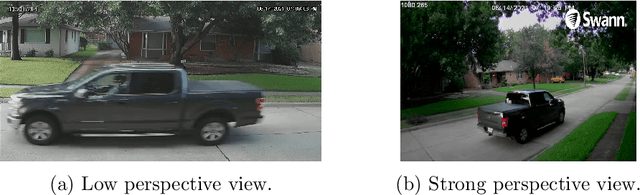
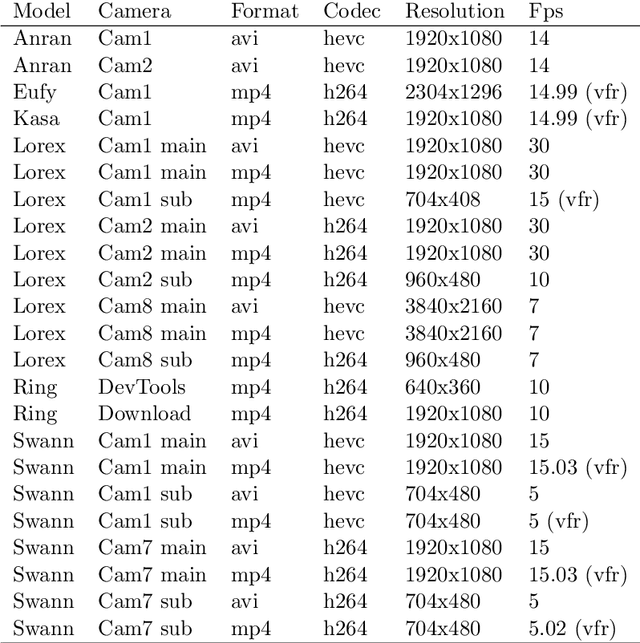
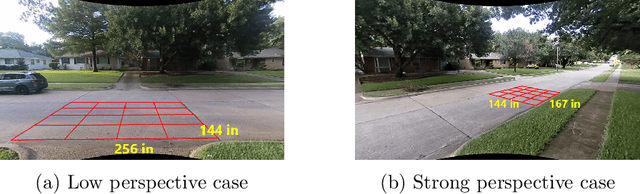
The need to estimate the speed of road vehicles has become increasingly important in the field of video forensics, particularly with the widespread deployment of CCTV cameras worldwide. Despite the development of various approaches, the accuracy of forensic speed estimation from real-world footage remains highly dependent on several factors, including camera specifications, acquisition methods, spatial and temporal resolution, compression methods, and scene perspective, which can significantly influence performance. In this paper, we introduce ForeSpeed, a comprehensive dataset designed to support the evaluation of speed estimation techniques in real-world scenarios using CCTV footage. The dataset includes recordings of a vehicle traveling at known speeds, captured by three digital and three analog cameras from two distinct perspectives. Real-world road metrics are provided to enable the restoration of the scene geometry. Videos were stored with multiple compression factors and settings, to simulate real world scenarios in which export procedures are not always performed according to forensic standards. Overall, ForeSpeed, includes a collection of 322 videos. As a case study, we employed the ForeSpeed dataset to benchmark a speed estimation algorithm available in a commercial product (Amped FIVE). Results demonstrate that while the method reliably estimates average speed across various conditions, its uncertainty range significantly increases when the scene involves strong perspective distortion. The ForeSpeed dataset is publicly available to the forensic community, with the aim of facilitating the evaluation of current methodologies and inspiring the development of new, robust solutions tailored to collision investigation and forensic incident analysis.
A leak in PRNU based source identification? Questioning fingerprint uniqueness
Sep 10, 2020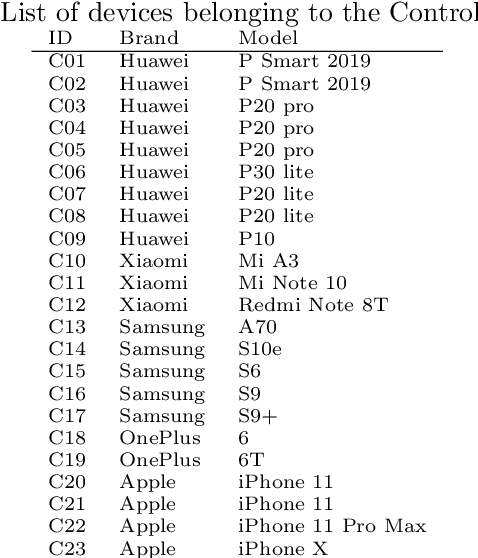
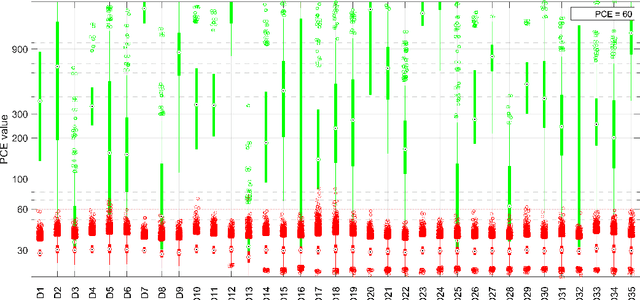
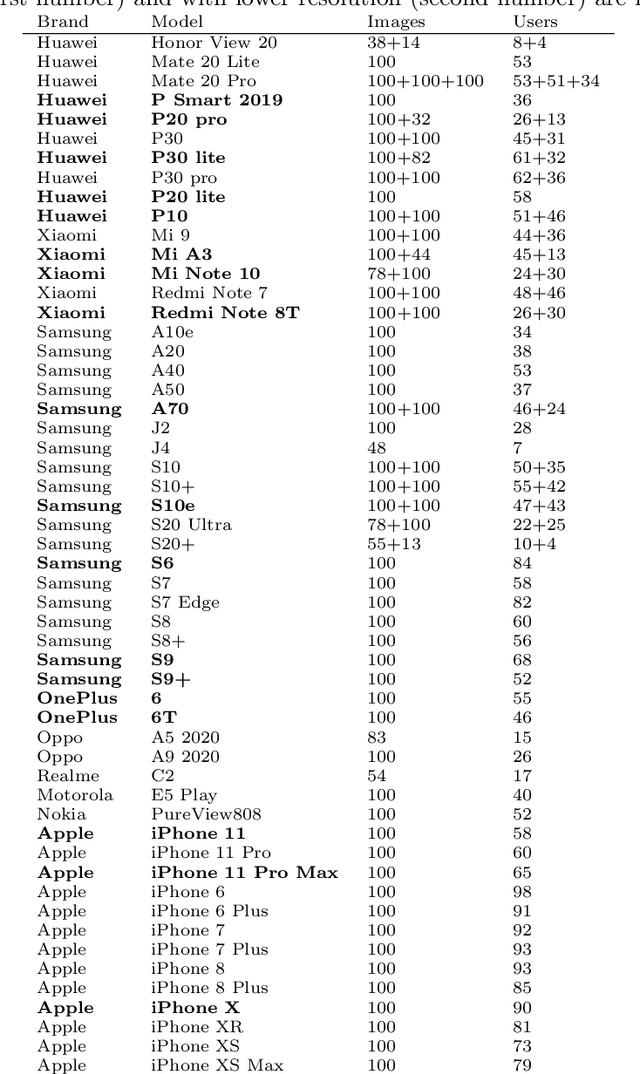
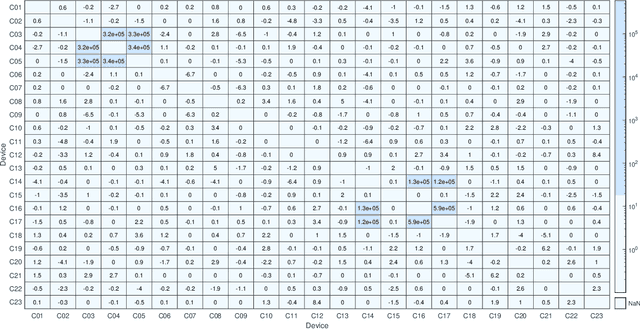
Photo Response Non Uniformity (PRNU) is considered the most effective trace for the image source attribution task. Its uniqueness ensures that the sensor pattern noises extracted from different cameras are strongly uncorrelated, even when they belong to the same camera model. However, with the advent of computational photography, most recent devices of the same model start exposing correlated patterns thus introducing the real chance of erroneous image source attribution. In this paper, after highlighting the issue under a controlled environment, we perform a large testing campaign on Flickr images to determine how widespread the issue is and which is the plausible cause. To this aim, we tested over $240000$ image pairs from $54$ recent smartphone models comprising the most relevant brands. Experiments show that many Samsung, Xiaomi and Huawei devices are strongly affected by this issue. Although the primary cause of high false alarm rates cannot be directly related to specific camera models, firmware nor image contents, it is evident that the effectiveness of PRNU-based source identification on the most recent devices must be reconsidered in light of these results. Therefore, this paper is to be intended as a call to action for the scientific community rather than a complete treatment of the subject.