 Add to Chrome
 Add to Firefox
 Add to Edge
Lynx: Progressive Speculative Quantization for accelerating KV Transfer in Long-Context Inference
Jul 02, 2026
Long-context inference is increasingly common in large language model (LLM) serving, driven by retrieval-augmented generation and agentic systems. In disaggregated inference, these workloads require transferring large Key-Value (KV) caches across the network, where decoding cannot begin until the transfer completes. Recent KV quantization techniques reduce data volume and alleviate this bottleneck, but existing schemes fail to achieve both low network-exposed latency and high inference accuracy. We challenge the assumption that the KV cache is an indivisible unit that must be fully received before use. We leverage the observation that different bits in the KV cache contribute unequally to attention computation and inference precision: the most significant bits capture the coarse structure of attention and the least significant bits refine precision. This property enables partial use of the KV cache during decoding. We present Lynx, a system that enables progressive, split-stream KV transfer by partitioning the KV cache into a high-priority Anchor stream carrying the most significant bits and a low-priority Residual stream carrying remaining precision. Decoding begins upon receipt of the Anchor stream and proceeds speculatively while the Residual stream is transferred concurrently, followed by verification that ensures equivalence to higher-precision decoding. Across multiple models and serving workloads, Lynx achieves Time-to-First-Token (TTFT) comparable to aggressive 4-bit KV quantization, while matching the accuracy of high-precision (BF16) inference, improving TTFT over standard 8-bit KV quantization by up to $1.43\times$ and improving accuracy over state-of-the-art by up to $5.1\%$.

Introducing k4.0s: a Model for Mixed-Criticality Container Orchestration in Industry 4.0
May 27, 2022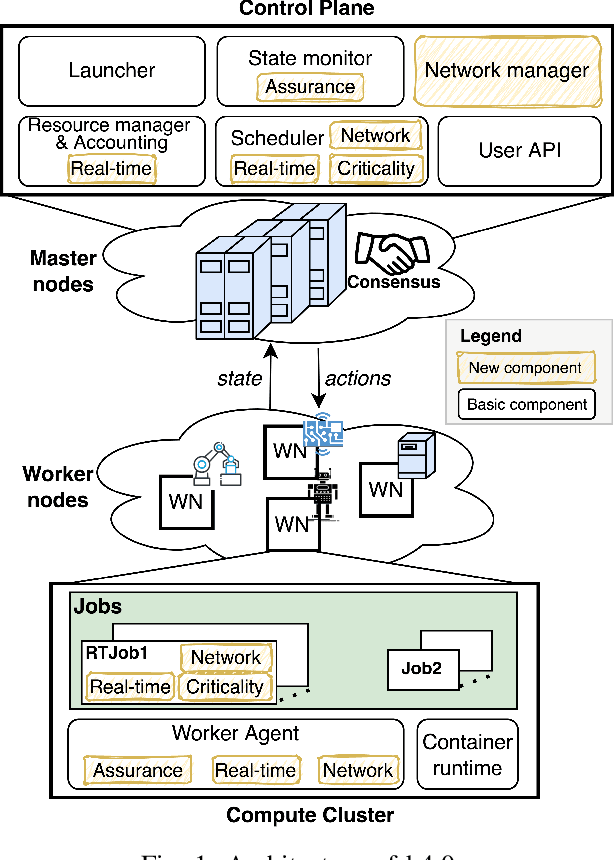
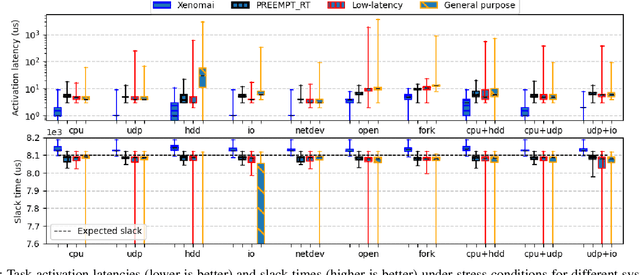
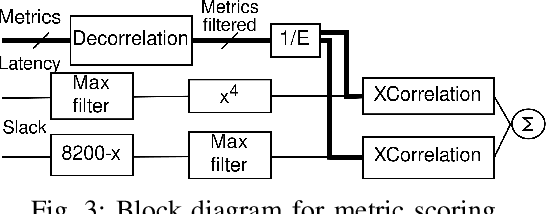
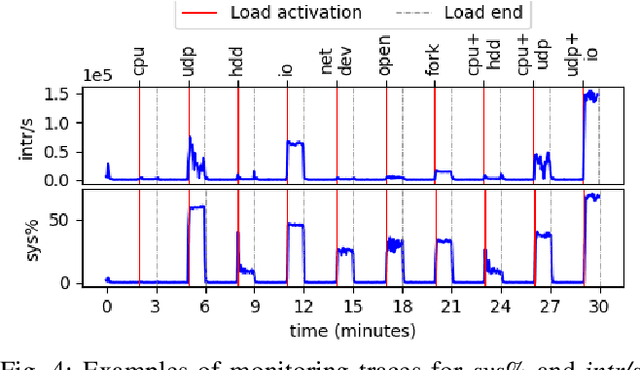
Time predictable edge cloud is seen as the answer for many arising needs in Industry 4.0 environments, since it is able to provide flexible, modular, and reconfigurable services with low latency and reduced costs. Orchestration systems are becoming the core component of clouds since they take decisions on the placement and lifecycle of software components. Current solutions start introducing real-time containers support for time predictability; however, these approaches lack of determinism as well as support for workloads requiring multiple levels of assurance/criticality. In this paper, we present k4.0s, an orchestration model for real-time and mixed-criticality environments, which includes timeliness, criticality and network requirements. The model leverages new abstractions for both node and jobs, e.g., node assurance, and requires novel monitoring strategies. We sketch an implementation of the proposal based on Kubernetes, and present an experimentation motivating the need for node assurance levels and adequate monitoring.