 Add to Chrome
 Add to Firefox
 Add to Edge
Old Tricks, New Models: How Simple Image Transformations Break Modern AI-based Content Moderation
Jul 30, 2026
While automated content-moderation systems have become essential for screening harmful content at scale, conventional task-specific classifiers often provide limited policy cov- erage and contextual understanding. Recently, commercial multimodal moderation APIs built on large foundation models have been introduced with the promise of providing broader and more capable safety filters. In this work, we analyze whether this shift also yields more robust image moderation. We conduct a large-scale black-box evaluation on three established commercial image-moderation services and compare their robustness. By evaluating seven simple, model-agnostic image transformations across multiple providers, datasets, harm categories, perceptual-similarity constraints, and transformation intensities, we find that: (1) all three commercial services can be bypassed using inexpensive image transformations that require no gradients, surrogate models, or knowledge of the target system; (2) even fixed transformations such as color inversion and grayscale conversion induce unsafe-to-safe decision changes while preserving content that remains recognizable to humans; (3) their robustness varies substantially across datasets and harm categories, with multimodal content and self-harm exhibiting pronounced vulnerabilities. This yields the conclusion that replacing conventional moderation classifiers with foundation-model-based APIs does not, by itself, provide a reliable security boundary. Such systems must be evaluated under realistic transformations and deployed as one component of a layered moderation pipeline rather than as standalone safety filters.

Your Attack Is Too DUMB: Formalizing Attacker Scenarios for Adversarial Transferability
Jun 27, 2023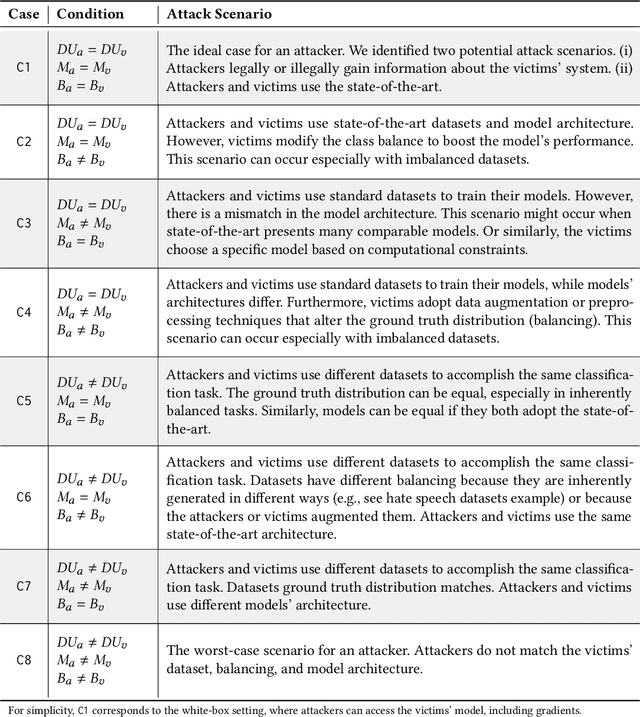
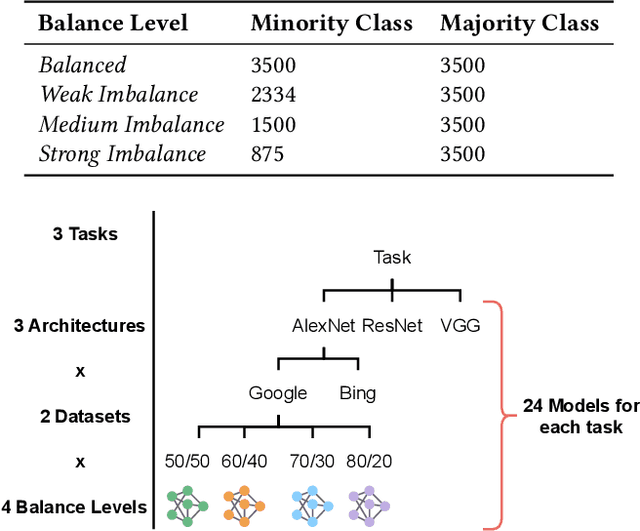
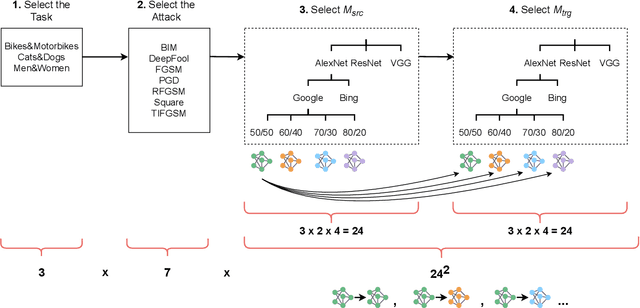

Evasion attacks are a threat to machine learning models, where adversaries attempt to affect classifiers by injecting malicious samples. An alarming side-effect of evasion attacks is their ability to transfer among different models: this property is called transferability. Therefore, an attacker can produce adversarial samples on a custom model (surrogate) to conduct the attack on a victim's organization later. Although literature widely discusses how adversaries can transfer their attacks, their experimental settings are limited and far from reality. For instance, many experiments consider both attacker and defender sharing the same dataset, balance level (i.e., how the ground truth is distributed), and model architecture. In this work, we propose the DUMB attacker model. This framework allows analyzing if evasion attacks fail to transfer when the training conditions of surrogate and victim models differ. DUMB considers the following conditions: Dataset soUrces, Model architecture, and the Balance of the ground truth. We then propose a novel testbed to evaluate many state-of-the-art evasion attacks with DUMB; the testbed consists of three computer vision tasks with two distinct datasets each, four types of balance levels, and three model architectures. Our analysis, which generated 13K tests over 14 distinct attacks, led to numerous novel findings in the scope of transferable attacks with surrogate models. In particular, mismatches between attackers and victims in terms of dataset source, balance levels, and model architecture lead to non-negligible loss of attack performance.