 Add to Chrome
 Add to Firefox
 Add to Edge
Textual Supervision Enhances Geospatial Representations in Vision-Language Models
Jun 05, 2026
Geospatial understanding is a critical yet underexplored dimension in the development of machine learning systems for tasks such as image geolocation and spatial reasoning. In this work, we analyze the geospatial representations acquired by three model families: vision-only architectures (e.g., ViT), vision-language models (e.g., CLIP), and large-scale multimodal foundation models (e.g., LLaVA, Qwen, and Gemma). By evaluating across image clusters, including people, landmarks, and everyday objects, grouped based on the degree of localizability, we reveal systematic gaps in spatial accuracy and show that textual supervision enhances the learning of geospatial representations. Our findings suggest the role of language as an effective complementary modality for encoding spatial context and multimodal learning as a key direction for advancing geospatial AI.

Examining the Behavior of LLM Architectures Within the Framework of Standardized National Exams in Brazil
Aug 09, 2024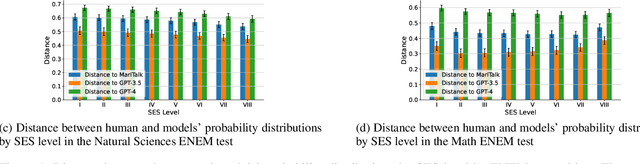
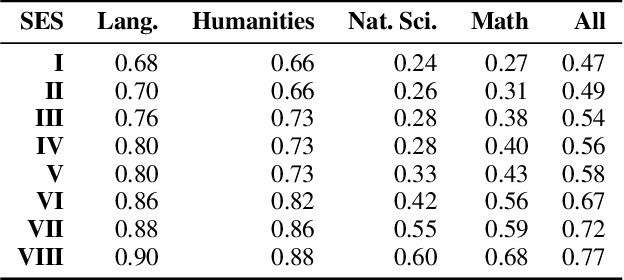
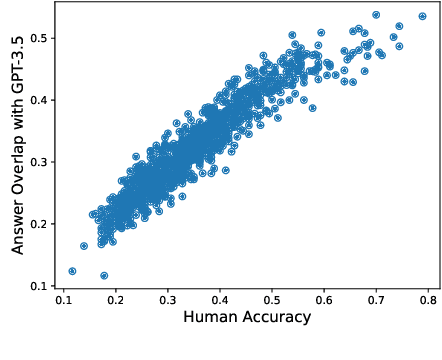
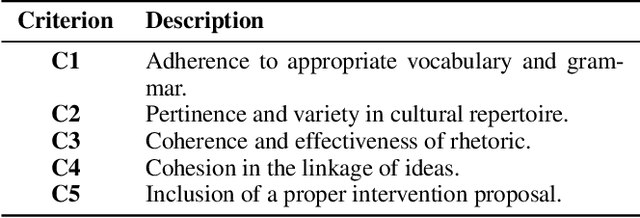
The Exame Nacional do Ensino M\'edio (ENEM) is a pivotal test for Brazilian students, required for admission to a significant number of universities in Brazil. The test consists of four objective high-school level tests on Math, Humanities, Natural Sciences and Languages, and one writing essay. Students' answers to the test and to the accompanying socioeconomic status questionnaire are made public every year (albeit anonymized) due to transparency policies from the Brazilian Government. In the context of large language models (LLMs), these data lend themselves nicely to comparing different groups of humans with AI, as we can have access to human and machine answer distributions. We leverage these characteristics of the ENEM dataset and compare GPT-3.5 and 4, and MariTalk, a model trained using Portuguese data, to humans, aiming to ascertain how their answers relate to real societal groups and what that may reveal about the model biases. We divide the human groups by using socioeconomic status (SES), and compare their answer distribution with LLMs for each question and for the essay. We find no significant biases when comparing LLM performance to humans on the multiple-choice Brazilian Portuguese tests, as the distance between model and human answers is mostly determined by the human accuracy. A similar conclusion is found by looking at the generated text as, when analyzing the essays, we observe that human and LLM essays differ in a few key factors, one being the choice of words where model essays were easily separable from human ones. The texts also differ syntactically, with LLM generated essays exhibiting, on average, smaller sentences and less thought units, among other differences. These results suggest that, for Brazilian Portuguese in the ENEM context, LLM outputs represent no group of humans, being significantly different from the answers from Brazilian students across all tests.