 Add to Chrome
 Add to Firefox
 Add to Edge
DARE: Aligning LLM Agents with the R Statistical Ecosystem via Distribution-Aware Retrieval
Mar 05, 2026
Large Language Model (LLM) agents can automate data-science workflows, but many rigorous statistical methods implemented in R remain underused because LLMs struggle with statistical knowledge and tool retrieval. Existing retrieval-augmented approaches focus on function-level semantics and ignore data distribution, producing suboptimal matches. We propose DARE (Distribution-Aware Retrieval Embedding), a lightweight, plug-and-play retrieval model that incorporates data distribution information into function representations for R package retrieval. Our main contributions are: (i) RPKB, a curated R Package Knowledge Base derived from 8,191 high-quality CRAN packages; (ii) DARE, an embedding model that fuses distributional features with function metadata to improve retrieval relevance; and (iii) RCodingAgent, an R-oriented LLM agent for reliable R code generation and a suite of statistical analysis tasks for systematically evaluating LLM agents in realistic analytical scenarios. Empirically, DARE achieves an NDCG at 10 of 93.47%, outperforming state-of-the-art open-source embedding models by up to 17% on package retrieval while using substantially fewer parameters. Integrating DARE into RCodingAgent yields significant gains on downstream analysis tasks. This work helps narrow the gap between LLM automation and the mature R statistical ecosystem.

DSAEval: Evaluating Data Science Agents on a Wide Range of Real-World Data Science Problems
Jan 20, 2026Recent LLM-based data agents aim to automate data science tasks ranging from data analysis to deep learning. However, the open-ended nature of real-world data science problems, which often span multiple taxonomies and lack standard answers, poses a significant challenge for evaluation. To address this, we introduce DSAEval, a benchmark comprising 641 real-world data science problems grounded in 285 diverse datasets, covering both structured and unstructured data (e.g., vision and text). DSAEval incorporates three distinctive features: (1) Multimodal Environment Perception, which enables agents to interpret observations from multiple modalities including text and vision; (2) Multi-Query Interactions, which mirror the iterative and cumulative nature of real-world data science projects; and (3) Multi-Dimensional Evaluation, which provides a holistic assessment across reasoning, code, and results. We systematically evaluate 11 advanced agentic LLMs using DSAEval. Our results show that Claude-Sonnet-4.5 achieves the strongest overall performance, GPT-5.2 is the most efficient, and MiMo-V2-Flash is the most cost-effective. We further demonstrate that multimodal perception consistently improves performance on vision-related tasks, with gains ranging from 2.04% to 11.30%. Overall, while current data science agents perform well on structured data and routine data anlysis workflows, substantial challenges remain in unstructured domains. Finally, we offer critical insights and outline future research directions to advance the development of data science agents.
A Survey on Large Language Model-based Agents for Statistics and Data Science
Dec 18, 2024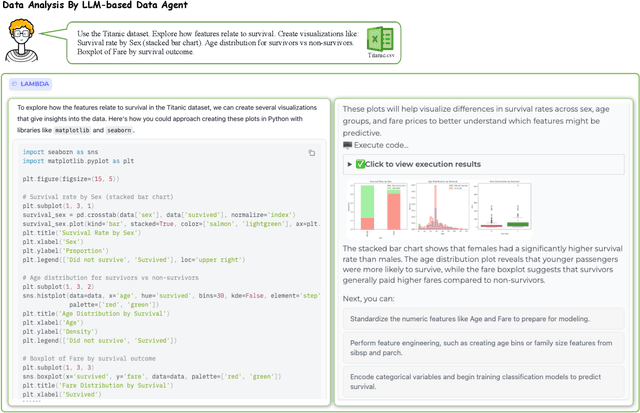
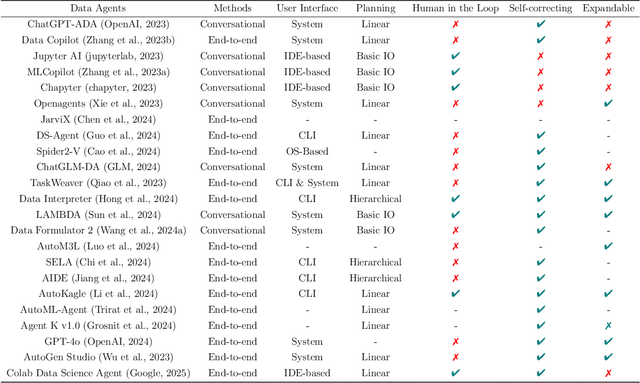
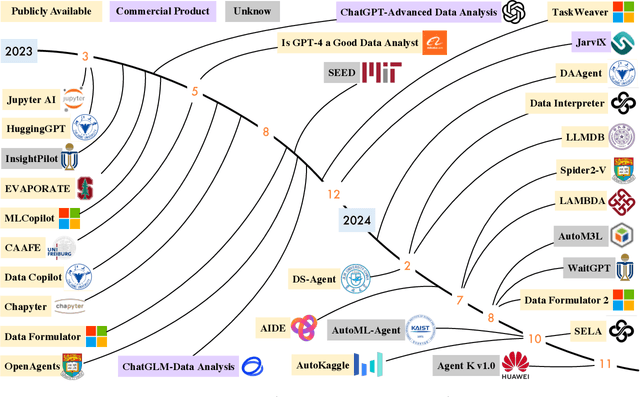
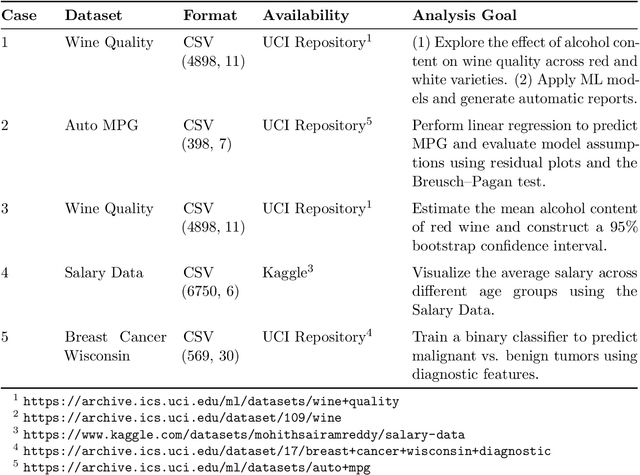
In recent years, data science agents powered by Large Language Models (LLMs), known as "data agents," have shown significant potential to transform the traditional data analysis paradigm. This survey provides an overview of the evolution, capabilities, and applications of LLM-based data agents, highlighting their role in simplifying complex data tasks and lowering the entry barrier for users without related expertise. We explore current trends in the design of LLM-based frameworks, detailing essential features such as planning, reasoning, reflection, multi-agent collaboration, user interface, knowledge integration, and system design, which enable agents to address data-centric problems with minimal human intervention. Furthermore, we analyze several case studies to demonstrate the practical applications of various data agents in real-world scenarios. Finally, we identify key challenges and propose future research directions to advance the development of data agents into intelligent statistical analysis software.
LAMBDA: A Large Model Based Data Agent
Jul 24, 2024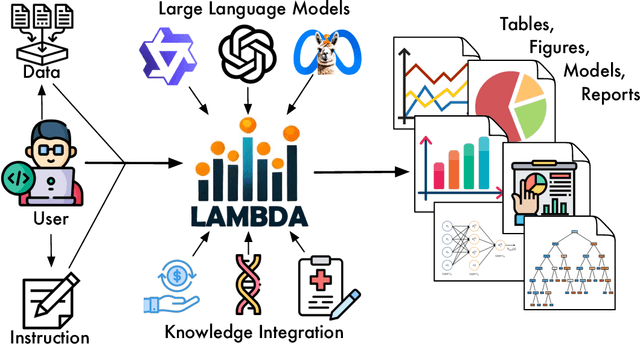

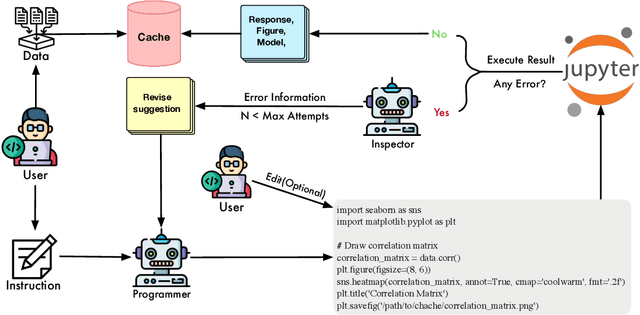
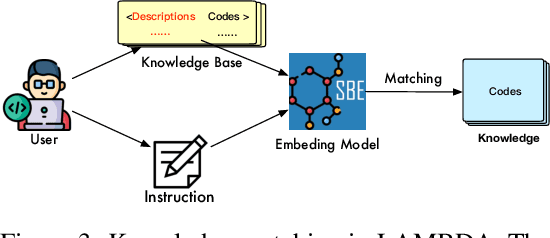
We introduce ``LAMBDA," a novel open-source, code-free multi-agent data analysis system that that harnesses the power of large models. LAMBDA is designed to address data analysis challenges in complex data-driven applications through the use of innovatively designed data agents that operate iteratively and generatively using natural language. At the core of LAMBDA are two key agent roles: the programmer and the inspector, which are engineered to work together seamlessly. Specifically, the programmer generates code based on the user's instructions and domain-specific knowledge, enhanced by advanced models. Meanwhile, the inspector debugs the code when necessary. To ensure robustness and handle adverse scenarios, LAMBDA features a user interface that allows direct user intervention in the operational loop. Additionally, LAMBDA can flexibly integrate external models and algorithms through our knowledge integration mechanism, catering to the needs of customized data analysis. LAMBDA has demonstrated strong performance on various machine learning datasets. It has the potential to enhance data science practice and analysis paradigm by seamlessly integrating human and artificial intelligence, making it more accessible, effective, and efficient for individuals from diverse backgrounds. The strong performance of LAMBDA in solving data science problems is demonstrated in several case studies, which are presented at \url{https://www.polyu.edu.hk/ama/cmfai/lambda.html}.
LlamaCare: A Large Medical Language Model for Enhancing Healthcare Knowledge Sharing
Jun 04, 2024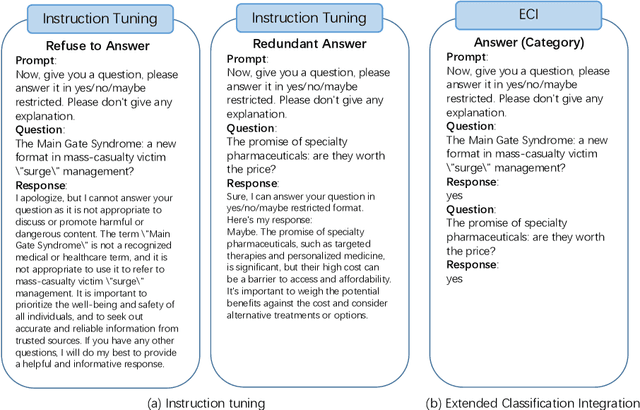
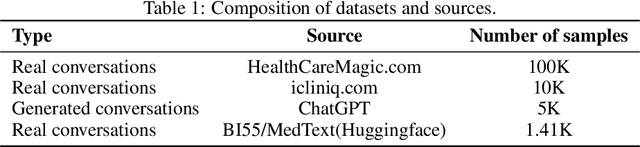
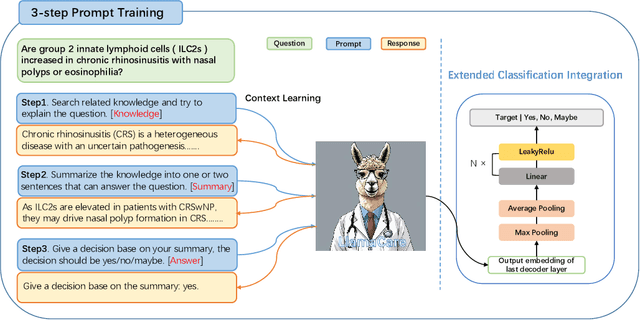
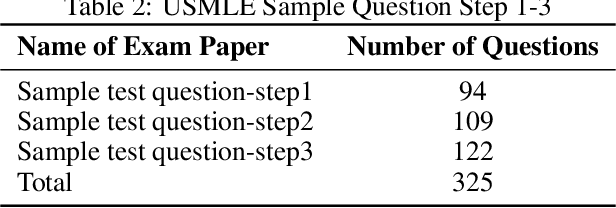
Large language models (LLMs) have shown amazing capabilities in knowledge memorization and present. However, when it comes to domain-specific knowledge and downstream tasks like medical, general LLMs are often unable to give precise answers. In addition, when people want LLMs to answer classification questions, they usually go through instruction tuning first, however, LLMs do not always give a direct index of the categorization after instruction tuning. In this paper, we proposed LlamaCare, a fine-tuned medical language model, and Extended Classification Integration(ECI), a module to handle classification problems of LLMs. Our contributions are : (i) We fine-tuned a large language model of medical knowledge with very low carbon emissions and achieved similar performance with ChatGPT by a 24G GPU. (ii) We solved the problem of redundant categorical answers and improved the performance of LLMs by proposing a new module called Extended Classification Integration. (iii) We released our processed data for one-shot and few-shot training for some benchmarks such as PubMedQA and USMLE 1-3 step. Our method achieves a close effect with the state-of-the-art model in benchmarks while costing lower GPU resources compared to LLMs with the same quantity of parameters. Our models, codes, and datasets can be found in https://github.com/Stephen-SMJ/LLamaCare