 Add to Chrome
 Add to Firefox
 Add to Edge
CoDAT: Collaborative Dual-Attention Transformer with Low-Cost Temporal Modeling for Efficient Edge Action Recognition
Aug 07, 2026
Real-time human action recognition on Internet-of-Things (IoT) edge devices requires models that capture rich spatio-temporal cues within strict latency, memory, and power envelopes. Current 3D CNNs, video transformers, and shift-based ViT deliver high accuracy but come at computational costs that preclude edge IoT deployment. This paper proposes CoDAT, a Collaborative Dual-Attention Transformer that replaces conventional multi-head attention with a lightweight dual-branch module: Spatial Convolutional Attention (SCA) for local aggregation and Strided Single-Head Attention (SSHA) for global context. SSHA jointly compresses the spatial resolution and channel dimensions of the query, key, and value tensors via stride-based sparse projection, then fuses the resulting global and local features at a markedly reduced cost. To enable temporal communication across frames, a parameter-free TShift module is embedded in each block. Extensive experiments on Jetson AGX Orin and Raspberry Pi 5 demonstrate that CoDAT achieves an energy-accuracy balance in both image and action recognition. On ImageNet-1K, CoDAT-M runs 2x faster than EfficientViT384 and FastViT-S12 at comparable accuracy, and CoDAT-L matches ViT-S with 3x fewer parameters at 2x higher throughput. On Kinetics-400 and MA-52, CoDAT achieves competitive Top-1 accuracy against state-of-the-art CNN, transformer, and hybrid baselines while running up to 2.9x faster than VSwin-T, 2x faster than ViT-Temporal-Shift variants, and 5x faster than UniFormer-B. On UCF-101, CoDAT-S384 matches TokShift and LAPS while being 6x faster and requiring up to 13x fewer FLOPs, establishing an efficiency-accuracy balance for real-time action recognition in edge IoT perception systems. Code is available at https://github.com/novendrastywn/CoDAT .

MicroViTv2: Beyond the FLOPS for Edge Energy-Friendly Vision Transformers
May 11, 2026The Vision Transformer (ViT) achieves remarkable accuracy across visual tasks but remains computationally expensive for edge deployment. This paper presents MicroViTv2, a lightweight Vision Transformer optimized for real-device efficiency. Built upon the original MicroViT, the proposed model is designed based on reparameterized design, specifically Reparameterized Patch Embedding (RepEmbed) and Reparameterized Depth-Wise convolution mixer (RepDW) for faster inference, and introduces the Single Depth-Wise Transposed Attention (SDTA) to capture long-range dependencies with minimal redundancy. Despite slightly higher FLOPs, MicroViTv2 improves accuracy up to 0.5% compared to its predecessor and surpassing MobileViTv2, EdgeNeXt, and EfficientViT while maintaining fast inference and high energy efficiency on Jetson AGX Orin. Experiments on ImageNet-1K and COCO demonstrate that hardware-aware design and structural re-parameterization are key to achieving high accuracy and low energy consumption, validating the need to evaluate efficiency beyond FLOPs. Code is available at https://github.com/novendrastywn/MicroViT.
FaceLiVTv2: An Improved Hybrid Architecture for Efficient Mobile Face Recognition
Apr 10, 2026Lightweight face recognition is increasingly important for deployment on edge and mobile devices, where strict constraints on latency, memory, and energy consumption must be met alongside reliable accuracy. Although recent hybrid CNN-Transformer architectures have advanced global context modeling, striking an effective balance between recognition performance and computational efficiency remains an open challenge. In this work, we present FaceLiVTv2, an improved version of our FaceLiVT hybrid architecture designed for efficient global--local feature interaction in mobile face recognition. At its core is Lite MHLA, a lightweight global token interaction module that replaces the original multi-layer attention design with multi-head linear token projections and affine rescale transformations, reducing redundancy while preserving representational diversity across heads. We further integrate Lite MHLA into a unified RepMix block that coordinates local and global feature interactions and adopts global depthwise convolution for adaptive spatial aggregation in the embedding stage. Under our experimental setup, results on LFW, CA-LFW, CP-LFW, CFP-FP, AgeDB-30, and IJB show that FaceLiVTv2 consistently improves the accuracy-efficiency trade-off over existing lightweight methods. Notably, FaceLiVTv2 reduces mobile inference latency by 22% relative to FaceLiVTv1, achieves speedups of up to 30.8% over GhostFaceNets on mobile devices, and delivers 20-41% latency improvements over EdgeFace and KANFace across platforms while maintaining higher recognition accuracy. These results demonstrate that FaceLiVTv2 offers a practical and deployable solution for real-time face recognition. Code is available at https://github.com/novendrastywn/FaceLiVT.
FaceLiVT: Face Recognition using Linear Vision Transformer with Structural Reparameterization For Mobile Device
Jun 12, 2025This paper introduces FaceLiVT, a lightweight yet powerful face recognition model that integrates a hybrid Convolution Neural Network (CNN)-Transformer architecture with an innovative and lightweight Multi-Head Linear Attention (MHLA) mechanism. By combining MHLA alongside a reparameterized token mixer, FaceLiVT effectively reduces computational complexity while preserving competitive accuracy. Extensive evaluations on challenging benchmarks; including LFW, CFP-FP, AgeDB-30, IJB-B, and IJB-C; highlight its superior performance compared to state-of-the-art lightweight models. MHLA notably improves inference speed, allowing FaceLiVT to deliver high accuracy with lower latency on mobile devices. Specifically, FaceLiVT is 8.6 faster than EdgeFace, a recent hybrid CNN-Transformer model optimized for edge devices, and 21.2 faster than a pure ViT-Based model. With its balanced design, FaceLiVT offers an efficient and practical solution for real-time face recognition on resource-constrained platforms.
MicroViT: A Vision Transformer with Low Complexity Self Attention for Edge Device
Feb 09, 2025The Vision Transformer (ViT) has demonstrated state-of-the-art performance in various computer vision tasks, but its high computational demands make it impractical for edge devices with limited resources. This paper presents MicroViT, a lightweight Vision Transformer architecture optimized for edge devices by significantly reducing computational complexity while maintaining high accuracy. The core of MicroViT is the Efficient Single Head Attention (ESHA) mechanism, which utilizes group convolution to reduce feature redundancy and processes only a fraction of the channels, thus lowering the burden of the self-attention mechanism. MicroViT is designed using a multi-stage MetaFormer architecture, stacking multiple MicroViT encoders to enhance efficiency and performance. Comprehensive experiments on the ImageNet-1K and COCO datasets demonstrate that MicroViT achieves competitive accuracy while significantly improving 3.6 faster inference speed and reducing energy consumption with 40% higher efficiency than the MobileViT series, making it suitable for deployment in resource-constrained environments such as mobile and edge devices.
PGT-Net: Progressive Guided Multi-task Neural Network for Small-area Wet Fingerprint Denoising and Recognition
Aug 14, 2023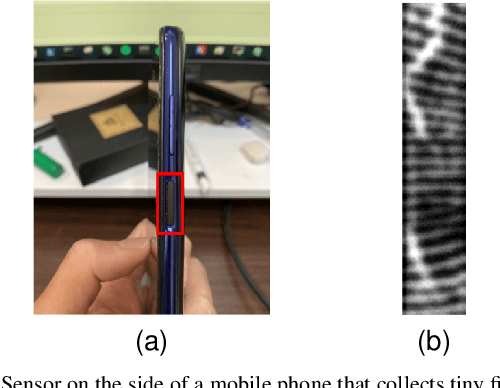
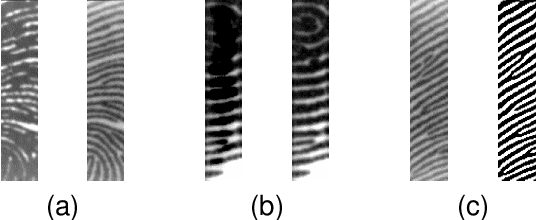
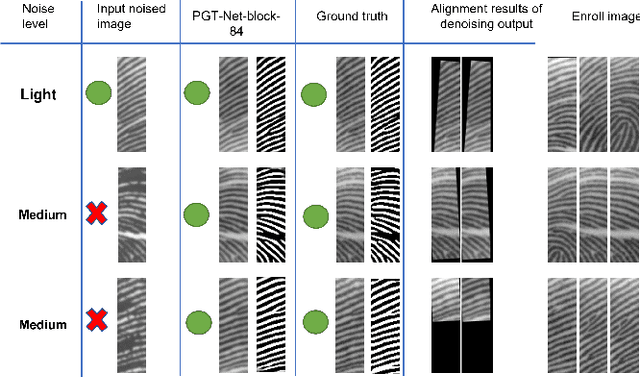
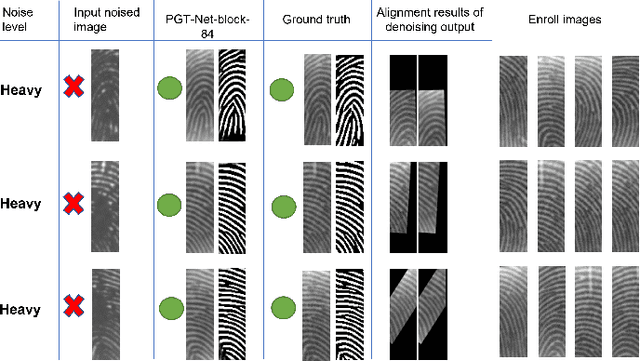
Fingerprint recognition on mobile devices is an important method for identity verification. However, real fingerprints usually contain sweat and moisture which leads to poor recognition performance. In addition, for rolling out slimmer and thinner phones, technology companies reduce the size of recognition sensors by embedding them with the power button. Therefore, the limited size of fingerprint data also increases the difficulty of recognition. Denoising the small-area wet fingerprint images to clean ones becomes crucial to improve recognition performance. In this paper, we propose an end-to-end trainable progressive guided multi-task neural network (PGT-Net). The PGT-Net includes a shared stage and specific multi-task stages, enabling the network to train binary and non-binary fingerprints sequentially. The binary information is regarded as guidance for output enhancement which is enriched with the ridge and valley details. Moreover, a novel residual scaling mechanism is introduced to stabilize the training process. Experiment results on the FW9395 and FT-lightnoised dataset provided by FocalTech shows that PGT-Net has promising performance on the wet-fingerprint denoising and significantly improves the fingerprint recognition rate (FRR). On the FT-lightnoised dataset, the FRR of fingerprint recognition can be declined from 17.75% to 4.47%. On the FW9395 dataset, the FRR of fingerprint recognition can be declined from 9.45% to 1.09%.