 Add to Chrome
 Add to Firefox
 Add to Edge
Ill-Conditioning in Dictionary-Based Dynamic-Equation Learning: A Systems Biology Case Study
Mar 11, 2026
Data-driven discovery of governing equations from time-series data provides a powerful framework for understanding complex biological systems. Library-based approaches that use sparse regression over candidate functions have shown considerable promise, but they face a critical challenge when candidate functions become strongly correlated: numerical ill-conditioning. Poor or restricted sampling, together with particular choices of candidate libraries, can produce strong multicollinearity and numerical instability. In such cases, measurement noise may lead to widely different recovered models, obscuring the true underlying dynamics and hindering accurate system identification. Although sparse regularization promotes parsimonious solutions and can partially mitigate conditioning issues, strong correlations may persist, regularization may bias the recovered models, and the regression problem may remain highly sensitive to small perturbations in the data. We present a systematic analysis of how ill-conditioning affects sparse identification of biological dynamics using benchmark models from systems biology. We show that combinations involving as few as two or three terms can already exhibit strong multicollinearity and extremely large condition numbers. We further show that orthogonal polynomial bases do not consistently resolve ill-conditioning and can perform worse than monomial libraries when the data distribution deviates from the weight function associated with the orthogonal basis. Finally, we demonstrate that when data are sampled from distributions aligned with the appropriate weight functions corresponding to the orthogonal basis, numerical conditioning improves, and orthogonal polynomial bases can yield improved model recovery accuracy across two baseline models.

SODAs: Sparse Optimization for the Discovery of Differential and Algebraic Equations
Mar 08, 2025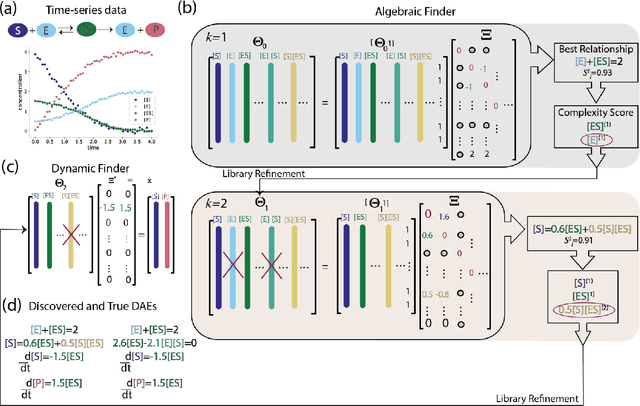
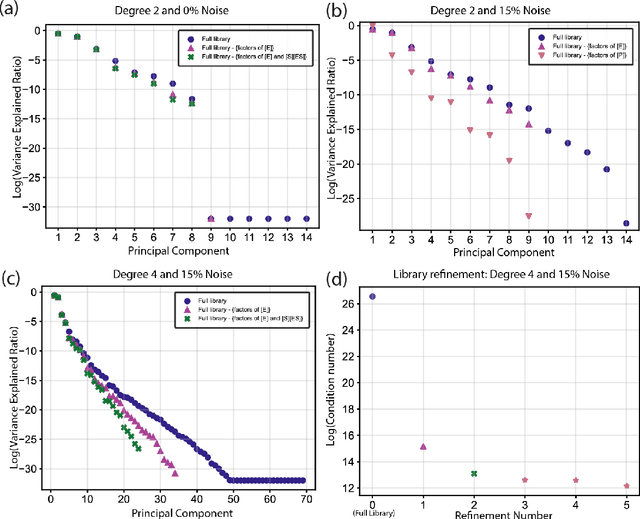
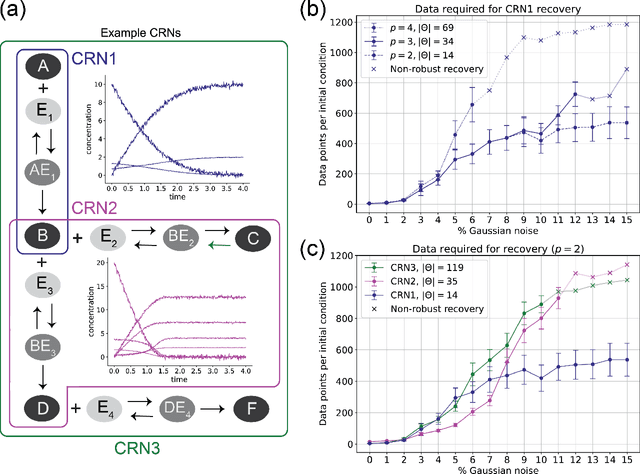
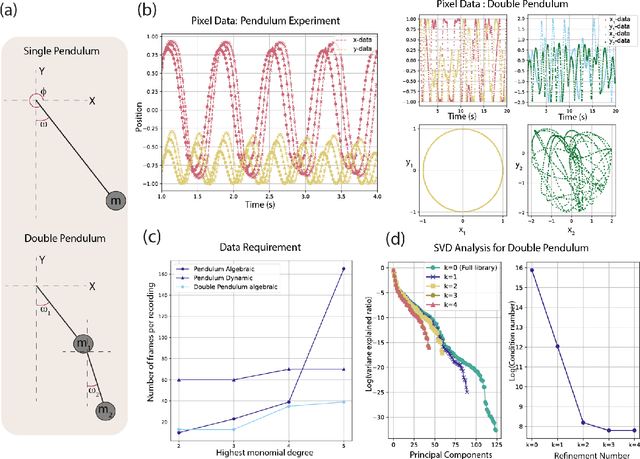
Differential-algebraic equations (DAEs) integrate ordinary differential equations (ODEs) with algebraic constraints, providing a fundamental framework for developing models of dynamical systems characterized by timescale separation, conservation laws, and physical constraints. While sparse optimization has revolutionized model development by allowing data-driven discovery of parsimonious models from a library of possible equations, existing approaches for dynamical systems assume DAEs can be reduced to ODEs by eliminating variables before model discovery. This assumption limits the applicability of such methods to DAE systems with unknown constraints and time scales. We introduce Sparse Optimization for Differential-Algebraic Systems (SODAs), a data-driven method for the identification of DAEs in their explicit form. By discovering the algebraic and dynamic components sequentially without prior identification of the algebraic variables, this approach leads to a sequence of convex optimization problems and has the advantage of discovering interpretable models that preserve the structure of the underlying physical system. To this end, SODAs improves numerical stability when handling high correlations between library terms -- caused by near-perfect algebraic relationships -- by iteratively refining the conditioning of the candidate library. We demonstrate the performance of our method on biological, mechanical, and electrical systems, showcasing its robustness to noise in both simulated time series and real-time experimental data.