 Add to Chrome
 Add to Firefox
 Add to Edge
Saranga: MilliWatt Ultrasound for Navigation in Visually Degraded Environments on Palm-Sized Aerial Robots
Mar 25, 2026
Tiny palm-sized aerial robots possess exceptional agility and cost-effectiveness in navigating confined and cluttered environments. However, their limited payload capacity directly constrains the sensing suite on-board the robot, thereby limiting critical navigational tasks in Global Positioning System (GPS)-denied wild scenes. Common methods for obstacle avoidance use cameras and LIght Detection And Ranging (LIDAR), which become ineffective in visually degraded conditions such as low visibility, dust, fog or darkness. Other sensors, such as RAdio Detection And Ranging (RADAR), have high power consumption, making them unsuitable for tiny aerial robots. Inspired by bats, we propose Saranga, a low-power ultrasound-based perception stack that localizes obstacles using a dual sonar array. We present two key solutions to combat the low Peak Signal-to-Noise Ratio of $-4.9$ decibels: physical noise reduction and a deep learning based denoising method. Firstly, we present a practical way to block propeller induced ultrasound noise on the weak echoes. The second solution is to train a neural network to utilize the \textcolor{black}{long horizon of ultrasound echoes} for finding signal patterns under high amounts of uncorrelated noise where classical methods were insufficient. We generalize to the real world by using a synthetic data generation pipeline and limited real noise data for training. We enable a palm-sized aerial robot to navigate in visually degraded conditions of dense fog, darkness, and snow in a cluttered environment with thin and transparent obstacles using only on-board sensing and computation. We provide extensive real world results to demonstrate the efficacy of our approach.

VizFlyt: Perception-centric Pedagogical Framework For Autonomous Aerial Robots
Apr 01, 2025Autonomous aerial robots are becoming commonplace in our lives. Hands-on aerial robotics courses are pivotal in training the next-generation workforce to meet the growing market demands. Such an efficient and compelling course depends on a reliable testbed. In this paper, we present VizFlyt, an open-source perception-centric Hardware-In-The-Loop (HITL) photorealistic testing framework for aerial robotics courses. We utilize pose from an external localization system to hallucinate real-time and photorealistic visual sensors using 3D Gaussian Splatting. This enables stress-free testing of autonomy algorithms on aerial robots without the risk of crashing into obstacles. We achieve over 100Hz of system update rate. Lastly, we build upon our past experiences of offering hands-on aerial robotics courses and propose a new open-source and open-hardware curriculum based on VizFlyt for the future. We test our framework on various course projects in real-world HITL experiments and present the results showing the efficacy of such a system and its large potential use cases. Code, datasets, hardware guides and demo videos are available at https://pear.wpi.edu/research/vizflyt.html
EdgeFlowNet: 100FPS@1W Dense Optical Flow For Tiny Mobile Robots
Nov 21, 2024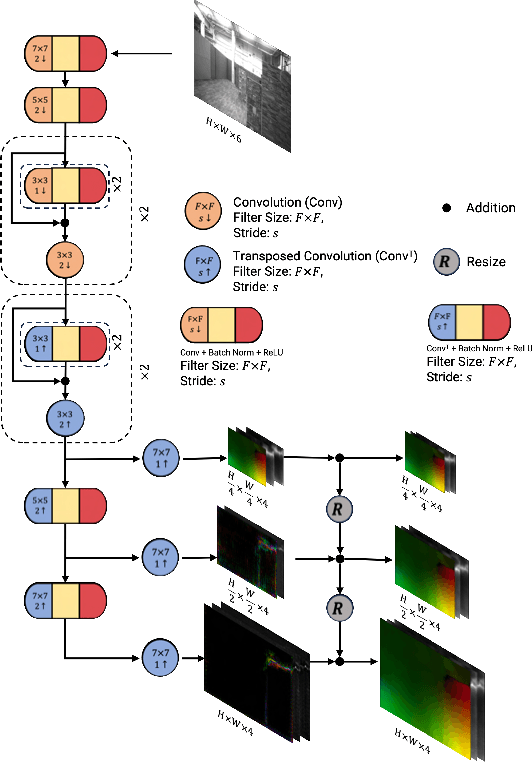

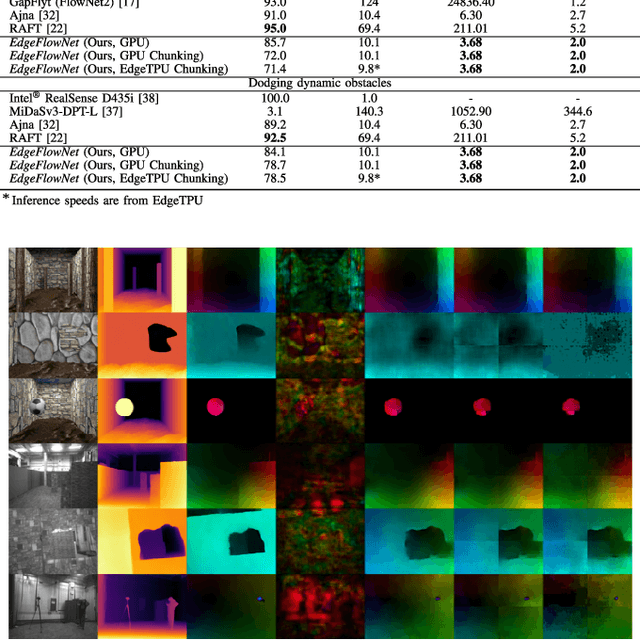
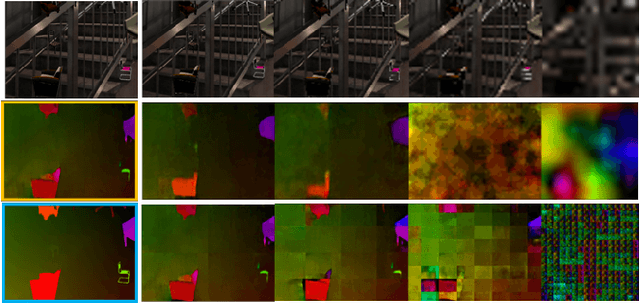
Optical flow estimation is a critical task for tiny mobile robotics to enable safe and accurate navigation, obstacle avoidance, and other functionalities. However, optical flow estimation on tiny robots is challenging due to limited onboard sensing and computation capabilities. In this paper, we propose EdgeFlowNet , a high-speed, low-latency dense optical flow approach for tiny autonomous mobile robots by harnessing the power of edge computing. We demonstrate the efficacy of our approach by deploying EdgeFlowNet on a tiny quadrotor to perform static obstacle avoidance, flight through unknown gaps and dynamic obstacle dodging. EdgeFlowNet is about 20 faster than the previous state-of-the-art approaches while improving accuracy by over 20% and using only 1.08W of power enabling advanced autonomy on palm-sized tiny mobile robots.