 Add to Chrome
 Add to Firefox
 Add to Edge
SteelBench: Evaluating Vision-Language Models in Real-World Industrial Environments
Jul 06, 2026
Existing video benchmarks evaluate action recognition on consumer videos, egocentric recordings, or simulated industrial environments. They do not test vision-language models under the visual and procedural conditions of real industrial CCTV, where workers appear as distant figures amid dust, steam, low light, glare, occlusion, and overlapping activities. We introduce STEELBENCH, a diagnostic benchmark for industrial surveillance that jointly evaluates per-worker activity recognition, safety-rule reasoning, and annotation provenance. SteelBench contains 1,345 densely annotated clips, curated from 149 hours of operational plant footage and 10,024 candidate clips using temporal deduplication, class balancing, and visibility-aware stratified sampling. Each clip includes dense per-worker action labels, PPE attributes, spatial context, and safety-rule annotations. Because model-assisted annotation can shape the labels later used for model evaluation, SteelBench includes a provenance-aware audit protocol. The protocol measures label influence, evaluates sensitivity to ground-truth provenance, and reports a human reference from expert-reviewed labels. Applying this audit, we find that unaudited VLM-sourced ground truth can inflate same-family model accuracy by up to 17 percentage points. Across nine VLMs from four architectural families, the best model reaches only 42.6% action accuracy, compared with an 84.6% human benchmark. Performance also fragments across recognition, robustness, calibration, and safety reasoning. Even when models predict the correct action, 37-58% of cases still yield incorrect safety judgments, and no model passes more than 2 of 5 diagnostic checks. The dataset is publicly available on Hugging Face.

AdaGradSelect: An adaptive gradient-guided layer selection method for efficient fine-tuning of SLMs
Dec 12, 2025Large Language Models (LLMs) can perform many NLP tasks well, but fully fine-tuning them is expensive and requires a lot of memory. Parameter-Efficient Fine-Tuning (PEFT) methods such as LoRA reduce this cost by adding small low-rank updates to frozen model weights. However, these methods restrict the training to a limited subspace, which can sometimes reduce performance. For Small Language Models (SLMs), where efficiency gains matter even more, we introduce AdaGradSelect, an adaptive method that selects which transformer blocks to update based on gradients. Early observations showed that updating only the transformer blocks with the highest gradient norms can achieve performance close to full fine-tuning. Building on this insight, AdaGradSelect adaptively chooses which blocks to train. It uses a combination of Dirichlet-based sampling, which depends on how frequently blocks were updated in the past, and an epsilon-greedy exploration strategy. This lets the method explore different blocks in early training and gradually focus on the most important ones in later epochs. Experiments show that AdaGradSelect trains about 12 percent faster and uses 35 percent less GPU memory while delivering performance very close to full fine-tuning. On the GSM8K dataset, it outperforms LoRA (rank 256) by about 3 percent on average across models such as Qwen2.5-0.5B, LLaMA3.2-1B, and Phi4-mini-3.8B. It also achieves similar accuracy on the MATH dataset. Overall, AdaGradSelect provides a more effective and resource-efficient alternative to traditional fine-tuning methods.
PatchAlign:Fair and Accurate Skin Disease Image Classification by Alignment with Clinical Labels
Sep 08, 2024
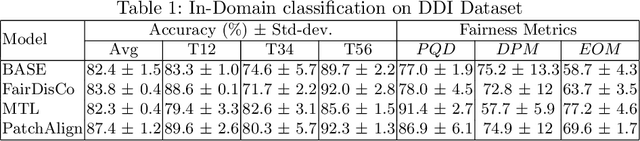

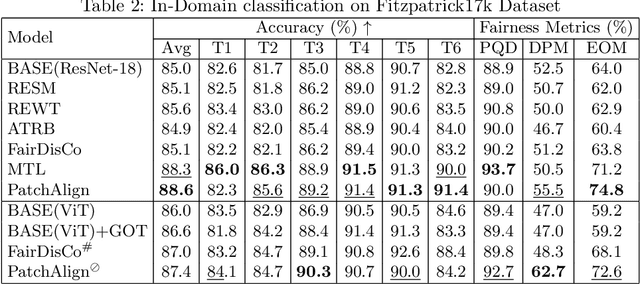
Deep learning models have achieved great success in automating skin lesion diagnosis. However, the ethnic disparity in these models' predictions needs to be addressed before deploying them. We introduce a novel approach, PatchAlign, to enhance skin condition image classification accuracy and fairness by aligning with clinical text representations of skin conditions. PatchAlign uses Graph Optimal Transport (GOT) Loss as a regularizer to perform cross-domain alignment. The representations obtained are robust and generalize well across skin tones, even with limited training samples. To reduce the effect of noise and artifacts in clinical dermatology images, we propose a learnable Masked Graph Optimal Transport for cross-domain alignment that further improves fairness metrics. We compare our model to the state-of-the-art FairDisCo on two skin lesion datasets with different skin types: Fitzpatrick17k and Diverse Dermatology Images (DDI). PatchAlign enhances the accuracy of skin condition image classification by 2.8% (in-domain) and 6.2% (out-domain) on Fitzpatrick17k, and 4.2% (in-domain) on DDI compared to FairDisCo. Additionally, it consistently improves the fairness of true positive rates across skin tones. The source code for the implementation is available at the following GitHub repository: https://github.com/aayushmanace/PatchAlign24, enabling easy reproduction and further experimentation.
Entropy Aware Training for Fast and Accurate Distributed GNN
Nov 04, 2023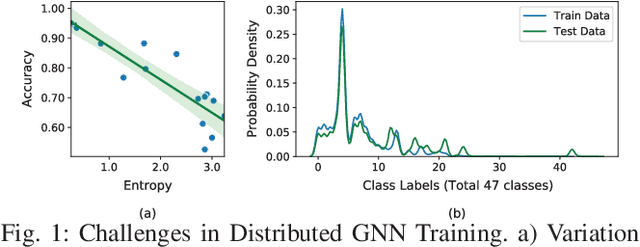
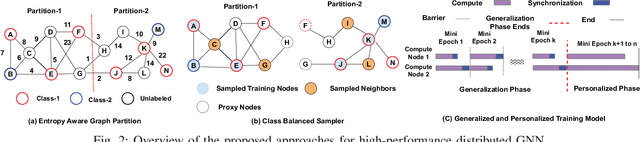
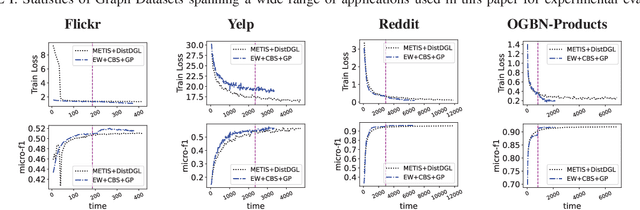

Several distributed frameworks have been developed to scale Graph Neural Networks (GNNs) on billion-size graphs. On several benchmarks, we observe that the graph partitions generated by these frameworks have heterogeneous data distributions and class imbalance, affecting convergence, and resulting in lower performance than centralized implementations. We holistically address these challenges and develop techniques that reduce training time and improve accuracy. We develop an Edge-Weighted partitioning technique to improve the micro average F1 score (accuracy) by minimizing the total entropy. Furthermore, we add an asynchronous personalization phase that adapts each compute-host's model to its local data distribution. We design a class-balanced sampler that considerably speeds up convergence. We implemented our algorithms on the DistDGL framework and observed that our training techniques scale much better than the existing training approach. We achieved a (2-3x) speedup in training time and 4\% improvement on average in micro-F1 scores on 5 large graph benchmarks compared to the standard baselines.