 Add to Chrome
 Add to Firefox
 Add to Edge
Generative AI-Driven Phase Control for RIS-Aided Cell-Free Massive MIMO Systems
Feb 11, 2026
This work investigates a generative artificial intelligence (GenAI) model to optimize the reconfigurable intelligent surface (RIS) phase shifts in RIS-aided cell-free massive multiple-input multiple-output (mMIMO) systems under practical constraints, including imperfect channel state information (CSI) and spatial correlation. We propose two GenAI based approaches, generative conditional diffusion model (GCDM) and generative conditional diffusion implicit model (GCDIM), leveraging the diffusion model conditioned on dynamic CSI to maximize the sum spectral efficiency (SE) of the system. To benchmark performance, we compare the proposed GenAI based approaches against an expert algorithm, traditionally known for achieving near-optimal solutions at the cost of computational efficiency. The simulation results demonstrate that GCDM matches the sum SE achieved by the expert algorithm while significantly reducing the computational overhead. Furthermore, GCDIM achieves a comparable sum SE with an additional $98\%$ reduction in computation time, underscoring its potential for efficient phase optimization in RIS-aided cell-free mMIMO systems.

Analysis and Optimization of RIS-Assisted Cell-Free Massive MIMO NOMA Systems
Jul 04, 2024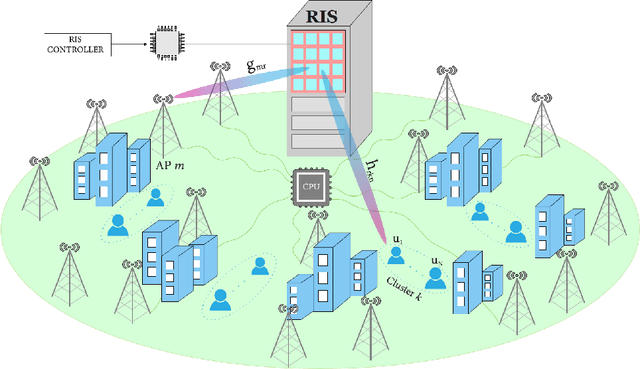
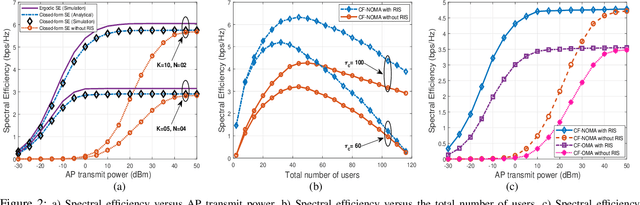
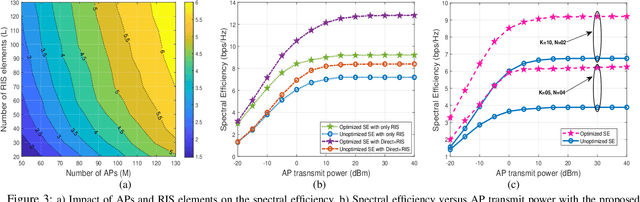
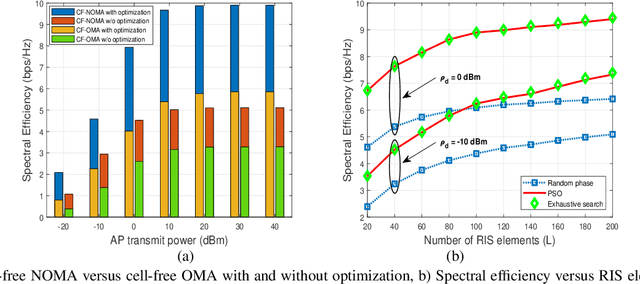
We consider a reconfigurable intelligent surface (RIS) assisted cell-free massive multiple-input multiple-output non-orthogonal multiple access (NOMA) system, where each access point (AP) serves all the users with the aid of the RIS. We practically model the system by considering imperfect instantaneous channel state information (CSI) and employing imperfect successive interference cancellation at the users end. We first obtain the channel estimates using linear minimum mean square error approach considering the spatial correlation at the RIS and then derive a closed-form downlink spectral efficiency (SE) expression using the statistical CSI. We next formulate a joint optimization problem to maximize the sum SE of the system. We first introduce a novel successive Quadratic Transform (successive-QT) algorithm to optimize the transmit power coefficients using the concept of block optimization along with quadratic transform and then use the particle swarm optimization technique to design the RIS phase shifts. Note that most of the existing works on RIS-aided cell-free systems are specific instances of the general scenario studied in this work. We numerically show that i) the RIS-assisted link is more advantageous at lower transmit power regions where the direct link between AP and user is weak, ii) NOMA outperforms orthogonal multiple access schemes in terms of SE, and iii) the proposed joint optimization framework significantly improves the sum SE of the system.