 Add to Chrome
 Add to Firefox
 Add to Edge
Sound Probabilistic Safety Bounds for Large Language Models
Jul 22, 2026
We propose a novel framework for computing rigorous bounds on the probability that a large language model (LLM) generates harmful output to a given prompt. We study a new application of the Clopper-Pearson confidence intervals to obtain probably approximately correct (PAC) bounds for this problem. As our main technical contribution, we propose an algorithm that leverages features in the latent space to prioritize exploring branches in the auto-regressive generation tree that are more likely to produce harmful outputs. Our approach in particular enables the efficient computation of useful lower bounds, even in scenarios where the true harm probability is extremely small, and crucially, the obtained lower bounds are sound, i.e., formally proven to be less than the actual harmfulness probability: our experimental results demonstrate the effectiveness of our method by computing non-trivial lower bounds on state-of-the-art LLMs. This study newly enables the evaluation and statistical certification of LLMs.

CBAG: An Efficient Genetic Algorithm for the Graph Burning Problem
Aug 06, 2022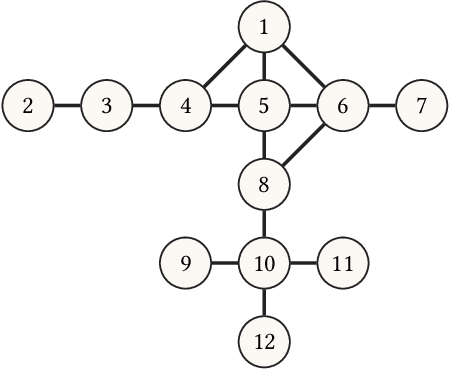
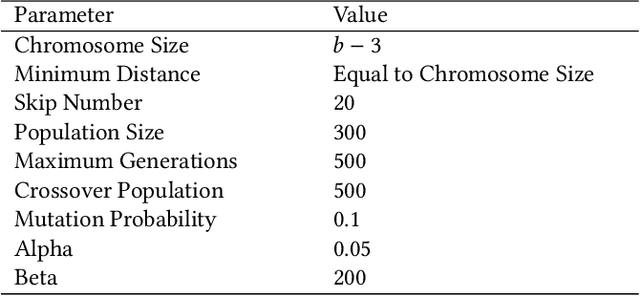
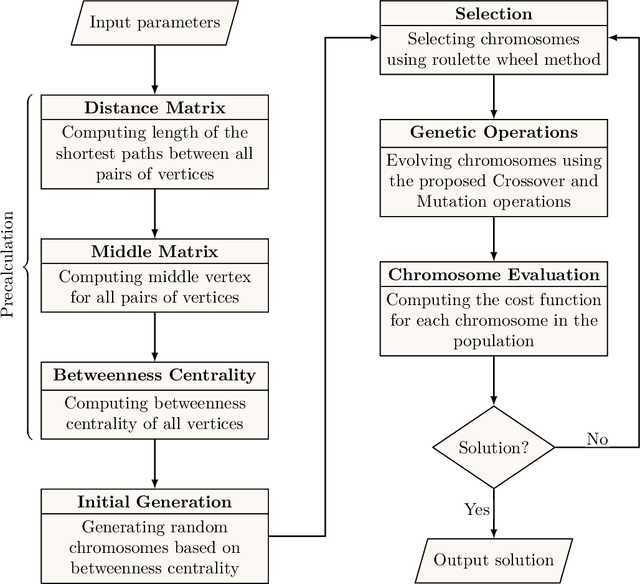
Information spread is an intriguing topic to study in network science, which investigates how information, influence, or contagion propagate through networks. Graph burning is a simplified deterministic model for how information spreads within networks. The complicated NP-complete nature of the problem makes it computationally difficult to solve using exact algorithms. Accordingly, a number of heuristics and approximation algorithms have been proposed in the literature for the graph burning problem. In this paper, we propose an efficient genetic algorithm called Centrality BAsed Genetic-algorithm (CBAG) for solving the graph burning problem. Considering the unique characteristics of the graph burning problem, we introduce novel genetic operators, chromosome representation, and evaluation method. In the proposed algorithm, the well-known betweenness centrality is used as the backbone of our chromosome initialization procedure. The proposed algorithm is implemented and compared with previous heuristics and approximation algorithms on 15 benchmark graphs of different sizes. Based on the results, it can be seen that the proposed algorithm achieves better performance in comparison to the previous state-of-the-art heuristics. The complete source code is available online and can be used to find optimal or near-optimal solutions for the graph burning problem.