 Add to Chrome
 Add to Firefox
 Add to Edge
Scene-aware Prediction of Diverse Human Movement Goals
Jun 29, 2026
Anticipation of human behaviours facilitates autonomous systems in proactive planning. Human behaviour could be stochastic due to varying goals. Human goals typically guide their own movement and could therefore help to predict the human trajectory and human motion in the long-term. To infer the human movement intentions, the environmental context plays a significant role, in addition to the social cues expressed by the individual. Previous works on human goals prediction either require semantic knowledge of the scene, or only tackle interactions with objects. In this paper, we propose a novel multi-goal prediction method using the generative model to address the stochasticity of human movement. It leverages the current RGB scene and the human pose to predict diverse potential future goals of human movement based on the Conditional Variational Autoencoder (CVAE). Our results demonstrate that our approach is capable of generating multiple movement goals in the scene via samplings in latent space of the CVAE and exhibits generalization capability across scenarios in GTA-IM dataset and PROX dataset. Code is publicly available at \href{https://github.com/Q-Y-Yang/DiverseGoalsPrediction.git}{\texttt{https://github.com/Q-Y-Yang/DiverseGoalsPrediction}}.

Long-Term Prediction of Local and Global Human Motion with Occlusion Recovery
Jun 26, 2026Human motion describes the three-dimensional full-body movement of a person. Anticipating such motion holds significant relevance across a wide range of application domains such as human-robot interaction, autonomous driving, animation, and healthcare. In recent research, spatial and temporal dependencies are modeled by bidirectional attention mechanisms. These typically anticipate human motion in an autoregressive manner which could cause an accumulation of errors over time. As a consequence, they solely focus on local pose forecasting. To address these limitations, we propose a non-autoregressive transformer based on spatio-temporal attention, and train it not only for local pose anticipation, but also for global motion prediction in space. Furthermore, to enhance its applicability in real-world scenarios, our model is also trained to recover missing joints due to occlusions, and is capable of processing varying lengths of history observations. Our code is publicly available at https://github.com/Q-Y-Yang/Prediction-of-Local-and-Global-Human-Motion.
NITEC: Versatile Hand-Annotated Eye Contact Dataset for Ego-Vision Interaction
Nov 08, 2023

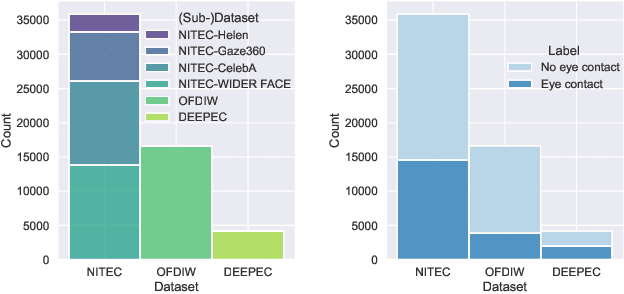

Eye contact is a crucial non-verbal interaction modality and plays an important role in our everyday social life. While humans are very sensitive to eye contact, the capabilities of machines to capture a person's gaze are still mediocre. We tackle this challenge and present NITEC, a hand-annotated eye contact dataset for ego-vision interaction. NITEC exceeds existing datasets for ego-vision eye contact in size and variety of demographics, social contexts, and lighting conditions, making it a valuable resource for advancing ego-vision-based eye contact research. Our extensive evaluations on NITEC demonstrate strong cross-dataset performance, emphasizing its effectiveness and adaptability in various scenarios, that allows seamless utilization to the fields of computer vision, human-computer interaction, and social robotics. We make our NITEC dataset publicly available to foster reproducibility and further exploration in the field of ego-vision interaction. https://github.com/thohemp/nitec