 Add to Chrome
 Add to Firefox
 Add to Edge
Generative Multi-Objective Bayesian Optimization with Scalable Batch Evaluations for Sample-Efficient De Novo Molecular Design
Dec 19, 2025
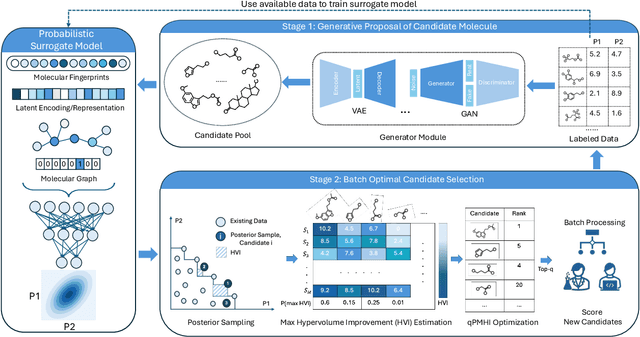
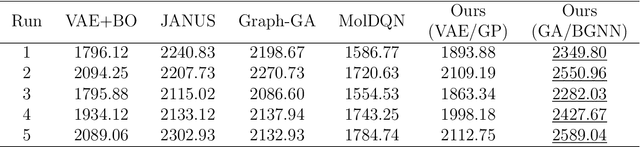
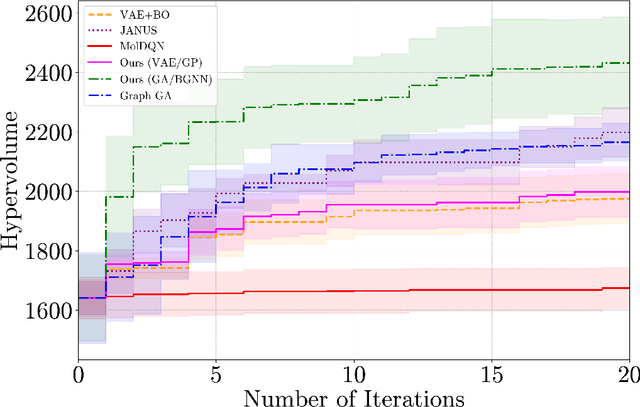

Designing molecules that must satisfy multiple, often conflicting objectives is a central challenge in molecular discovery. The enormous size of chemical space and the cost of high-fidelity simulations have driven the development of machine learning-guided strategies for accelerating design with limited data. Among these, Bayesian optimization (BO) offers a principled framework for sample-efficient search, while generative models provide a mechanism to propose novel, diverse candidates beyond fixed libraries. However, existing methods that couple the two often rely on continuous latent spaces, which introduces both architectural entanglement and scalability challenges. This work introduces an alternative, modular "generate-then-optimize" framework for de novo multi-objective molecular design/discovery. At each iteration, a generative model is used to construct a large, diverse pool of candidate molecules, after which a novel acquisition function, qPMHI (multi-point Probability of Maximum Hypervolume Improvement), is used to optimally select a batch of candidates most likely to induce the largest Pareto front expansion. The key insight is that qPMHI decomposes additively, enabling exact, scalable batch selection via only simple ranking of probabilities that can be easily estimated with Monte Carlo sampling. We benchmark the framework against state-of-the-art latent-space and discrete molecular optimization methods, demonstrating significant improvements across synthetic benchmarks and application-driven tasks. Specifically, in a case study related to sustainable energy storage, we show that our approach quickly uncovers novel, diverse, and high-performing organic (quinone-based) cathode materials for aqueous redox flow battery applications.

SyMANTIC: An Efficient Symbolic Regression Method for Interpretable and Parsimonious Model Discovery in Science and Beyond
Feb 05, 2025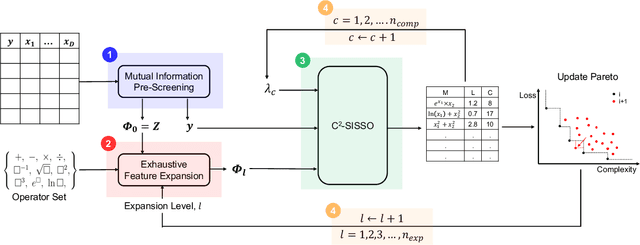
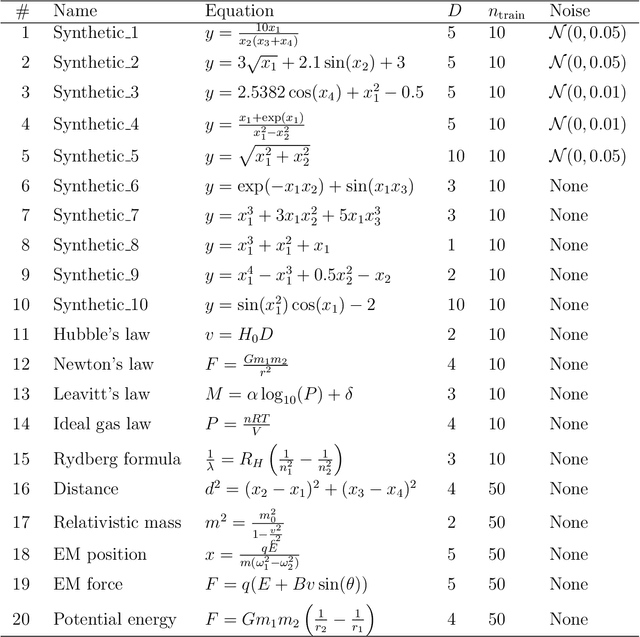
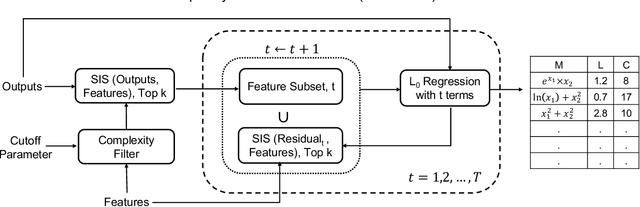

Symbolic regression (SR) is an emerging branch of machine learning focused on discovering simple and interpretable mathematical expressions from data. Although a wide-variety of SR methods have been developed, they often face challenges such as high computational cost, poor scalability with respect to the number of input dimensions, fragility to noise, and an inability to balance accuracy and complexity. This work introduces SyMANTIC, a novel SR algorithm that addresses these challenges. SyMANTIC efficiently identifies (potentially several) low-dimensional descriptors from a large set of candidates (from $\sim 10^5$ to $\sim 10^{10}$ or more) through a unique combination of mutual information-based feature selection, adaptive feature expansion, and recursively applied $\ell_0$-based sparse regression. In addition, it employs an information-theoretic measure to produce an approximate set of Pareto-optimal equations, each offering the best-found accuracy for a given complexity. Furthermore, our open-source implementation of SyMANTIC, built on the PyTorch ecosystem, facilitates easy installation and GPU acceleration. We demonstrate the effectiveness of SyMANTIC across a range of problems, including synthetic examples, scientific benchmarks, real-world material property predictions, and chaotic dynamical system identification from small datasets. Extensive comparisons show that SyMANTIC uncovers similar or more accurate models at a fraction of the cost of existing SR methods.