 Add to Chrome
 Add to Firefox
 Add to Edge
Spectral Energy Centroid: a Metric for Improving Performance and Analyzing Spectral Bias in Implicit Neural Representations
May 12, 2026
Implicit Neural Representations (INRs) model continuous signals using multilayer perceptrons (MLPs), enabling compact, differentiable, and high-fidelity representations of data across diverse domains. However, due to the low-frequency bias of MLPs that prevents effective learning of small details, the model's frequency must be carefully tuned through the embedding layer. Prior work established that this tuning can be performed before training based on the target signal, but it did not account for the significant effect of model depth, indicating that our understanding of the relationship between frequency and INR performance remains limited. To gain insights into this relationship, we utilize the Spectral Energy Centroid (SEC) metric that quantifies the frequency of target images and the spectral bias of INR models. We show that SEC is a versatile tool for INR analysis, demonstrating its utility across three tasks: (1) a data-driven strategy (SEC-Conf) for hyperparameter selection that outperforms existing heuristics and is robust to model depth, (2) a reliable proxy for signal complexity, and (3) effective alignment of spectral biases across diverse INR architectures.

A Hypernetwork-Based Approach to KAN Representation of Audio Signals
Mar 04, 2025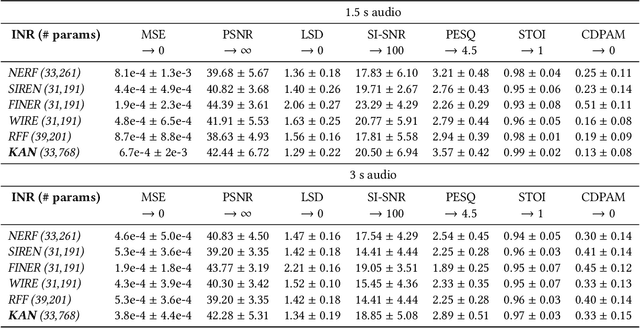
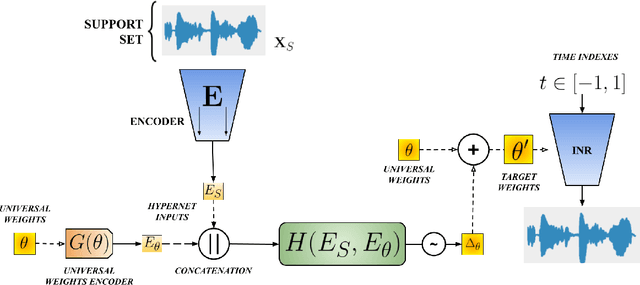
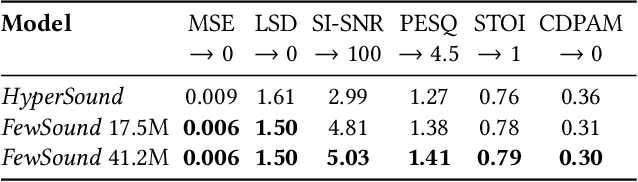

Implicit neural representations (INR) have gained prominence for efficiently encoding multimedia data, yet their applications in audio signals remain limited. This study introduces the Kolmogorov-Arnold Network (KAN), a novel architecture using learnable activation functions, as an effective INR model for audio representation. KAN demonstrates superior perceptual performance over previous INRs, achieving the lowest Log-SpectralDistance of 1.29 and the highest Perceptual Evaluation of Speech Quality of 3.57 for 1.5 s audio. To extend KAN's utility, we propose FewSound, a hypernetwork-based architecture that enhances INR parameter updates. FewSound outperforms the state-of-the-art HyperSound, with a 33.3% improvement in MSE and 60.87% in SI-SNR. These results show KAN as a robust and adaptable audio representation with the potential for scalability and integration into various hypernetwork frameworks. The source code can be accessed at https://github.com/gmum/fewsound.git.