 Add to Chrome
 Add to Firefox
 Add to Edge
Spectral Energy Centroid: a Metric for Improving Performance and Analyzing Spectral Bias in Implicit Neural Representations
May 12, 2026
Implicit Neural Representations (INRs) model continuous signals using multilayer perceptrons (MLPs), enabling compact, differentiable, and high-fidelity representations of data across diverse domains. However, due to the low-frequency bias of MLPs that prevents effective learning of small details, the model's frequency must be carefully tuned through the embedding layer. Prior work established that this tuning can be performed before training based on the target signal, but it did not account for the significant effect of model depth, indicating that our understanding of the relationship between frequency and INR performance remains limited. To gain insights into this relationship, we utilize the Spectral Energy Centroid (SEC) metric that quantifies the frequency of target images and the spectral bias of INR models. We show that SEC is a versatile tool for INR analysis, demonstrating its utility across three tasks: (1) a data-driven strategy (SEC-Conf) for hyperparameter selection that outperforms existing heuristics and is robust to model depth, (2) a reliable proxy for signal complexity, and (3) effective alignment of spectral biases across diverse INR architectures.

FreSh: Frequency Shifting for Accelerated Neural Representation Learning
Oct 07, 2024Implicit Neural Representations (INRs) have recently gained attention as a powerful approach for continuously representing signals such as images, videos, and 3D shapes using multilayer perceptrons (MLPs). However, MLPs are known to exhibit a low-frequency bias, limiting their ability to capture high-frequency details accurately. This limitation is typically addressed by incorporating high-frequency input embeddings or specialized activation layers. In this work, we demonstrate that these embeddings and activations are often configured with hyperparameters that perform well on average but are suboptimal for specific input signals under consideration, necessitating a costly grid search to identify optimal settings. Our key observation is that the initial frequency spectrum of an untrained model's output correlates strongly with the model's eventual performance on a given target signal. Leveraging this insight, we propose frequency shifting (or FreSh), a method that selects embedding hyperparameters to align the frequency spectrum of the model's initial output with that of the target signal. We show that this simple initialization technique improves performance across various neural representation methods and tasks, achieving results comparable to extensive hyperparameter sweeps but with only marginal computational overhead compared to training a single model with default hyperparameters.
HyperNeRFGAN: Hypernetwork approach to 3D NeRF GAN
Jan 27, 2023
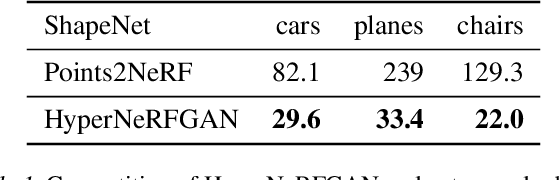
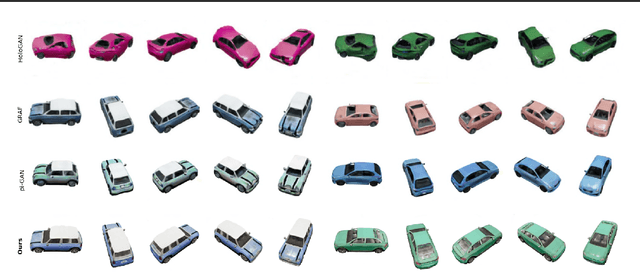
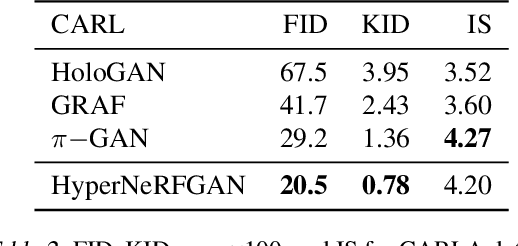
Recently, generative models for 3D objects are gaining much popularity in VR and augmented reality applications. Training such models using standard 3D representations, like voxels or point clouds, is challenging and requires complex tools for proper color rendering. In order to overcome this limitation, Neural Radiance Fields (NeRFs) offer a state-of-the-art quality in synthesizing novel views of complex 3D scenes from a small subset of 2D images. In the paper, we propose a generative model called HyperNeRFGAN, which uses hypernetworks paradigm to produce 3D objects represented by NeRF. Our GAN architecture leverages a hypernetwork paradigm to transfer gaussian noise into weights of NeRF model. The model is further used to render 2D novel views, and a classical 2D discriminator is utilized for training the entire GAN-based structure. Our architecture produces 2D images, but we use 3D-aware NeRF representation, which forces the model to produce correct 3D objects. The advantage of the model over existing approaches is that it produces a dedicated NeRF representation for the object without sharing some global parameters of the rendering component. We show the superiority of our approach compared to reference baselines on three challenging datasets from various domains.