 Add to Chrome
 Add to Firefox
 Add to Edge
Managing Task Execution for Unknown Workloads in Batteryless IoT: A Hardware-Agnostic Evaluation
Jun 23, 2026
In recent years, the Internet of Things (IoT) paradigm has been shifting toward batteryless, energy-harvesting architectures. Sustaining reliable operation in these systems requires intelligent management of highly volatile stored energy. As edge applications grow in complexity, traditional energy-aware schedulers struggle with unpredictable workloads due to their reliance on static execution thresholds or pre-measured, hardware-specific task profiles. To overcome this, we propose two novel, hardware-agnostic dynamic scheduling strategies treating applications as a "black box," requiring no prior energy information: a model-free Reinforcement Learning (RL) agent and an on-the-fly Approximated Prediction (AP) method. We evaluate these methods against an adaptive task rate approach (AsTAR) and optimized static thresholds using a custom-built, physically accurate simulation framework driven by real-world solar data and dynamic LoRa transmission profiles. Rather than claiming universal superiority, our analysis exposes the distinct operational trade-offs of each method: the AP approach delivers lightweight, near-oracle task throughput; the RL agent provides tunable survival-execution balancing; and AsTAR excels at execution pacing across long energy gaps. Finally, we demonstrate that while these advanced strategies provide critical resilience for severely constrained systems with small capacitors, devices with larger energy buffers can efficiently rely on simpler, less computationally expensive static policies.

InfiniteEn: A Multi-Source Energy Harvesting System with Load Monitoring Module for Batteryless Internet of Things
Jan 25, 2024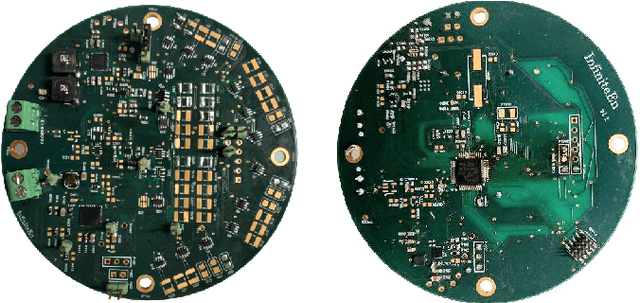
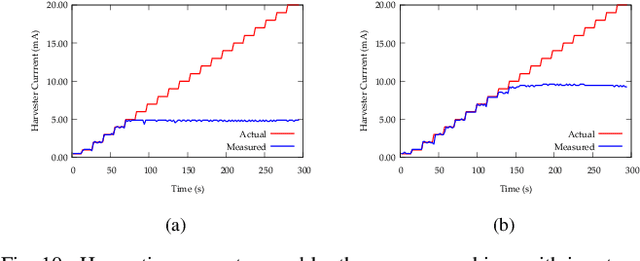
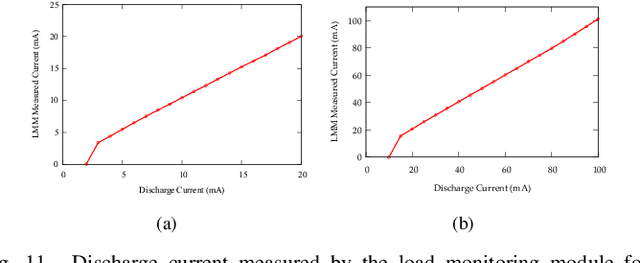
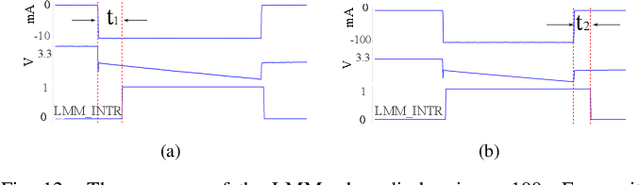
This paper presents InfiniteEn, a multi-source energy harvesting platform designed for the Internet of Batteryless Things (IoBT). InfiniteEn incorporates an efficient energy combiner to combine energy from different harvesting sources. The energy combiner uses capacitor-to-capacitor energy transfer to combine energy from multiple sources and achieves a nominal efficiency of 88\%. In addition to multiplexing different sources, the energy combiner facilitates the estimation of the harvesting rate and the calibration of the capacity of the energy buffer. The energy storage architecture of InfiniteEn employs an array of storage buffers that can be configured on demand to cope with varying energy harvesting rates and load's energy requirements. To address the challenge of tracking the energy state of batteryless devices with minimum energy overhead, this work introduces the concept of a Load Monitoring Module (LMM). InfiniteEn is a load-agnostic platform, meaning that it does not require any prior knowledge of the energy profile of the load to track its energy states. The LMM assists InfiniteEn in tracking the energy state of the load and dynamically modifying the storage buffers to meet the load's energy requirements. Furthermore, the module can detect and signal any abnormalities in the energy consumption pattern of the load caused by a hardware or software defect. Experiments demonstrate that LMM has a response time of less than 11 ms to energy state changes.