 Add to Chrome
 Add to Firefox
 Add to Edge
Multi-Agent Influence Diagrams to Hybrid Threat Modeling
Mar 03, 2026
Western governments have adopted an assortment of counter-hybrid threat measures to defend against hostile actions below the conventional military threshold. The impact of these measures is unclear because of the ambiguity of hybrid threats, their cross-domain nature, and uncertainty about how countermeasures shape adversarial behavior. This paper offers a novel approach to clarifying this impact by unifying previously bifurcating hybrid threat modeling methods through a (multi-agent) influence diagram framework. The model balances the costs of countermeasures, their ability to dissuade the adversary from executing hybrid threats, and their potential to mitigate the impact of hybrid threats. We run 1000 semi-synthetic variants of a real-world-inspired scenario simulating the strategic interaction between attacking agent A and defending agent B over a cyber attack on critical infrastructure to explore the effectiveness of a set of five different counter-hybrid threat measures. Counter-hybrid measures range from strengthening resilience and denial of the adversary's ability to execute a hybrid threat to dissuasion through the threat of punishment. Our analysis primarily evaluates the overarching characteristics of counter-hybrid threat measures. This approach allows us to generalize the effectiveness of these measures and examine parameter impact sensitivity. In addition, we discuss policy relevance and outline future research avenues.

Graphical Models for Decision-Making: Integrating Causality and Game Theory
Apr 16, 2025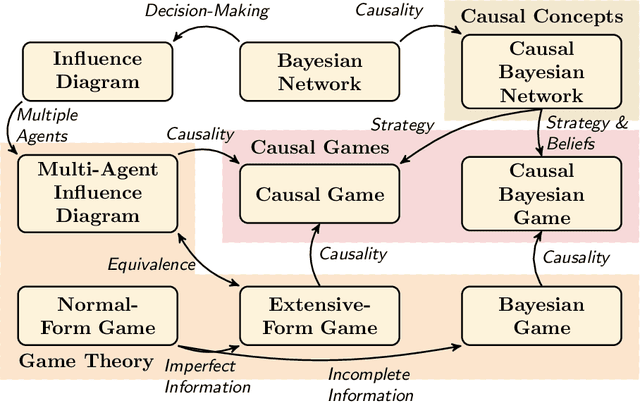
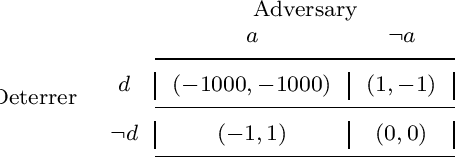
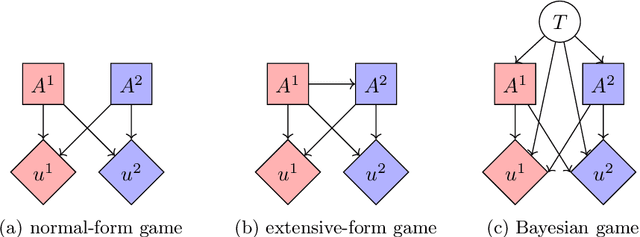
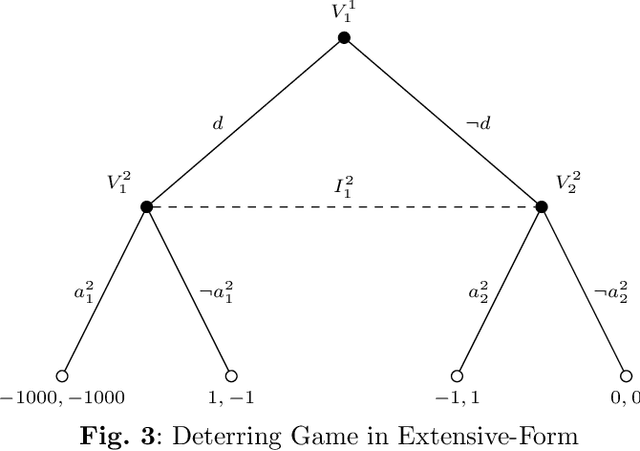
Causality and game theory are two influential fields that contribute significantly to decision-making in various domains. Causality defines and models causal relationships in complex policy problems, while game theory provides insights into strategic interactions among stakeholders with competing interests. Integrating these frameworks has led to significant theoretical advancements with the potential to improve decision-making processes. However, practical applications of these developments remain underexplored. To support efforts toward implementation, this paper clarifies key concepts in game theory and causality that are essential to their intersection, particularly within the context of probabilistic graphical models. By rigorously examining these concepts and illustrating them with intuitive, consistent examples, we clarify the required inputs for implementing these models, provide practitioners with insights into their application and selection across different scenarios, and reference existing research that supports their implementation. We hope this work encourages broader adoption of these models in real-world scenarios.