 Add to Chrome
 Add to Firefox
 Add to Edge
Control of Fully Actuated Aerial Vehicles: A Comparison of Model-based and Sensor-based Dynamic Inversion
May 12, 2026
Fully actuated multirotor platforms decouple translational force generation from vehicle attitude, enabling independent control of position and orientation and shifting performance limitations from attitude authority to actuator dynamics and control effectiveness. This paper compares a model-based nonlinear dynamic inversion controller (geometric NDI) with a sensor-based incremental dynamic inversion controller (INDI) on a fixed-tilt fully actuated hexarotor. Both controllers share an identical outer-loop structure and are both executed at 500 Hz; therefore, performance differences can be attributed primarily to the inversion strategy. Controller performance is evaluated in five experiments covering attitude step tracking under nominal conditions and under a 50% mismatch in the rotor force coefficient, hover disturbance rejection under an external lateral load, waypoint tracking in the presence of wind gust disturbances, reduced control frequency, and injected sensor degradation. The results show that INDI offers clear advantages under parameter mismatch, gust disturbances, and sensor degradation, and maintains lower position errors across the controller-frequency sweep. However, its advantages are not universal: geometric NDI yields better attitude tracking at reduced control frequencies. To the authors' best knowledge, this work presents the first experimental validation of a full pose tracking INDI controller with decoupled translational and rotational dynamics. These findings highlight the trade-off between measurement-based and model-based inversion for robust control and rapid deployment of fully actuated UAVs.

ADMM-based Continuous Trajectory Optimization in Graphs of Convex Sets
Mar 11, 2026This paper presents a numerical solver for computing continuous trajectories in non-convex environments. Our approach relies on a customized implementation of the Alternating Direction Method of Multipliers (ADMM) built upon two key components: First, we parameterize trajectories as polynomials, allowing the primal update to be computed in closed form as a minimum-control-effort problem. Second, we introduce the concept of a spatio-temporal allocation graph based on a mixed-integer formulation and pose the slack update as a shortest-path search. The combination of these ingredients results in a solver with several distinct advantages over the state of the art. By jointly optimizing over both discrete spatial and continuous temporal domains, our method accesses a larger search space than existing decoupled approaches, enabling the discovery of superior trajectories. Additionally, the solver's structural robustness ensures reliable convergence from naive initializations, removing the bottleneck of complex warm starting in non-convex environments.
Learning Robust Agile Flight Control with Stability Guarantees
Oct 14, 2025In the evolving landscape of high-speed agile quadrotor flight, achieving precise trajectory tracking at the platform's operational limits is paramount. Controllers must handle actuator constraints, exhibit robustness to disturbances, and remain computationally efficient for safety-critical applications. In this work, we present a novel neural-augmented feedback controller for agile flight control. The controller addresses individual limitations of existing state-of-the-art control paradigms and unifies their strengths. We demonstrate the controller's capabilities, including the accurate tracking of highly aggressive trajectories that surpass the feasibility of the actuators. Notably, the controller provides universal stability guarantees, enhancing its robustness and tracking performance even in exceedingly disturbance-prone settings. Its nonlinear feedback structure is highly efficient enabling fast computation at high update rates. Moreover, the learning process in simulation is both fast and stable, and the controller's inherent robustness allows direct deployment to real-world platforms without the need for training augmentations or fine-tuning.
Geometric Slosh-Free Tracking for Robotic Manipulators
Feb 07, 2024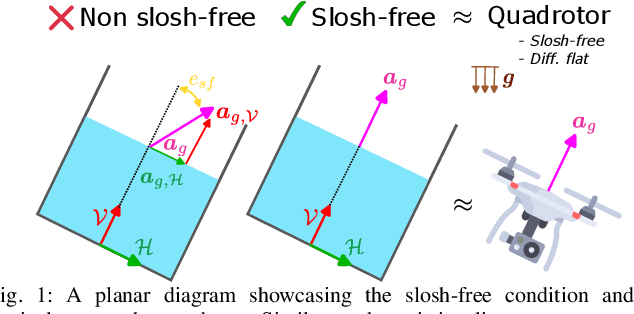
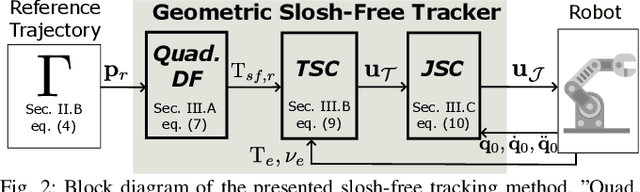
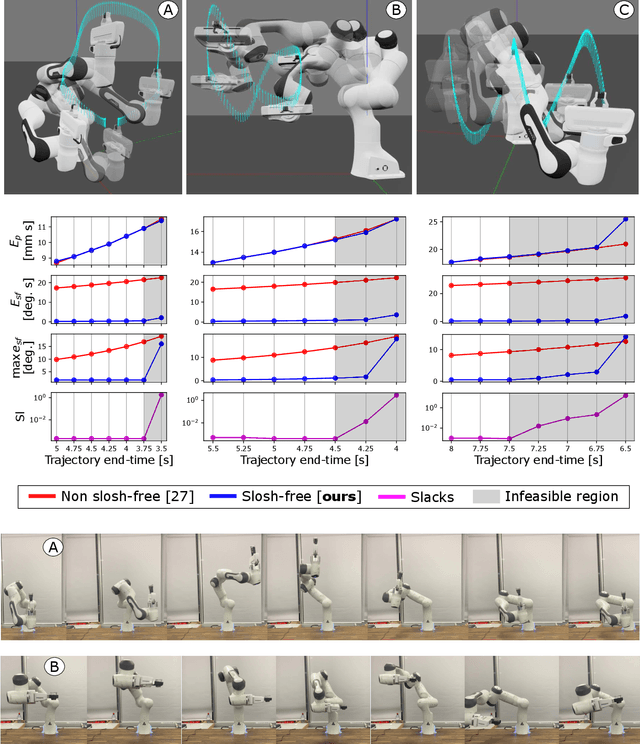
This work focuses on the agile transportation of liquids with robotic manipulators. In contrast to existing methods that are either computationally heavy, system/container specific or dependant on a singularity-prone pendulum model, we present a real-time slosh-free tracking technique. This method solely requires the reference trajectory and the robot's kinematic constraints to output kinematically feasible joint space commands. The crucial element underlying this approach consists on mimicking the end-effector's motion through a virtual quadrotor, which is inherently slosh-free and differentially flat, thereby allowing us to calculate a slosh-free reference orientation. Through the utilization of a cascaded proportional-derivative (PD) controller, this slosh-free reference is transformed into task space acceleration commands, which, following the resolution of a Quadratic Program (QP) based on Resolved Acceleration Control (RAC), are translated into a feasible joint configuration. The validity of the proposed approach is demonstrated by simulated and real-world experiments on a 7 DoF Franka Emika Panda robot. Code: https://github.com/jonarriza96/gsft Video: https://youtu.be/4kitqYVS9n8