 Add to Chrome
 Add to Firefox
 Add to Edge
HydroDiffusion: Diffusion-Based Probabilistic Streamflow Forecasting with a State Space Backbone
Dec 13, 2025
Recent advances have introduced diffusion models for probabilistic streamflow forecasting, demonstrating strong early flood-warning skill. However, current implementations rely on recurrent Long Short-Term Memory (LSTM) backbones and single-step training objectives, which limit their ability to capture long-range dependencies and produce coherent forecast trajectories across lead times. To address these limitations, we developed HydroDiffusion, a diffusion-based probabilistic forecasting framework with a decoder-only state space model backbone. The proposed framework jointly denoises full multi-day trajectories in a single pass, ensuring temporal coherence and mitigating error accumulation common in autoregressive prediction. HydroDiffusion is evaluated across 531 watersheds in the contiguous United States (CONUS) in the CAMELS dataset. We benchmark HydroDiffusion against two diffusion baselines with LSTM backbones, as well as the recently proposed Diffusion-based Runoff Model (DRUM). Results show that HydroDiffusion achieves strong nowcast accuracy when driven by observed meteorological forcings, and maintains consistent performance across the full simulation horizon. Moreover, HydroDiffusion delivers stronger deterministic and probabilistic forecast skill than DRUM in operational forecasting. These results establish HydroDiffusion as a robust generative modeling framework for medium-range streamflow forecasting, providing both a new modeling benchmark and a foundation for future research on probabilistic hydrologic prediction at continental scales.

A Deep State Space Model for Rainfall-Runoff Simulations
Jan 24, 2025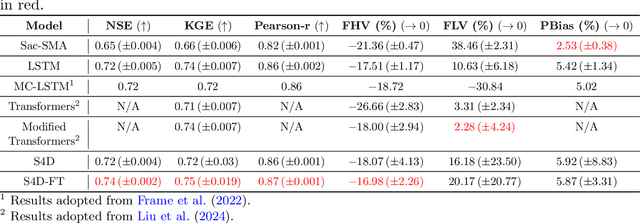
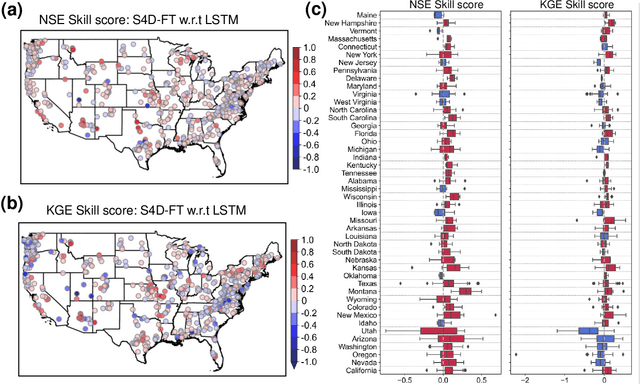
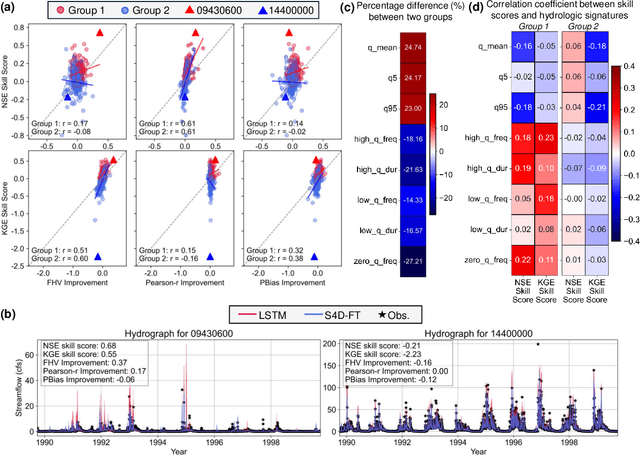
The classical way of studying the rainfall-runoff processes in the water cycle relies on conceptual or physically-based hydrologic models. Deep learning (DL) has recently emerged as an alternative and blossomed in hydrology community for rainfall-runoff simulations. However, the decades-old Long Short-Term Memory (LSTM) network remains the benchmark for this task, outperforming newer architectures like Transformers. In this work, we propose a State Space Model (SSM), specifically the Frequency Tuned Diagonal State Space Sequence (S4D-FT) model, for rainfall-runoff simulations. The proposed S4D-FT is benchmarked against the established LSTM and a physically-based Sacramento Soil Moisture Accounting model across 531 watersheds in the contiguous United States (CONUS). Results show that S4D-FT is able to outperform the LSTM model across diverse regions. Our pioneering introduction of the S4D-FT for rainfall-runoff simulations challenges the dominance of LSTM in the hydrology community and expands the arsenal of DL tools available for hydrological modeling.