 Add to Chrome
 Add to Firefox
 Add to Edge
Understanding Teacher Revisions of Large Language Model-Generated Feedback
Mar 29, 2026
Large language models (LLMs) increasingly generate formative feedback for students, yet little is known about how teachers revise this feedback before it reaches learners. Teachers' revisions shape what students receive, making revision practices central to evaluating AI classroom tools. We analyze a dataset of 1,349 instances of AI-generated feedback and corresponding teacher-edited explanations from 117 teachers. We examine (i) textual characteristics associated with teacher revisions, (ii) whether revision decisions can be predicted from the AI feedback text, and (iii) how revisions change the pedagogical type of feedback delivered. First, we find that teachers accept AI feedback without modification in about 80% of cases, while edited feedback tends to be significantly longer and subsequently shortened by teachers. Editing behavior varies substantially across teachers: about 50% never edit AI feedback, and only about 10% edit more than two-thirds of feedback instances. Second, machine learning models trained only on the AI feedback text as input features, using sentence embeddings, achieve fair performance in identifying which feedback will be revised (AUC=0.75). Third, qualitative coding shows that when revisions occur, teachers often simplify AI-generated feedback, shifting it away from high-information explanations toward more concise, corrective forms. Together, these findings characterize how teachers engage with AI-generated feedback in practice and highlight opportunities to design feedback systems that better align with teacher priorities while reducing unnecessary editing effort.

A Mixed User-Centered Approach to Enable Augmented Intelligence in Intelligent Tutoring Systems: The Case of MathAIde app
Jul 31, 2025Integrating Artificial Intelligence in Education (AIED) aims to enhance learning experiences through technologies like Intelligent Tutoring Systems (ITS), offering personalized learning, increased engagement, and improved retention rates. However, AIED faces three main challenges: the critical role of teachers in the design process, the limitations and reliability of AI tools, and the accessibility of technological resources. Augmented Intelligence (AuI) addresses these challenges by enhancing human capabilities rather than replacing them, allowing systems to suggest solutions. In contrast, humans provide final assessments, thus improving AI over time. In this sense, this study focuses on designing, developing, and evaluating MathAIde, an ITS that corrects mathematics exercises using computer vision and AI and provides feedback based on photos of student work. The methodology included brainstorming sessions with potential users, high-fidelity prototyping, A/B testing, and a case study involving real-world classroom environments for teachers and students. Our research identified several design possibilities for implementing AuI in ITSs, emphasizing a balance between user needs and technological feasibility. Prioritization and validation through prototyping and testing highlighted the importance of efficiency metrics, ultimately leading to a solution that offers pre-defined remediation alternatives for teachers. Real-world deployment demonstrated the usefulness of the proposed solution. Our research contributes to the literature by providing a usable, teacher-centered design approach that involves teachers in all design phases. As a practical implication, we highlight that the user-centered design approach increases the usefulness and adoption potential of AIED systems, especially in resource-limited environments.
Recognizing Handwritten Mathematical Expressions of Vertical Addition and Subtraction
Aug 10, 2023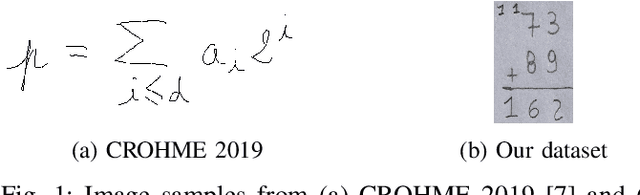

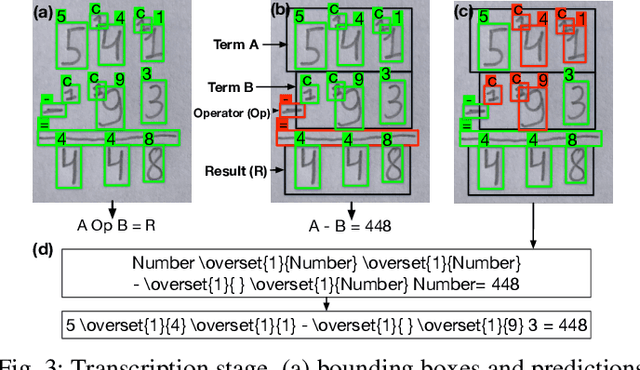
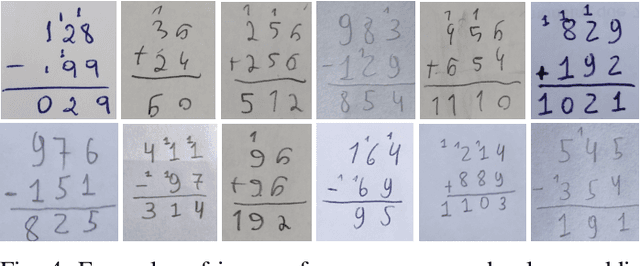
Handwritten Mathematical Expression Recognition (HMER) is a challenging task with many educational applications. Recent methods for HMER have been developed for complex mathematical expressions in standard horizontal format. However, solutions for elementary mathematical expression, such as vertical addition and subtraction, have not been explored in the literature. This work proposes a new handwritten elementary mathematical expression dataset composed of addition and subtraction expressions in a vertical format. We also extended the MNIST dataset to generate artificial images with this structure. Furthermore, we proposed a solution for offline HMER, able to recognize vertical addition and subtraction expressions. Our analysis evaluated the object detection algorithms YOLO v7, YOLO v8, YOLO-NAS, NanoDet and FCOS for identifying the mathematical symbols. We also proposed a transcription method to map the bounding boxes from the object detection stage to a mathematical expression in the LATEX markup sequence. Results show that our approach is efficient, achieving a high expression recognition rate. The code and dataset are available at https://github.com/Danielgol/HME-VAS
Automating Gamification Personalization: To the User and Beyond
Jan 14, 2021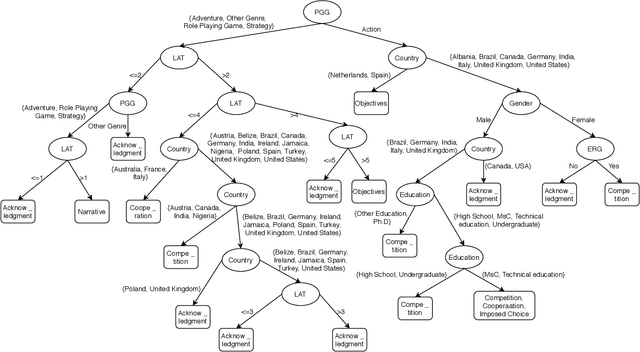
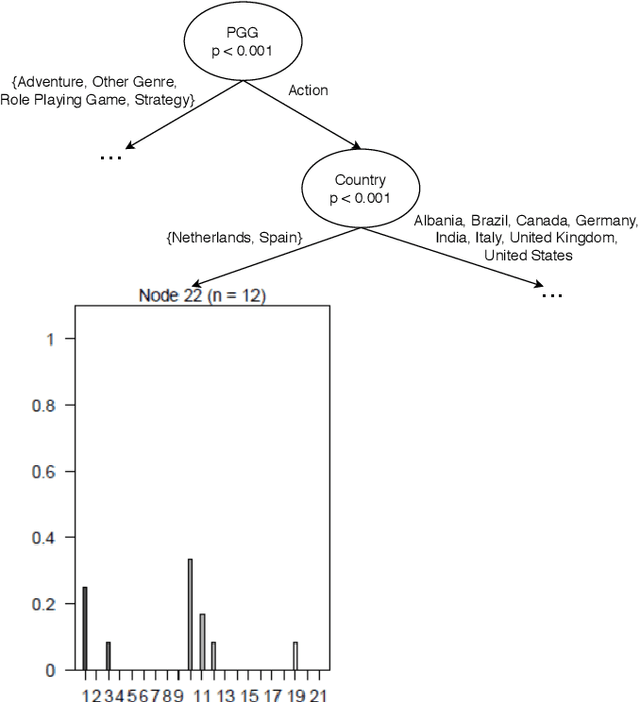
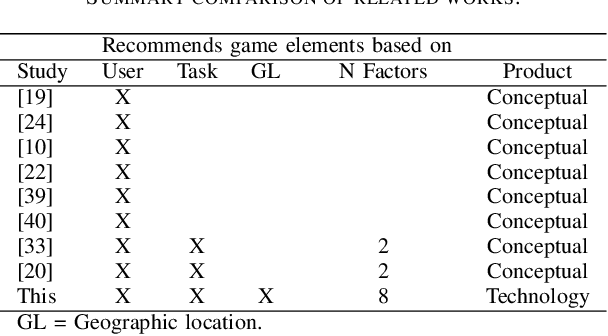
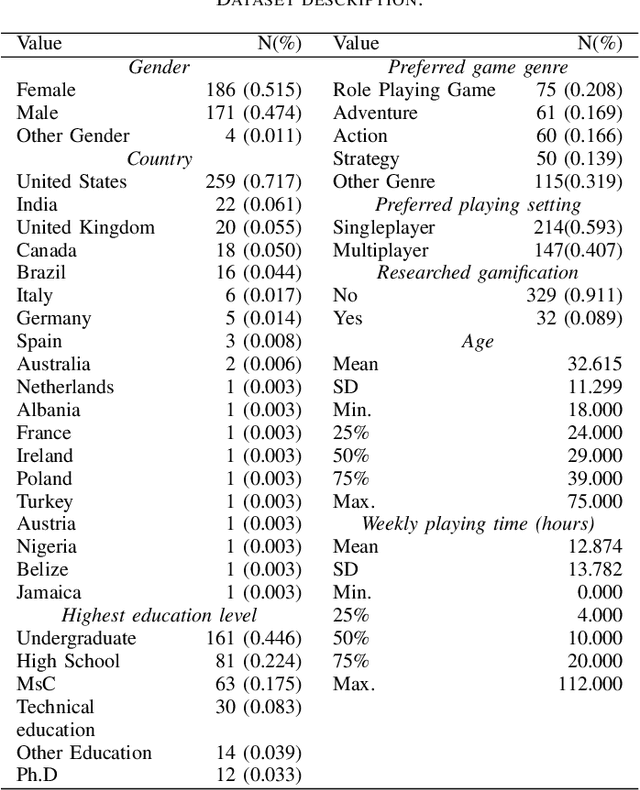
Personalized gamification explores knowledge about the users to tailor gamification designs to improve one-size-fits-all gamification. The tailoring process should simultaneously consider user and contextual characteristics (e.g., activity to be done and geographic location), which leads to several occasions to tailor. Consequently, tools for automating gamification personalization are needed. The problems that emerge are that which of those characteristics are relevant and how to do such tailoring are open questions, and that the required automating tools are lacking. We tackled these problems in two steps. First, we conducted an exploratory study, collecting participants' opinions on the game elements they consider the most useful for different learning activity types (LAT) via survey. Then, we modeled opinions through conditional decision trees to address the aforementioned tailoring process. Second, as a product from the first step, we implemented a recommender system that suggests personalized gamification designs (which game elements to use), addressing the problem of automating gamification personalization. Our findings i) present empirical evidence that LAT, geographic locations, and other user characteristics affect users' preferences, ii) enable defining gamification designs tailored to user and contextual features simultaneously, and iii) provide technological aid for those interested in designing personalized gamification. The main implications are that demographics, game-related characteristics, geographic location, and LAT to be done, as well as the interaction between different kinds of information (user and contextual characteristics), should be considered in defining gamification designs and that personalizing gamification designs can be improved with aid from our recommender system.