 Add to Chrome
 Add to Firefox
 Add to Edge
UPV_RIR_DB: A Structured Room Impulse Response Database with Hierarchical Metadata and Acoustic Indicators
Mar 26, 2026
This paper presents UPV_RIR_DB, a structured database of measured room impulse responses (RIRs) designed to provide acoustic data with explicit spatial metadata and traceable acquisition parameters. The dataset currently contains 166 multichannel RIR files measured in three rooms of the Universitat Politècnica de València (UPV). Each multichannel RIR file contains impulse responses for multiple source-receiver pairs, with each pair covering a 25 cm2 area - the typical size of a personal sound zone. Considering the number of sources and receiver channels associated with each microphone modality, the database contains a total of 18,976 single impulse responses. A hierarchical organization is adopted in which directory structure and metadata jointly describe the measurement context. Each room includes a metadata file containing acquisition parameters, hardware description, spatial coordinates of zones and microphones, and acoustic indicators such as reverberation time. A central index links each RIR file with its experimental context, ensuring traceability and enabling reproducible analysis. The resulting database provides a consistent framework for storing, inspecting, and reusing real RIR measurements while preserving compatibility with both MATLAB- and JSON-based workflows. The UPV_RIR_DB dataset is publicly available through the open repository Zenodo.

Combinations of Adaptive Filters
Dec 22, 2021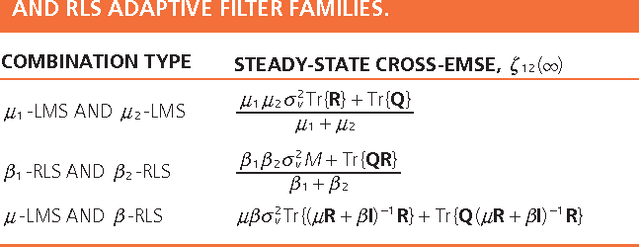
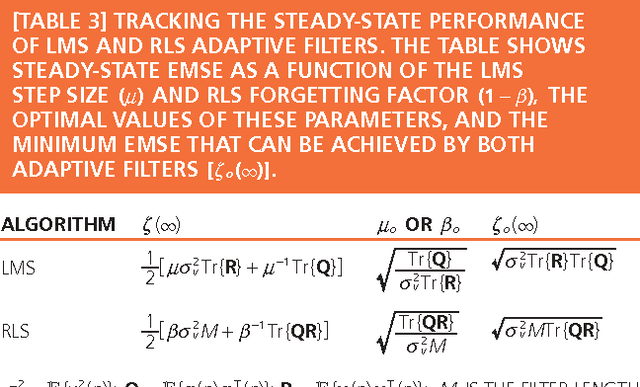
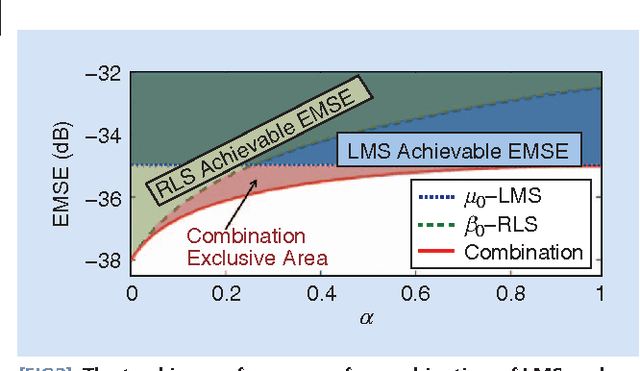
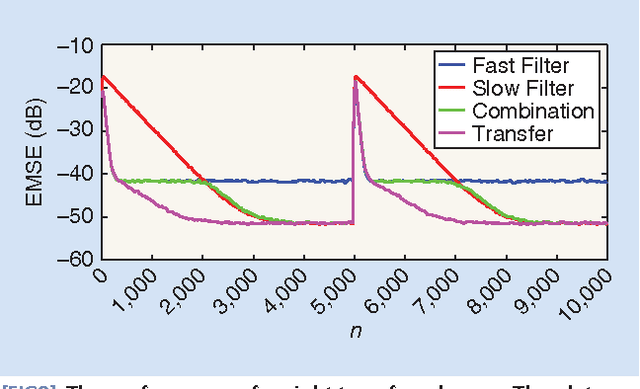
Adaptive filters are at the core of many signal processing applications, ranging from acoustic noise supression to echo cancelation, array beamforming, channel equalization, to more recent sensor network applications in surveillance, target localization, and tracking. A trending approach in this direction is to recur to in-network distributed processing in which individual nodes implement adaptation rules and diffuse their estimation to the network. When the a priori knowledge about the filtering scenario is limited or imprecise, selecting the most adequate filter structure and adjusting its parameters becomes a challenging task, and erroneous choices can lead to inadequate performance. To address this difficulty, one useful approach is to rely on combinations of adaptive structures. The combination of adaptive filters exploits to some extent the same divide and conquer principle that has also been successfully exploited by the machine-learning community (e.g., in bagging or boosting). In particular, the problem of combining the outputs of several learning algorithms (mixture of experts) has been studied in the computational learning field under a different perspective: rather than studying the expected performance of the mixture, deterministic bounds are derived that apply to individual sequences and, therefore, reflect worst-case scenarios. These bounds require assumptions different from the ones typically used in adaptive filtering, which is the emphasis of this overview article. We review the key ideas and principles behind these combination schemes, with emphasis on design rules. We also illustrate their performance with a variety of examples.
Adaptive Diffusion Schemes for Heterogeneous Networks
Aug 17, 2017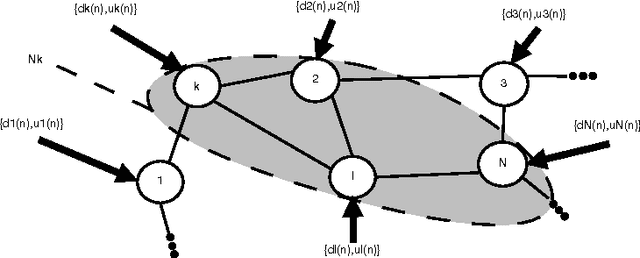
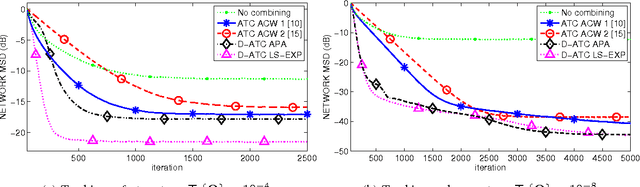
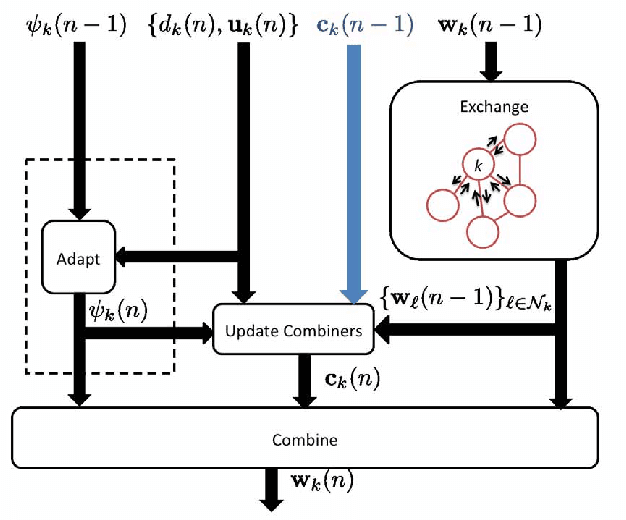
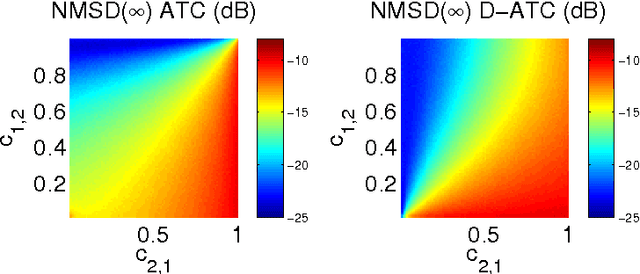
In this paper, we deal with distributed estimation problems in diffusion networks with heterogeneous nodes, i.e., nodes that either implement different adaptive rules or differ in some other aspect such as the filter structure or length, or step size. Although such heterogeneous networks have been considered from the first works on diffusion networks, obtaining practical and robust schemes to adaptively adjust the combiners in different scenarios is still an open problem. In this paper, we study a diffusion strategy specially designed and suited to heterogeneous networks. Our approach is based on two key ingredients: 1) the adaptation and combination phases are completely decoupled, so that network nodes keep purely local estimations at all times; and 2) combiners are adapted to minimize estimates of the network mean-square-error. Our scheme is compared with the standard Adapt-then-Combine scheme and theoretically analyzed using energy conservation arguments. Several experiments involving networks with heterogeneous nodes show that the proposed decoupled Adapt-then-Combine approach with adaptive combiners outperforms other state-of-the-art techniques, becoming a competitive approach in these scenarios.
* To appear in in IEEE Transactions on Signal Processing. URL: http://ieeexplore.ieee.org/document/8010454/