 Add to Chrome
 Add to Firefox
 Add to Edge
UPV_RIR_DB: A Structured Room Impulse Response Database with Hierarchical Metadata and Acoustic Indicators
Mar 26, 2026
This paper presents UPV_RIR_DB, a structured database of measured room impulse responses (RIRs) designed to provide acoustic data with explicit spatial metadata and traceable acquisition parameters. The dataset currently contains 166 multichannel RIR files measured in three rooms of the Universitat Politècnica de València (UPV). Each multichannel RIR file contains impulse responses for multiple source-receiver pairs, with each pair covering a 25 cm2 area - the typical size of a personal sound zone. Considering the number of sources and receiver channels associated with each microphone modality, the database contains a total of 18,976 single impulse responses. A hierarchical organization is adopted in which directory structure and metadata jointly describe the measurement context. Each room includes a metadata file containing acquisition parameters, hardware description, spatial coordinates of zones and microphones, and acoustic indicators such as reverberation time. A central index links each RIR file with its experimental context, ensuring traceability and enabling reproducible analysis. The resulting database provides a consistent framework for storing, inspecting, and reusing real RIR measurements while preserving compatibility with both MATLAB- and JSON-based workflows. The UPV_RIR_DB dataset is publicly available through the open repository Zenodo.

Transfer functions of FXLMS-based Multi-channel Multi-tone Active Noise Equalizers
Jul 03, 2022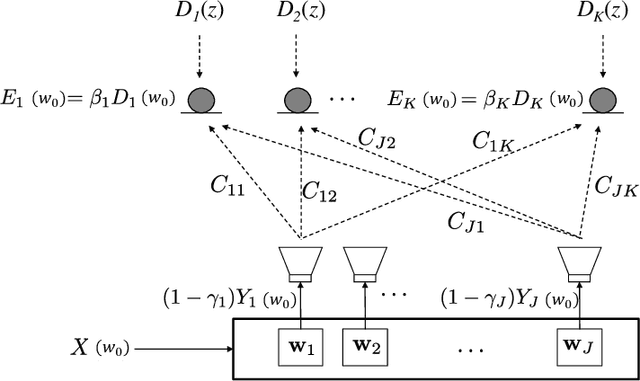
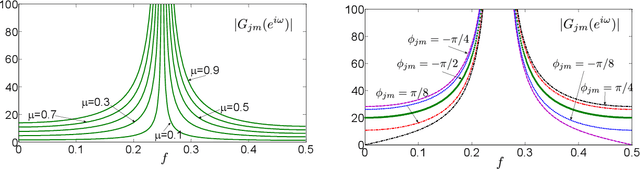
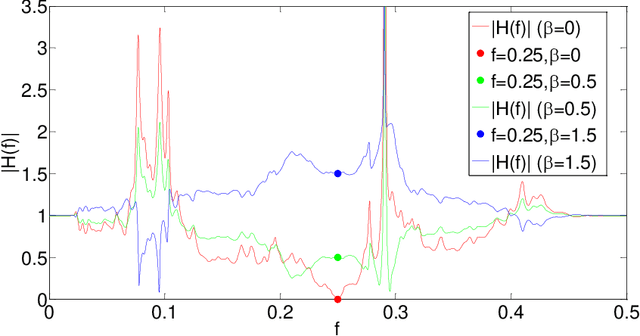
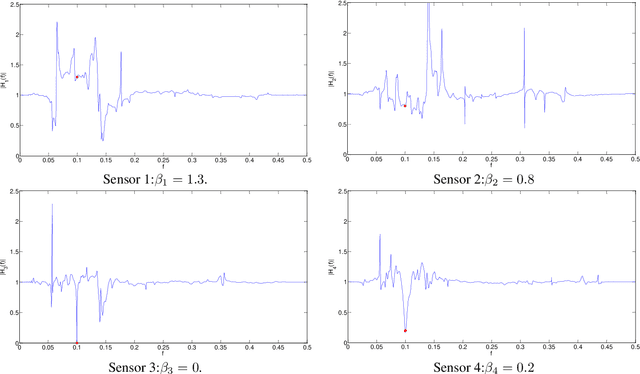
Multi-channel Multi-tone Active Noise Equalizers can achieve different user-selected noise spectrum profiles even at different space positions. They can apply a different equalization factor at each noise frequency component and each control point. Theoretically, the value of the transfer function at the frequencies where the noise signal has energy is determined by the equalizer configuration. In this work, we show how to calculate these transfer functions with a double aim: to verify that at the frequencies of interest the values imposed by the equalizer settings are obtained, and to characterize the behavior of these transfer functions in the rest of the spectrum, as well as to get clues to predict the convergence behaviour of the algorithm. The information provided thanks to these transfer functions serves as a practical alternative to the cumbersome statistical analysis of convergence, whose results are often of no practical use.