 Add to Chrome
 Add to Firefox
 Add to Edge
Towards Trust Calibration in Socially Interactive Agents: Investigating Gendered Multimodal Behaviors Generation with LLMs
May 19, 2026
As Socially Interactive Agents (SIAs) become increasingly integrated into daily life, the ability to calibrate user trust to an agent's actual capabilities would help ensure appropriate usage of these agents. In this paper, we explore the capacity of Large Language Models (LLMs) to generate multimodal behaviors (verbal, vocal, gestural, and facial expression modalities) that reflect varying levels of ability and benevolence, two key dimensions of trustworthiness. We propose a novel method for automatically generating behaviors aligned with specific levels of these traits, a first step towards enabling nuanced and trust-calibrated interactions. By analyzing a large dataset of multimodal transcripts generated by LLMs, we demonstrate that GPT-5.4 is able to produce coherent behavior across different modalities (text, intonation, facial expression, and gesture). Using Random Forest feature importance analysis, we show that the generated behaviors align with theoretical expectations for ability and benevolence. However, we also find that when gender is specified in the prompt, LLMs tend to reproduce societal gender stereotypes, associating male agents' behaviors with high ability and female agents' behaviors with high benevolence. To validate our approach, we conducted a user study on Prolific using a within-subjects design. Participants perceived different levels of ability and benevolence in the generated behaviors align with the intended instructions.

Tailored Conversations beyond LLMs: A RL-Based Dialogue Manager
Jun 24, 2025In this work, we propose a novel framework that integrates large language models (LLMs) with an RL-based dialogue manager for open-ended dialogue with a specific goal. By leveraging hierarchical reinforcement learning to model the structured phases of dialogue and employ meta-learning to enhance adaptability across diverse user profiles, our approach enhances adaptability and efficiency, enabling the system to learn from limited data, transition fluidly between dialogue phases, and personalize responses to heterogeneous patient needs. We apply our framework to Motivational Interviews, aiming to foster behavior change, and demonstrate that the proposed dialogue manager outperforms a state-of-the-art LLM baseline in terms of reward, showing a potential benefit of conditioning LLMs to create open-ended dialogue systems with specific goals.
EMMI -- Empathic Multimodal Motivational Interviews Dataset: Analyses and Annotations
Jun 24, 2024The study of multimodal interaction in therapy can yield a comprehensive understanding of therapist and patient behavior that can be used to develop a multimodal virtual agent supporting therapy. This investigation aims to uncover how therapists skillfully blend therapy's task goal (employing classical steps of Motivational Interviewing) with the social goal (building a trusting relationship and expressing empathy). Furthermore, we seek to categorize patients into various ``types'' requiring tailored therapeutic approaches. To this intent, we present multimodal annotations of a corpus consisting of simulated motivational interviewing conversations, wherein actors portray the roles of patients and therapists. We introduce EMMI, composed of two publicly available MI corpora, AnnoMI and the Motivational Interviewing Dataset, for which we add multimodal annotations. We analyze these annotations to characterize functional behavior for developing a virtual agent performing motivational interviews emphasizing social and empathic behaviors. Our analysis found three clusters of patients expressing significant differences in behavior and adaptation of the therapist's behavior to those types. This shows the importance of a therapist being able to adapt their behavior depending on the current situation within the dialog and the type of user.
Seeing and hearing what has not been said; A multimodal client behavior classifier in Motivational Interviewing with interpretable fusion
Sep 27, 2023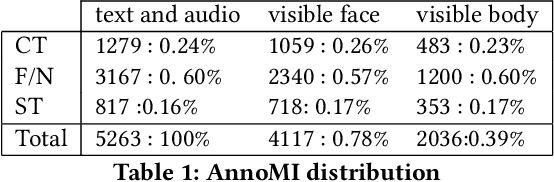
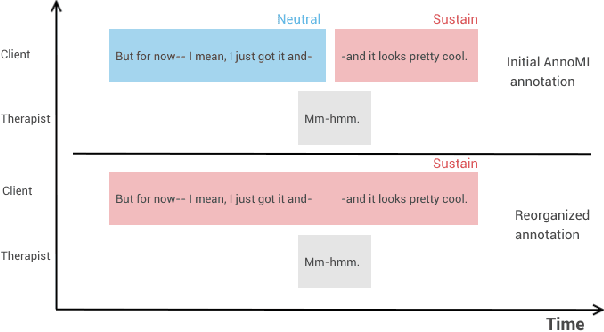

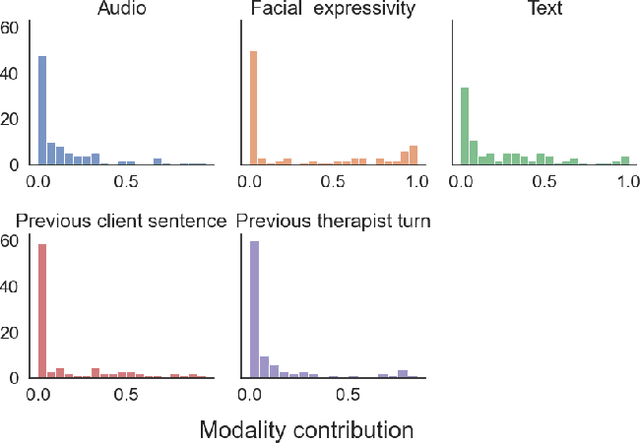
Motivational Interviewing (MI) is an approach to therapy that emphasizes collaboration and encourages behavioral change. To evaluate the quality of an MI conversation, client utterances can be classified using the MISC code as either change talk, sustain talk, or follow/neutral talk. The proportion of change talk in a MI conversation is positively correlated with therapy outcomes, making accurate classification of client utterances essential. In this paper, we present a classifier that accurately distinguishes between the three MISC classes (change talk, sustain talk, and follow/neutral talk) leveraging multimodal features such as text, prosody, facial expressivity, and body expressivity. To train our model, we perform annotations on the publicly available AnnoMI dataset to collect multimodal information, including text, audio, facial expressivity, and body expressivity. Furthermore, we identify the most important modalities in the decision-making process, providing valuable insights into the interplay of different modalities during a MI conversation.