 Add to Chrome
 Add to Firefox
 Add to Edge
Global Difference Constraint Propagation for Constraint Programming
Jul 22, 2026
Difference constraints of the form $x - y \leq d$ are well studied, with efficient algorithms for satisfaction and implication, because of their connection to shortest paths. Finite domain propagation algorithms, however, typically do not make use of these algorithms, and treat each difference constraint as a separate propagator. Propagation does guarantee completeness of solving, but can be needlessly slow. In this paper we describe how to build a (bounds consistent) global propagator for difference constraints that treats them all simultaneously. SAT modulo theory solvers have included theory solvers for difference constraints for some time. While a theory solver for difference constraints gives the basis of a global difference constraint propagator, we show how the requirements on the propagator are quite different. Crucially, we show how to explain propagations by a global difference constraint propagator, in order to use it within a lazy clause generation solver. We give experiments showing that treating difference constraints globally can substantially improve on the standard propagation approach.

An Enhanced Large Neighborhood Search Approach for the Capacitated Facility Location Problem with Incompatible Customers
May 27, 2026A new variant of the classic capacitated facility location problem, which considers incompatibilities between customers, has recently been introduced in the literature. This problem captures the situation where given pairs of customers cannot be served by the same facility. Such a feature is crucial for many practical cases of location problems, such as the presence of hazardous or polluting materials and contention between competing costumers. In this paper, we propose a Large Neighborhood Search (LNS) method to solve this problem. Within the framework of LNS, we introduce three different destroy operators, which are combined in a hybrid manner, and we use an exact solver in the repair phase. Different algorithmic components are investigated for the design of LNS. The experimental analysis shows that our new method outperforms existing state-of-the-art metaheuristics, providing new best solutions for all available benchmark instances.
Integrating Column Generation and Large Neighborhood Search for Bus Driver Scheduling with Complex Break Constraints
May 05, 2025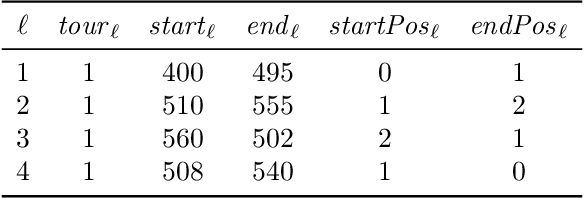
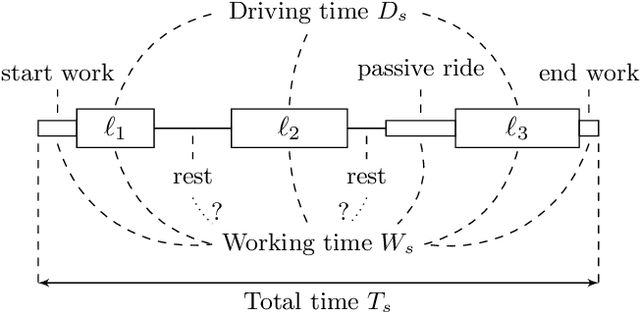
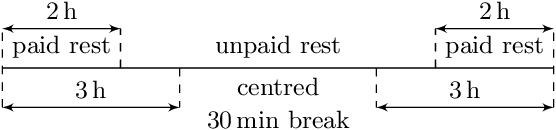
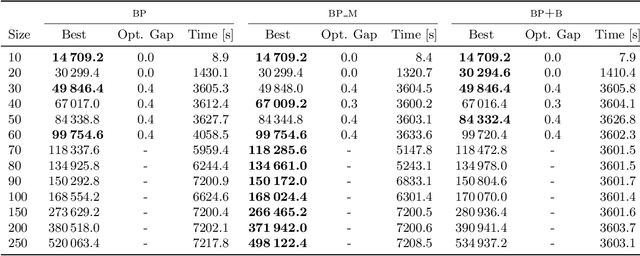
The Bus Driver Scheduling Problem (BDSP) is a combinatorial optimization problem with the goal to design shifts to cover prearranged bus tours. The objective takes into account the operational cost as well as the satisfaction of drivers. This problem is heavily constrained due to strict legal rules and collective agreements. The objective of this article is to provide state-of-the-art exact and hybrid solution methods that can provide high-quality solutions for instances of different sizes. This work presents a comprehensive study of both an exact method, Branch and Price (B&P), as well as a Large Neighborhood Search (LNS) framework which uses B&P or Column Generation (CG) for the repair phase to solve the BDSP. It further proposes and evaluates a novel deeper integration of B&P and LNS, storing the generated columns from the LNS subproblems and reusing them for other subproblems, or to find better global solutions. The article presents a detailed analysis of several components of the solution methods and their impact, including general improvements for the B&P subproblem, which is a high-dimensional Resource Constrained Shortest Path Problem (RCSPP), and the components of the LNS. The evaluation shows that our approach provides new state-of-the-art results for instances of all sizes, including exact solutions for small instances, and low gaps to a known lower bound for mid-sized instances. Conclusions: We observe that B&P provides the best results for small instances, while the tight integration of LNS and CG can provide high-quality solutions for larger instances, further improving over LNS which just uses CG as a black box. The proposed methods are general and can also be applied to other rule sets and related optimization problems