 Add to Chrome
 Add to Firefox
 Add to Edge
LP-GEMM: Integrating Layout Propagation into GEMM Operations
Apr 06, 2026
In Scientific Computing and modern Machine Learning (ML) workloads, sequences of dependent General Matrix Multiplications (GEMMs) often dominate execution time. While state-of-the-art BLAS libraries aggressively optimize individual GEMM calls, they remain constrained by the BLAS API, which requires each call to independently pack input matrices and restore outputs to a canonical memory layout. In sequential GEMMs, these constraints cause redundant packing and unpacking, wasting valuable computational resources. This paper introduces LP-GEMM, a decomposition of the GEMM kernel that enables packing-layout propagation across sequential GEMM operations. This approach eliminates unnecessary data repacking while preserving full BLAS semantic correctness at the boundaries. We evaluate LP-GEMM on x86 (AVX-512) and RISC-V (RVV 1.0) architectures across MLP-like and Attention-like workloads. Our results show average speedups of 2.25x over OpenBLAS on Intel x86 for sequential GEMMs and competitive gains relative to vendor-optimized libraries such as Intel MKL. We demonstrate the practicality of the approach beyond microbenchmarks by implementing a standalone C++ version of the Llama-3.2 inference path using exclusively BLAS-level GEMM calls. These results confirm that leveraging data layout propagation between operations can significantly boost performance.

ConvBench: A Comprehensive Benchmark for 2D Convolution Primitive Evaluation
Jul 15, 2024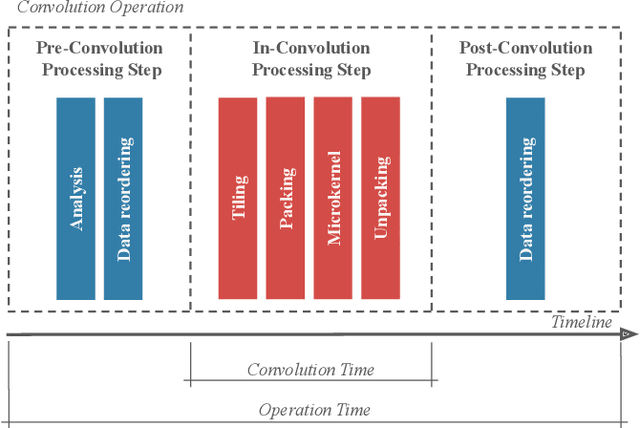
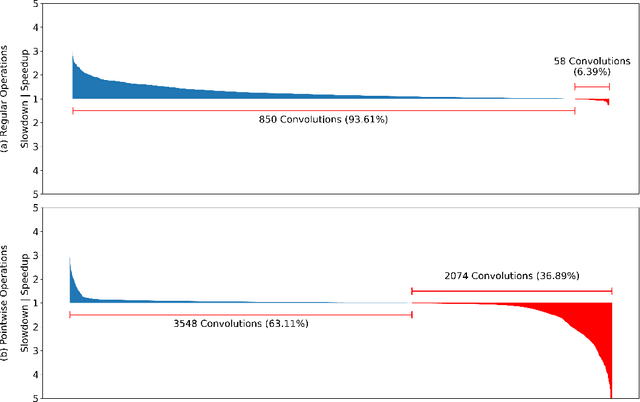
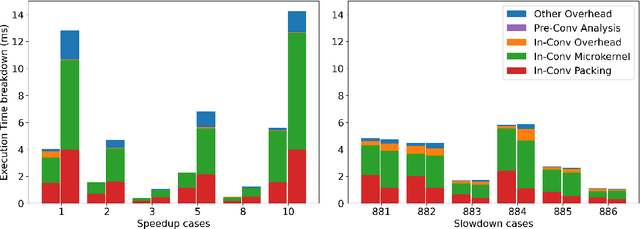
Convolution is a compute-intensive operation placed at the heart of Convolution Neural Networks (CNNs). It has led to the development of many high-performance algorithms, such as Im2col-GEMM, Winograd, and Direct-Convolution. However, the comparison of different convolution algorithms is an error-prone task as it requires specific data layouts and system resources. Failure to address these requirements might lead to unwanted time penalties. Thus, considering all processing steps within convolution algorithms is essential to comprehensively evaluate and fairly compare their performance. Furthermore, most known convolution benchmarking adopts ad-hoc testing suites with limited coverage and handmade operations. This paper proposes ConvBench, a primitive-level benchmark for the evaluation and comparison of convolution algorithms. It assesses 9243 convolution operations derived from 1097 real-world deep learning models, resulting in performance and execution breakdown graphs for a detailed evaluation. ConvBench capability is evaluated across the Sliced Convolution (SConv) algorithm. The experiments showed results faster than Im2col-GEMM in 93.6% of the convolutions. However, the use of ConvBench allowed the delving into the remaining 6.4% underperforming convolutions, uncovering a critical slowdown of 79.5% on average of SConv's packing step. This analysis underscores a potential source of optimization for SConv, opening up new paths for convolution designers to improve their algorithms.