 Add to Chrome
 Add to Firefox
 Add to Edge
Equivalence Testing Under Privacy Constraints
Apr 07, 2026
Protecting individual privacy is essential across research domains, from socio-economic surveys to big-tech user data. This need is particularly acute in healthcare, where analyses often involve sensitive patient information. A typical example is comparing treatment efficacy across hospitals or ensuring consistency in diagnostic laboratory calibrations, both requiring privacy-preserving statistical procedures. However, standard equivalence testing procedures for differences in proportions or means, commonly used to assess average equivalence, can inadvertently disclose sensitive information. To address this problem, we develop differentially private equivalence testing procedures that rely on simulation-based calibration, as the finite-sample distribution is analytically intractable. Our approach introduces a unified framework, termed DP-TOST, for conducting differentially private equivalence testing of both means and proportions. Through numerical simulations and real-world applications, we demonstrate that the proposed method maintains type-I error control at the nominal level and achieves power comparable to its non-private counterpart as the privacy budget and/or sample size increases, while ensuring strong privacy guarantees. These findings establish a reliable and practical framework for privacy-preserving equivalence testing in high-stakes fields such as healthcare, among others.

Inference for Large Scale Regression Models with Dependent Errors
Sep 08, 2024


The exponential growth in data sizes and storage costs has brought considerable challenges to the data science community, requiring solutions to run learning methods on such data. While machine learning has scaled to achieve predictive accuracy in big data settings, statistical inference and uncertainty quantification tools are still lagging. Priority scientific fields collect vast data to understand phenomena typically studied with statistical methods like regression. In this setting, regression parameter estimation can benefit from efficient computational procedures, but the main challenge lies in computing error process parameters with complex covariance structures. Identifying and estimating these structures is essential for inference and often used for uncertainty quantification in machine learning with Gaussian Processes. However, estimating these structures becomes burdensome as data scales, requiring approximations that compromise the reliability of outputs. These approximations are even more unreliable when complexities like long-range dependencies or missing data are present. This work defines and proves the statistical properties of the Generalized Method of Wavelet Moments with Exogenous variables (GMWMX), a highly scalable, stable, and statistically valid method for estimating and delivering inference for linear models using stochastic processes in the presence of data complexities like latent dependence structures and missing data. Applied examples from Earth Sciences and extensive simulations highlight the advantages of the GMWMX.
Tk-merge: Computationally Efficient Robust Clustering Under General Assumptions
Jan 17, 2022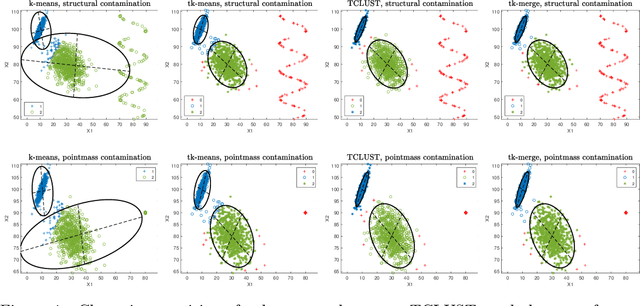
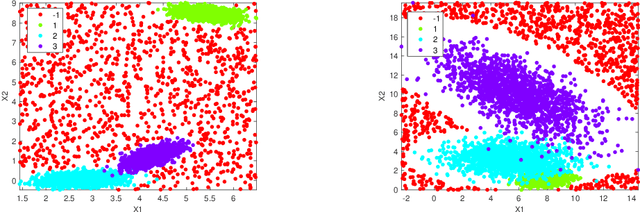
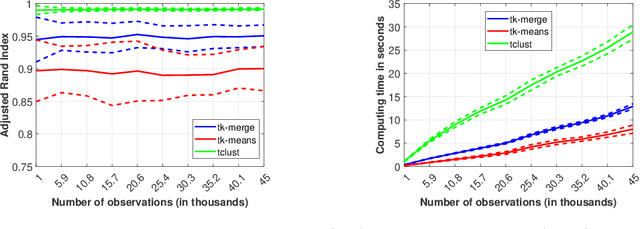
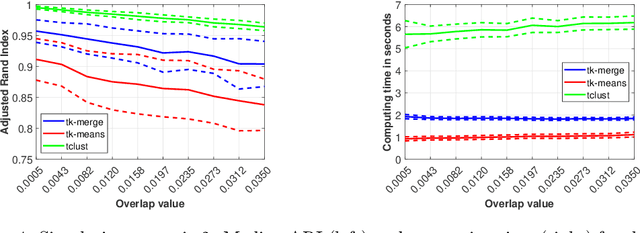
We address general-shaped clustering problems under very weak parametric assumptions with a two-step hybrid robust clustering algorithm based on trimmed k-means and hierarchical agglomeration. The algorithm has low computational complexity and effectively identifies the clusters also in presence of data contamination. We also present natural generalizations of the approach as well as an adaptive procedure to estimate the amount of contamination in a data-driven fashion. Our proposal outperforms state-of-the-art robust, model-based methods in our numerical simulations and real-world applications related to color quantization for image analysis, human mobility patterns based on GPS data, biomedical images of diabetic retinopathy, and functional data across weather stations.