 Add to Chrome
 Add to Firefox
 Add to Edge
Perspective: Towards sustainable exploration of chemical spaces with machine learning
Mar 31, 2026
Artificial intelligence is transforming molecular and materials science, but its growing computational and data demands raise critical sustainability challenges. In this Perspective, we examine resource considerations across the AI-driven discovery pipeline--from quantum-mechanical (QM) data generation and model training to automated, self-driving research workflows--building on discussions from the ``SusML workshop: Towards sustainable exploration of chemical spaces with machine learning'' held in Dresden, Germany. In this context, the availability of large quantum datasets has enabled rigorous benchmarking and rapid methodological progress, while also incurring substantial energy and infrastructure costs. We highlight emerging strategies to enhance efficiency, including general-purpose machine learning (ML) models, multi-fidelity approaches, model distillation, and active learning. Moreover, incorporating physics-based constraints within hierarchical workflows, where fast ML surrogates are applied broadly and high-accuracy QM methods are used selectively, can further optimize resource use without compromising reliability. Equally important is bridging the gap between idealized computational predictions and real-world conditions by accounting for synthesizability and multi-objective design criteria, which is essential for practical impact. Finally, we argue that sustainable progress will rely on open data and models, reusable workflows, and domain-specific AI systems that maximize scientific value per unit of computation, enabling efficient and responsible discovery of technological materials and therapeutics.

Emergence of Latent Binary Encoding in Deep Neural Network Classifiers
Oct 12, 2023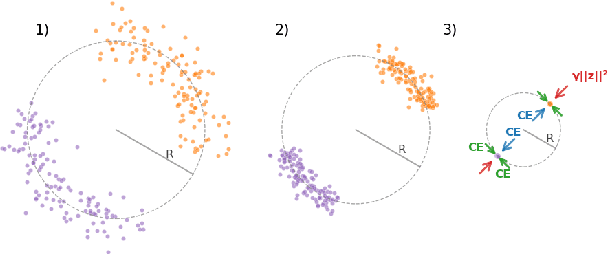
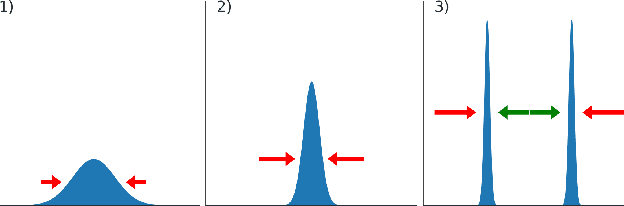
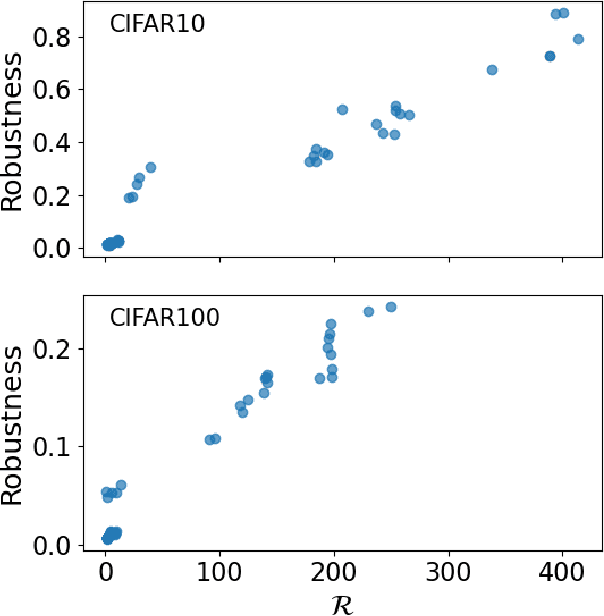
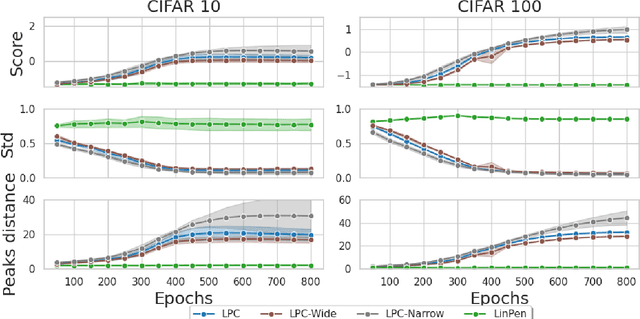
We observe the emergence of binary encoding within the latent space of deep-neural-network classifiers. Such binary encoding is induced by introducing a linear penultimate layer, which is equipped during training with a loss function that grows as $\exp(\vec{x}^2)$, where $\vec{x}$ are the coordinates in the latent space. The phenomenon we describe represents a specific instance of a well-documented occurrence known as \textit{neural collapse}, which arises in the terminal phase of training and entails the collapse of latent class means to the vertices of a simplex equiangular tight frame (ETF). We show that binary encoding accelerates convergence toward the simplex ETF and enhances classification accuracy.
Extrapolation to complete basis-set limit in density-functional theory by quantile random-forest models
Mar 31, 2023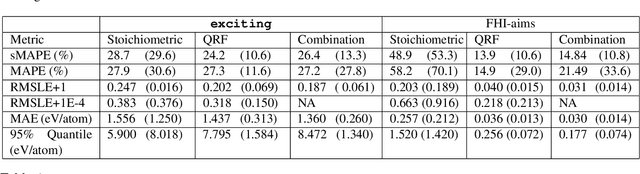
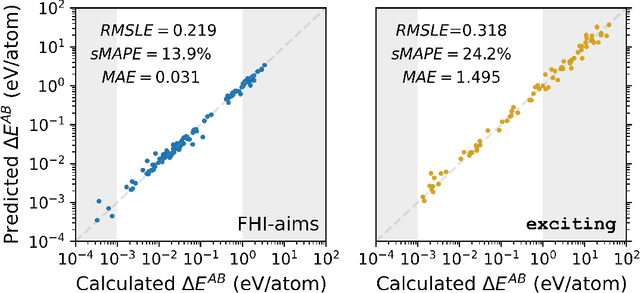
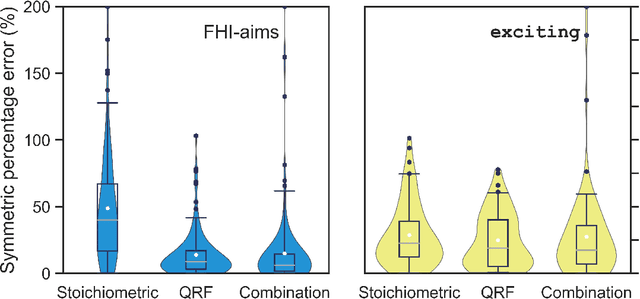
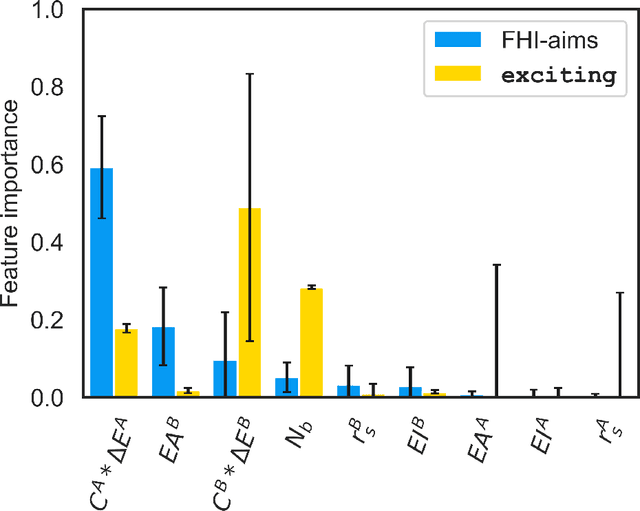
The numerical precision of density-functional-theory (DFT) calculations depends on a variety of computational parameters, one of the most critical being the basis-set size. The ultimate precision is reached with an infinitely large basis set, i.e., in the limit of a complete basis set (CBS). Our aim in this work is to find a machine-learning model that extrapolates finite basis-size calculations to the CBS limit. We start with a data set of 63 binary solids investigated with two all-electron DFT codes, exciting and FHI-aims, which employ very different types of basis sets. A quantile-random-forest model is used to estimate the total-energy correction with respect to a fully converged calculation as a function of the basis-set size. The random-forest model achieves a symmetric mean absolute percentage error of lower than 25% for both codes and outperforms previous approaches in the literature. Our approach also provides prediction intervals, which quantify the uncertainty of the models' predictions.